
How to Set SEO Lead Targets When Your Annual Plan Is Already Approved


Contents+
- 01Why the approved plan sets the minimum for your SEO target
- 02Step 1. Turn the annual plan into a monthly SEO lead line
- 03Step 2. Measure what organic search delivers today
- 04Step 3. Work backwards from revenue with funnel ratios
- 05Step 4. Keep the target on the plan line until month four
- 06Step 5. Adjust the monthly line for Indonesian seasonality
- 07Step 6. Write the justification procurement will ask for
- 08How to report progress against both lines
An SEO lead target set against an approved annual plan should follow that plan for the first three to four months, then rise above it once the content and technical work starts to compound. The number should be justified with the funnel maths management already trusts, running from leads to prospects, sales and revenue.
Most agencies get this wrong in one of two ways. Some copy the client's approved number into the proposal, which gives management no reason to hire anyone. Others promise a big jump from the first month, which no procurement team can defend and no SEO programme can deliver on schedule. A question we hear from enterprise marketing teams once a proposal lands is why our lead target differs from the plan they already signed off, and what the difference rests on.
The method below is the one Search Agency uses when an enterprise client already has an approved number. It works whether you are the marketing manager building the target yourself or the person reviewing an agency's proposal before it goes to procurement.
Why the approved plan sets the minimum for your SEO target
An annual plan that has been approved is a commitment management has already made to the board, to sales and to finance. Any SEO target you propose sits next to that commitment and will be read against it line by line. A target below the plan looks like an excuse in advance. A target identical to the plan raises an obvious question, which is why the company needs an outside partner to deliver a number it already expects to hit.
Treat the approved plan as the floor. Your SEO target should never fall below it in any month and should end the year clearly above it. The gap between the two lines is the value you are asking management to pay for. It needs to be large enough to matter and small enough to be believed.
How large the gap should be depends on how much untapped demand the site has. A site with thin content and technical debt has more room to grow than a mature site that already ranks for its main products. The size of the gap is a judgement call. The rest of the method exists to make that judgement defensible.
Step 1. Turn the annual plan into a monthly SEO lead line
Annual plans are usually set at business level. The first job is to pull out the part that belongs to organic search. Ask the planning or performance team for three things, namely the total lead target per month, the share expected from organic search, and the definition of a lead that the plan uses. If the plan only gives a yearly total, spread it by month using last year's monthly pattern so seasonality is already built in.
The definition matters more than most teams expect. A lead might be a submitted form, a WhatsApp click, a phone call or a registered account. Each one converts to revenue at a different rate. In Google Analytics 4 these actions are tracked as key events. The SEO target should count the same key events the business plan counts. If the plan counts qualified leads after a sales call while your report counts form submissions, the two lines will never be comparable.
Attribution is the second trap, because GA4 offers data-driven and last click attribution models. In both of them, direct visits get no credit unless the whole path was direct. Organic search can win or lose hundreds of leads depending on which model the plan used. Our GA4 measurement framework shows how to set the key events up so every channel is counted the same way. Agree on the attribution model before anyone writes a number down and record it in a measurement agreement signed before work starts. Changing the model halfway through the year will move the SEO line on its own, with no change in real performance.
- Monthly lead target from the approved plan, split by product line if the plan does so.
- Share of leads assigned to organic search in each month.
- Written definition of a lead, matched to a named GA4 key event.
- Attribution model used for the plan, and the one used for SEO reporting.
- Sales funnel ratios for at least the last 12 months.
Step 2. Measure what organic search delivers today
Your baseline is the number of organic leads the site produces now, and the trend behind it. Pull at least 12 months of organic leads from GA4 and the matching clicks and impressions from the Search Console Performance report. Split branded searches from non-branded searches, because branded demand mostly reflects advertising and reputation, while non-branded demand is where SEO work creates new leads.
Then calculate the lead rate, which is organic leads divided by organic sessions, for each main section of the site. A product page that converts 4% of its visitors and a blog article that converts 0.2% need different plans. Lumping them together hides where the next leads will come from. If the lead rate on key pages is low, part of the target will come from conversion work on pages that already get traffic, which is often faster than earning new rankings.
Avoid forecasting leads from traffic trends alone. Click-through rates on Google have moved sharply as AI Overviews spread. Seer Interactive's 2026 CTR study found organic CTR on searches with an AI Overview at 1.31% in December 2025 and 2.36% in February 2026, a swing large enough that the authors warned against forecasting from it. Searches that end without any click are rising too, as covered in our look at zero-click search in 2026. A target built on leads and lead rates survives those swings better than one built on sessions, which is the same reason we argue rankings belong in the metrics column.
Step 3. Work backwards from revenue with funnel ratios
Leads only matter to management because of what they turn into. Translate every target into revenue before you present it. Most sales teams already track three ratios, which are the share of leads that become real prospects, the share of prospects that close, and the average value of a closed deal. These three numbers turn a lead target into a revenue figure that finance can check against its own model.
Take an illustrative business whose approved plan expects 4,000 organic leads in December. If 30% of leads become prospects, 15% of prospects close and the average deal is worth Rp 25 million, then 4,000 leads produce 1,200 prospects, 180 sales and Rp 4,500 million in revenue. An SEO target of 4,800 leads for the same month adds 800 leads, which at the same ratios means 36 more sales and about Rp 900 million in extra revenue.
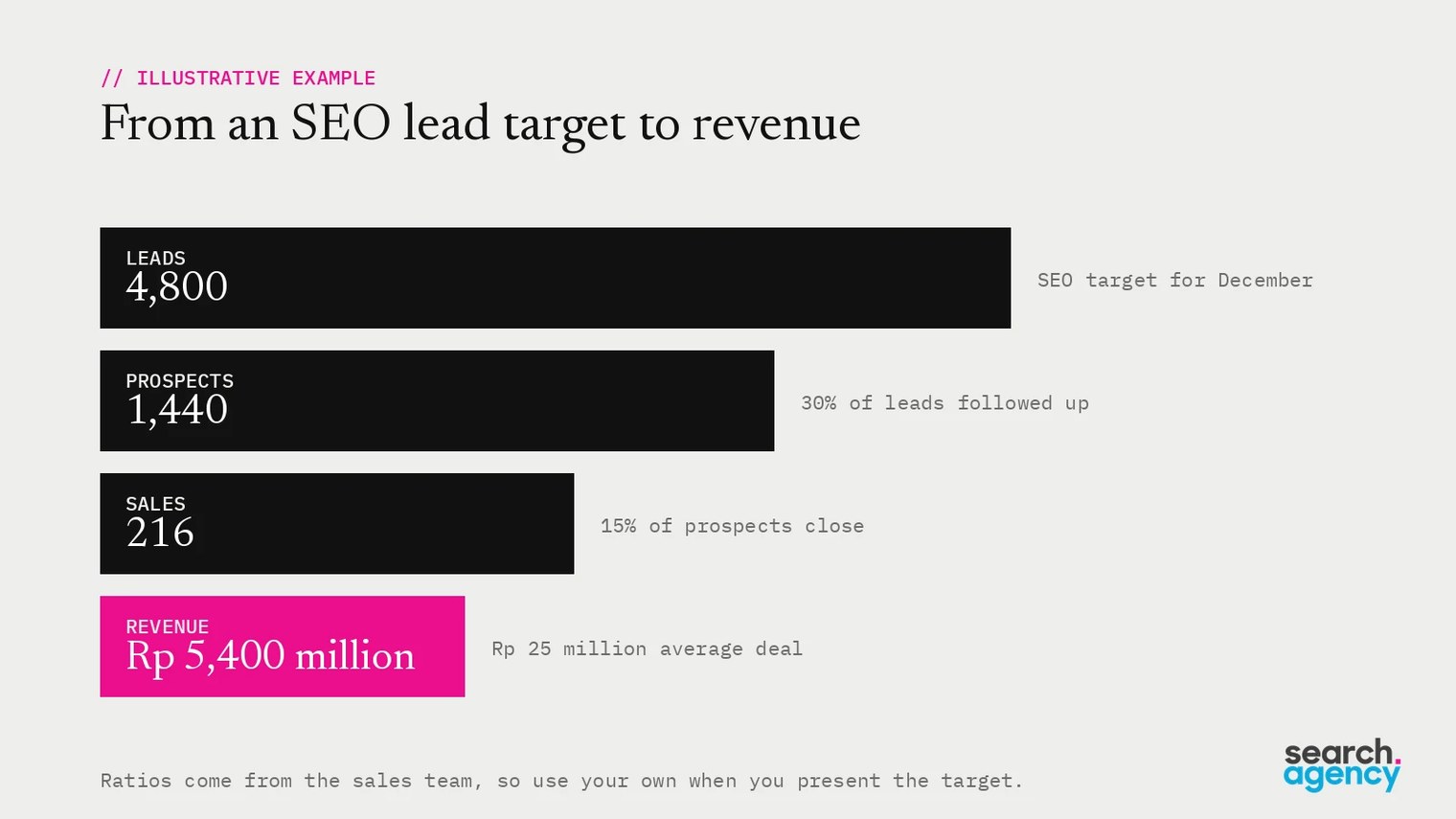
This calculation also protects the sales team. If the target adds more leads than the sales team can follow up, the prospect rate will fall and the revenue will not arrive. Ask the sales manager how many extra leads per month the team can handle before you lock the number. Use the ratios for each product line if they differ by much. Our guide to what a good ROI for SEO looks like shows how to put the same revenue figure against the cost of the programme.
Step 4. Keep the target on the plan line until month four
SEO builds slowly before it compounds. The target line should hug the approved plan for the first three to four months. During that period the work is mostly fixing technical issues, publishing and improving pages, and waiting for search engines to recrawl and rerank them. Ahrefs found that only 1.74% of newly published pages reached Google's top 10 within a year. In the same study, 72.9% of pages in the top 10 were more than three years old. A jump in month one is an empty promise.
From month five onwards the line can climb faster than the plan, because improved pages start ranking and new pages begin to collect traffic. In the illustrative example, the SEO target equals the plan from January to April, rises to 3,430 leads in May against a plan of 3,360, and reaches 4,800 in December against a plan of 4,000. Over the full year that is 45,210 leads against a plan of 42,000, or about 7.6% more, while the December run rate is 20% above the plan.

The December run rate is the number to highlight in the proposal, because it sets the starting point for next year's plan. A business that exits the year at 4,800 leads a month starts the following year about 9,600 leads ahead on an annualised basis compared with exiting at 4,000. That carry-over is often a stronger argument to management than the full-year total and rewards the slow early months that the stages of an SEO campaign require.
Step 5. Adjust the monthly line for Indonesian seasonality
A straight ramp ignores the calendar. In Indonesia the calendar moves lead volume a lot. Google's own Ramadan 2026 guide for Indonesia reports more Google searches during Ramadan than in the rest of the year. Think with Google notes that Ramadan's effects start weeks before the month begins and last for weeks after it. Depending on the category, demand can rise sharply before Lebaran and drop during the holiday itself, when sales teams are also on leave.
Apply last year's monthly pattern from GA4 to the ramp. Each month's target then reflects both the growth curve and the season. Ramadan moves about 11 days earlier every year. The high and low months shift with it. A copy of last year's calendar will be out by a couple of weeks. Year-end holidays, school enrolment periods and payday cycles can matter as much in some categories. The sales team usually knows which ones affect their numbers.
Seasonality also changes when SEO work should be done. Pages that target Ramadan or year-end demand need to be published or updated two to three months earlier. The target line should credit them with leads only after they have had time to rank. Writing that timing into the plan prevents an awkward conversation when a seasonal peak arrives and the new pages are still too young to capture it.
Step 6. Write the justification procurement will ask for
Procurement and finance teams will not approve a target because it sounds ambitious. They approve it when the reasoning is written down, the inputs are named and the conditions are clear. A one-page justification attached to the proposal does this and saves several rounds of email once the proposal reaches the approval chain.
- The approved plan line and the proposed SEO line, shown month by month.
- The baseline, with the date range and data source for each number.
- The funnel ratios used to convert leads into revenue, and who supplied them.
- The assumptions, such as the number of pages improved and published each month.
- The dependencies on the client side, such as developer time and content approval speed.
- The risks, such as algorithm updates, AI Overviews expanding to new query types or a site migration.
- The checkpoint dates when the target will be reviewed and, if needed, reset.
Dependencies deserve the most care, because an SEO target assumes the client's developers will ship technical fixes and that content will be approved within an agreed number of days. If approvals take three weeks instead of three days, the ramp will slip. The justification should say so plainly in advance. Our breakdown of what a search retainer funds lists the client dependencies we write into every engagement.
Be honest about what cannot be promised. Google's own advice on hiring an SEO warns that nobody can guarantee a number one ranking. The same applies to an exact lead count. A target is a commitment to a plan of work and a forecast of its result. The justification should present it that way.
How to report progress against both lines
Once the campaign starts, every monthly report should show three lines on one chart, namely the approved plan, the agreed SEO target and actual organic leads. Showing all three keeps the conversation anchored to the commitment management made and shows early whether the gap is opening as forecast. A report that only shows SEO's own target makes it too easy to forget the plan the business is measured against.
In the first three months, leads will track close to the plan by design. The report should also show leading indicators that predict the later climb. These include pages fixed and published against the schedule, pages indexed, non-branded impressions in Search Console and the lead rate on key pages. If those indicators are on track in month three, the acceleration from month five is likely to follow. If they are behind, the team still has time to adjust before the gap is due to appear.
Set a formal review at the end of month four, when the line is supposed to pull ahead of the plan. At that review, compare actual leads with the target, check whether the funnel ratios have held, and decide together whether to keep, raise or lower the target for the rest of the year. Writing the review into the plan from the start makes a change of target read as good governance. Our notes on building an SEO dashboard people open every month cover how to lay this out so management reads it.
AI search adds one more line worth watching. Buyers increasingly meet a brand in ChatGPT, Gemini or Google's AI Mode before they search for it by name. Those visits often arrive as branded or direct traffic that the SEO line does not capture. Our own test of AI citations and qualified demand shows how hard this is to attribute today. Track AI visibility separately and keep it out of the lead target until the measurement is reliable. Search Agency builds this target model into every proposal we send to an enterprise client. Our DOKU case study shows what the work behind the line looks like in practice. If you already have an approved plan for next year, send us your current numbers and we will map the SEO target against it.
See where your brand stands in AI answers today, benchmarked against your competitors, no pitch required.
Related reading
All posts →
What Google AI Mode Cites When Indonesians Plan a Trip
We wanted to see exactly which sites those are. So we built a structured set of Bahasa Indonesia travel prompts, ran each through Google AI Mode, and parsed every domain it cited. What came back was a clear picture of who Google has decided is authoritative on Indonesian travel, and an equally clear picture of who is being read around.
Read post →
How Startups Get Measurable SEO ROI in 3 to 6 Months on a Small Budget
Most startups quit SEO by month six because they aimed at keywords they could never win. Here is the budget plan that shows a real return while it is still small.
Read post →
What Really Sets the Cost of SEO
Ask three agencies to price SEO for the same website and the quotes can land five times apart. Here are the five things that actually set your SEO price, and how to read a quote instead of guessing at it.
Read post →