Do AI Citations Produce Qualified Demand? A Test on Our Own Site


Contents+
- 01Why more citations alone cannot justify a budget
- 02What changed on search.agency during the study period
- 03How we defined demand for this study
- 04What AI Mode visibility looked like on 3 November 2026
- 05What AI referrals and enquiry events did
- 06Which AI-referred visits we could trace
- 07Other explanations for the same numbers
- 08What the evidence supports
- 09What we would fund next
On the evidence we have, we cannot tell. Visits from AI assistants to search.agency rose from almost none to about 28 a week during 2026. Google AI Mode cited our site in 1 of 11 answers we collected on 3 November 2026. Over the whole history of our analytics, only 10 sessions that arrived from an AI assistant went on to fire an enquiry event. We have no sales records in this study, so we cannot say whether any of those 10 became a real opportunity.
This article reports that result plainly. It is a study of Search Agency's own website, written by Search Agency, a company that sells AI-search services and has an obvious interest in AI visibility looking valuable. We used only our own Google Analytics 4 (GA4) and Search Console data and a small set of Google AI Mode answers. No client data appears here.
If you are a CMO or a finance partner deciding whether AI visibility deserves more budget, the method matters more than our numbers. The same four questions apply to your site, and most companies will hit the same gaps we did.
Why more citations alone cannot justify a budget
A citation is a link to your page inside an AI answer. It shows that a model used your content for one question at one moment. It says nothing about how many buyers asked that question, whether they clicked, or whether they later signed a contract.
Budget decisions need a commercial outcome. In this series we use one definition for that outcome. Qualified demand is a commercial result recorded in a CRM (the customer database a sales team works from), such as a sales-accepted opportunity. A visit, a citation or a form submission does not count by default, because spam, job seekers and students fill in forms too.
That definition creates four separate kinds of evidence, and they should never be blended into one score.
- Observable AI referrals are visits where analytics recorded an AI assistant as the source.
- Self-reported discovery is a buyer telling you that an AI tool helped them find you.
- Modeled association is a statistical link between AI visibility and some other demand signal, such as searches for your brand name.
- Incremental effect is demand that would not have happened without the AI visibility, which needs a controlled design to prove.
Our earlier piece on measuring search influence describes these signals in general terms. This article applies them to one real site and reports what each layer could and could not show.
What changed on search.agency during the study period
A proper outcome study starts from a dated change, such as a content programme launched on a known day, and compares the weeks before and after. We did not run one. Search Agency kept no intervention log for its own site during 2025 and 2026, so there is no clean start date to test.
We can still document what the data shows changing in the same months. These changes matter because each one could move enquiries on its own.
| Period | Observable change in GA4 or Search Console |
|---|---|
| November 2025 | Paid Search brought 3,398 sessions in the month |
| May 2026 | A week with 84 contact-form sessions, alongside 695 Paid Search sessions in the month |
| June 2026 | Paid Search rose to 9,392 sessions in the month |
| June 2026 | The contact-form event submit_contact stopped and generate_lead replaced it |
| June 2026 | GA4 started grouping some ChatGPT and Claude visits into an AI Assistant channel |
| June to September 2026 | Two webinar pages recorded 119 lead-form sessions |
| October 2026 | Paid Search returned with 1,503 sessions in the month |
The event change in June 2026 is the most important item on this list. Before it, a contact-form submission fired one event. After it, a different event fired on a wider set of pages. Any chart that runs straight across June 2026 compares two different measurements.
How we defined demand for this study
The brief for this study asked for sales-accepted opportunities from a CRM, with timestamps and a written qualification rule. This study had no CRM access, so we could not reach that definition.
The closest signal available was a GA4 enquiry event. We counted a session as an enquiry session when submit_contact or generate_lead fired on /contact, /audit or /ai-search. We excluded lead events on webinar, bootcamp and career pages, because a webinar sign-up or a job application is a different intent. We also excluded clicks on the audit button, because a click is not a submission.
| Stage | What it would take to count | Available in this study |
|---|---|---|
| AI-referred visit | GA4 session source is an AI assistant domain | Yes |
| Enquiry event | Contact or audit form event fires in that session | Yes, with a tracking break in June 2026 |
| Valid enquiry | A person checks it is a real company with a real need | No |
| Sales-accepted opportunity | Sales agrees to pursue it, recorded in a CRM with a date | No |
| Won revenue | Signed contract linked back to the enquiry | No |
So every outcome number below is an enquiry event. It is not qualified demand by the definition above, and we have not checked how many of those form submissions were spam, job seekers or existing contacts. Read every count as an upper bound on enquiries and as an unknown on opportunities.
We also checked whether buyers could tell us how they found us. The contact form asks for name, email, company, website and a message. It has no question about discovery source, so the self-reported layer is empty for this study.
What AI Mode visibility looked like on 3 November 2026
We built a fixed panel of five buyer questions where search.agency could plausibly appear, and asked each one in English and in Indonesian. We repeated the main English shortlist question once. That produced 11 answers, all collected on 3 November 2026 from Google AI Mode through SearchAPI, a third-party collection service, with the location set to Jakarta. This is a single-surface study of Google AI Mode collected through an API, and the consumer interface you see in a browser may differ.
All 11 answers were valid and every one cited between two and three web pages. There were no failures or refusals.
| Measure | Result |
|---|---|
| Valid responses | 11 of 11 |
| Owned-domain citation rate for search.agency (answers citing search.agency out of all valid answers) | 1 of 11 |
| Citation-conditional rate (answers citing search.agency out of answers citing anything) | 1 of 11 |
| Brand mention rate (answers naming Search Agency) | 1 of 11 |
| English answers citing search.agency | 1 of 6 |
| Indonesian answers citing search.agency | 0 of 5 |
| Answers citing aisearch.id, an affiliated site reported separately | 3 of 11, all English |
The single citation is the most useful result in the panel, because it shows how unstable an AI citation can be. We asked "best AI search agency in Indonesia" twice on the same day. The first answer listed five other agencies and did not name Search Agency. The second answer named Search Agency as the only agency and cited our homepage. A collection of the same question a few days earlier, made for another article in this series, also cited only our homepage.
Those are three answers to one question, and they are not three independent buyers. They do show that a single check, on a single day, could have told us we were either the only recommendation or absent from the list.
The aisearch.id site describes itself as "AI Search by Search Agency" but is registered to a different legal entity. We have not treated it as an owned domain here, and we report it separately so that readers can judge it for themselves.
This is a snapshot. We have no earlier citation record for search.agency beyond that one earlier answer, so we cannot show citations rising or falling over time. Our July 2026 study of AI Mode citations in Indonesian banking measured banks and fintech domains and did not track our own site. Any claim that our citations "grew" during 2026 would be invented.
What AI referrals and enquiry events did
The referral layer is the one place where we can show a trend. We counted any session whose source was chatgpt.com, chat.openai.com, openai, perplexity.ai, gemini.google.com, copilot.com, copilot.microsoft.com, claude.ai or notebooklm.google.com. Counting by source keeps the series consistent through the June 2026 change in how GA4 labels these visits.
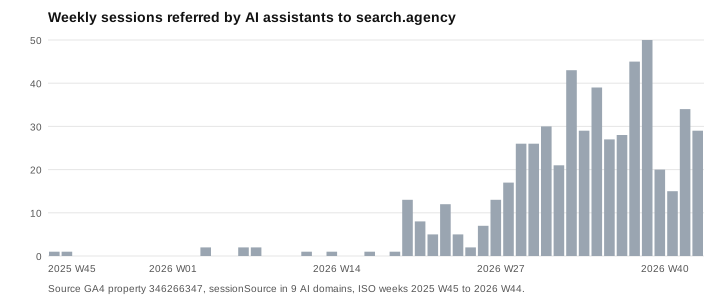
Across the full GA4 history, which starts in December 2022, there were 601 AI-referred sessions out of 132,793 sessions in total. That is 0.45 percent. ChatGPT accounted for 510 of them, Claude for 41, Gemini for 15 and Perplexity for 13.
| Measure | 2026 weeks 1 to 20 | 2026 weeks 27 to 44 |
|---|---|---|
| All sessions | 2,887 | 21,538 |
| AI-referred sessions | 10 | 499 |
| AI-referred sessions per week | 0.5 | 27.7 |
| AI share of all sessions | 0.35 percent | 2.32 percent |
| Enquiry sessions (different events in each period) | 134 | 35 |
| Enquiry sessions from AI referrals | 0 | 8 |
| Branded Google clicks (Search Console) | 199 | 348 |
AI-referred visits engaged at about the same rate as the rest of the site. Using GA4's standard definition of an engaged session, 233 of the 601 AI sessions were engaged (38.8 percent), against 37.4 percent for all sessions.
Enquiry events tell a messier story, and we show them on their own chart with their own scale.
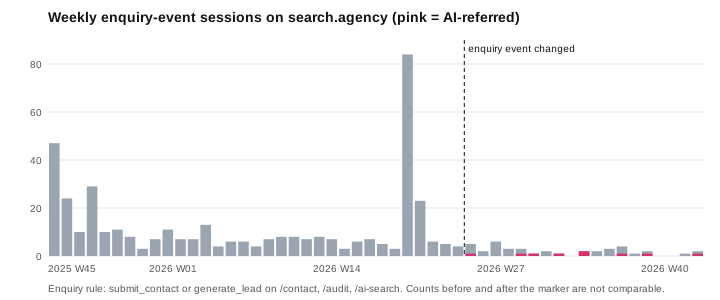
Before June 2026, enquiry sessions ran at about seven a week, with spikes in weeks of heavy paid search. After June 2026 they ran at about two a week. The drop coincides with the switch from submit_contact to generate_lead. We cannot tell how much of it is a real fall in enquiries and how much is a change in what gets counted.
From 18 May to 1 November 2026 there were 162 enquiry sessions. Paid Search produced 77 of them, Direct 35, Organic Search 29 and the AI Assistant channel 9. The AI share of enquiry sessions in that window was 5.6 percent, which is higher than its share of all visits. With nine sessions, that difference is too small to mean much.
Which AI-referred visits we could trace
These are the only visits where we can see an AI assistant in the record and an enquiry event in the same session. They are examples, and ten sessions cannot stand in for every buyer who used an AI tool.
| Date | AI source | Page where the enquiry event fired |
|---|---|---|
| 12 May 2026 | Gemini | /contact |
| 25 June 2026 | ChatGPT | /ai-search |
| 20 July 2026 | ChatGPT | /ai-search |
| 31 July 2026 | ChatGPT | /audit |
| 13 August 2026 | ChatGPT | /ai-search |
| 27 August 2026 | ChatGPT, two sessions | /contact and /audit |
| 15 September 2026 | ChatGPT | /audit |
| 3 October 2026 | ChatGPT | /audit |
| 27 October 2026 | ChatGPT | /audit |
Six more lead events came from AI-referred sessions and were left out. Five were job applications on the careers page and one was a bootcamp registration. That ratio is a useful warning for anyone reporting "leads from ChatGPT" without reading what the forms contained.
The landing pages give a little more context. The AI search service page was the most common first page for AI-referred visits, with 103 sessions. The homepage had 89, the SEO Fighter Bootcamp page 47, the careers page 44 and an AI search case study 30. Another 79 sessions had no landing page recorded. The mix suggests that AI assistants send a blend of potential buyers, students and job seekers, and the referral count alone cannot separate them.
Direct traffic also grew in 2026, from 254 sessions in April to 1,632 in October. Some people who read about us in an AI answer may have typed our address directly. We have not assigned any Direct traffic to AI, because nothing in the data shows which Direct visits started in an AI tool.
Other explanations for the same numbers
Several things changed at the same time as AI referrals grew. Each one could explain part of the movement in enquiries or branded search.
- Paid search ran in bursts, with 9,392 sessions in June 2026 and 1,503 in October 2026, and paid search produced the largest single share of enquiry sessions.
- The enquiry event changed in June 2026, which breaks the outcome series at the exact point where AI referrals started to climb.
- Webinars on AI visibility drew 119 lead-form sessions between June and September 2026 and put the brand in front of new people through other channels.
- Ordinary SEO kept working, and Search Console shows total Google clicks rising from 551 to 1,119 between the two periods.
- Training products and hiring pages pulled visitors with different intent, and some of them arrived through AI assistants.
- GA4 changed how it labels AI visits in June 2026, which affects any report built on the channel grouping.
- Seasonality and normal week-to-week noise are large on a site with a few hundred sessions a week.
We had no price changes or sales-team changes on record for this period, but we also had no system that would have logged them. A company with a real CRM and a marketing calendar would be able to rule some of these in or out.
What the evidence supports
The table below keeps the four layers apart, as the measurement design requires.
| Evidence layer | What we found | Strength |
|---|---|---|
| Observable AI referrals | 601 sessions all time, rising to about 28 a week in late 2026, 10 sessions with an enquiry event | Directly observed, small volume |
| Self-reported discovery | Not collected, because the contact form has no discovery question | None |
| Modeled association | Weekly AI referrals and branded Google clicks moved together (correlation 0.47 over 44 weeks), while AI referrals and enquiry sessions did not (minus 0.17) | Weak and confounded |
| Incremental effect | No intervention date, no control group and one site | Not supportable |
A correlation of 0.47 means the two weekly series tend to rise together, with plenty of weeks that break the pattern. It does not mean AI referrals caused branded searches. Paid search, webinars and ordinary SEO all grew brand exposure in the same months.
The honest summary is that AI assistants now send search.agency a small, growing stream of visits, and a handful of those visits submitted an enquiry. We cannot connect that stream to qualified demand, and the one AI Mode citation we observed was not stable from one run to the next. The answer to the title question, for our own site in 2026, is inconclusive.
We also want to be clear about what this does not show. It does not show that AI visibility has no commercial value. A null result from a study with no CRM, no discovery question and a broken enquiry series mostly tells you the study could not detect an effect of the size that might exist.
What we would fund next
For our own site, the evidence supports a measurement budget before a visibility budget. Spending more to raise citations would be hard to justify when we cannot yet see whether the current citations produce a single qualified opportunity.
The first step is to connect enquiry forms to a CRM and record a qualification decision and a date for every enquiry. That alone would turn ten unknown sessions into a known number of real opportunities, and it would give future studies the primary outcome the method needs.
The second step is to add a discovery question to the contact and audit forms, with AI assistants as a listed option. Buyers who found you through an AI answer and then typed your address leave no referral trail, and asking them is the only cheap way to see that group.
The third step is to freeze the event definitions. Changing the enquiry event mid-year cost us the ability to compare the first half of 2026 with the second half. It is an easy mistake for any team to repeat.
The fourth step is to start a dated citation record. A fixed prompt panel, run on a schedule with repeats and saved in full, would turn this single snapshot into a series. Our guide to AI share of voice explains the rates we used here.
Only after those four steps would a visibility investment be testable. The test would set a dated change, a pre-agreed outcome such as sales-accepted opportunities, a waiting period that matches the sales cycle, and the smallest change worth paying for. If the goal is business growth more than traffic, our piece on turning SEO goals into business growth covers how to set that bar.
Many teams can now see AI referrals in their analytics without being able to see what those visits are worth. If that describes your team, we can help you design an AI-search measurement plan around qualified demand.
See where your brand stands in AI answers today, benchmarked against your competitors, no pitch required.
AI Travel Recommendations Versus Marketplace Economics in Indonesia
Google AI Mode often tells travellers to book direct, yet most links in its Indonesian travel answers point to Google listings. A 20-scenario study plus a contribution model you fill in yourself.
Read post →
Who Owns Wrong AI Answers About Bank Products?
We checked 121 claims in 42 Google AI Mode answers about three savings accounts. Few were wrong, but many could not be verified because the banks' own pages disagreed.
Read post →
When AI Confuses Properties Within a Hotel Brand
Google AI Mode named the right hotel brand in all 35 answers we tested. Three answers still attached a fact to the wrong property or place.
Read post →