
Who Owns Wrong AI Answers About Bank Products?


When an AI answer gets a bank fee or an eligibility rule wrong, the bank still owns the operational work of finding it, checking it, fixing its own sources and telling customers what is true. The bank does not control the answer itself. In our test of 42 Google AI Mode answers about three Indonesian savings accounts, outright factual errors were rare. The larger problem was answers that could not be checked, often because two official pages from the same bank disagreed with each other.
This article reports that small study and turns it into a working process. It is written for bank digital leads, product owners, compliance teams and customer experience managers. "Ownership" here means operational accountability inside the bank. It is not a statement about legal liability, and nothing here is financial advice or a legal opinion.
The ownership question
A customer asks Google about a savings account and reads a confident answer about fees, deposits and documents. If that answer is wrong, the customer may arrive at a branch with the wrong paperwork or expect a fee that no longer applies. The bank did not write the answer, yet the complaint lands with the bank.
Inside most banks, nobody's job description covers this. Product teams own the product terms. Digital teams own the website. Compliance owns disclosure rules, and customer service owns complaints. An external AI answer sits between all four, so it tends to belong to no one.
The gap matters because the bank controls most of the inputs. AI answers are assembled from pages that already exist, and most of those pages were published by the bank itself. When the bank's own pages are unclear, out of date or inconsistent, the answer inherits the problem.
Our earlier study of which sources Google AI Mode cites for Indonesian banking queries found that bank websites supply a large share of citations. That study measured who gets cited. This one asks a different question, which is whether the facts in the answers were right.
What was verified
This is a single-surface study of Google AI Mode, collected through a third-party API called SearchAPI with the location set to Jakarta. It is not the consumer interface, and results there may differ. We collected answers on 3 November 2026.
We kept the scope to rupiah savings accounts, because fees and eligibility rules for savings products are published openly and can be checked line by line. We picked five widely held savings products from five Indonesian banks and built a dated truth register for each one from official product pages, official fee pages and published product summaries. None of the five banks is a Search Agency client.
The planned sample was 90 answers, made up of six question types for five products with three repetitions each. We stopped collection at 42 answers to fit the study budget. The completed sample covers three products, called Bank A, Bank B and Bank C in this article. Truth registers for the other two products were built and kept in the evidence file, but they were not queried.
| Item | Completed |
|---|---|
| Surface | Google AI Mode via SearchAPI, location Jakarta |
| Collection date | 3 November 2026 |
| Products queried | 3 savings products (Bank A, Bank B, Bank C) |
| Prompts | 14 (six question types for Bank A and Bank B, two for Bank C) |
| Repetitions | 3 per prompt |
| Valid answers | 42 of 42, with no technical failures and no refusals |
| Language split | 24 answers to Bahasa Indonesia prompts, 18 to English prompts |
| Extracted factual claims | 121 |
The question types covered the monthly admin fee, the minimum opening deposit, the minimum balance, the minimum age to open an account alone, whether a foreign resident can open one, and the documents required. Prompts were phrased the way customers ask, such as "Berapa biaya admin bulanan" or "Can a foreigner living in Indonesia open this account?"
Repeated answers to the same prompt are not independent customers. They show how stable the answer is for one question, so we report results at the claim and prompt level and avoid treating 42 answers as 42 people.
Every claim about the product was extracted and coded against the truth register. The codes came from the brief. A claim could be correct and sufficiently qualified, incorrect, stale, missing a material condition, unsupported by any source, unverifiable, or properly uncertain. A responsible refusal does not count as an error, and a conditional statement is judged only against the scenario it describes. Claims were coded twice, and the second pass record sits in the evidence folder. Both passes were done by the same research team, so an independent second reviewer is still required before publication.
Promotions were in the original brief. None of the three product pages showed a dated savings promotion on the fetch date, so promotions were recorded in the register and not tested.
Where answers went wrong
Of 121 claims, 97 were correct and qualified. Two were verifiably wrong, one incorrect and one stale. That gives a factual error rate of 1.9 percent, which is 2 errors out of 107 claims we could adjudicate. Fourteen claims, or 11.6 percent of all claims, could not be adjudicated at all.
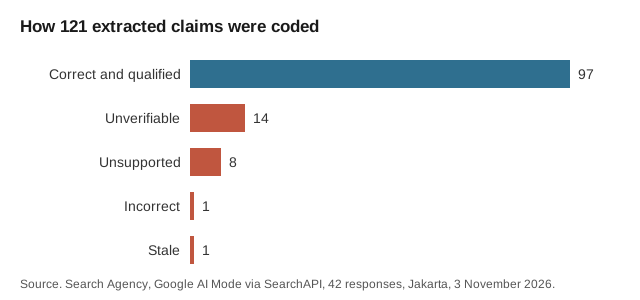
Another eight claims were unsupported. Their headline number usually matched the bank, but the answer added a condition that no official page stated. The most common example tied the monthly admin fee to the debit card type, when the bank's fee pages list one admin fee and a separate card fee.
Counting by answer gives a less comfortable picture. Twenty of the 42 answers contained at least one claim that was wrong, unsupported or impossible to verify. A customer reading one answer had close to an even chance of meeting at least one fact that the bank's own pages did not clearly back.
| Bank | Claims | Correct | Incorrect or stale | Unsupported | Unverifiable |
|---|---|---|---|---|---|
| Bank A | 52 | 40 | 0 | 5 | 7 |
| Bank B | 47 | 39 | 0 | 3 | 5 |
| Bank C | 22 | 18 | 2 | 0 | 2 |
The claim verification table below shows the material cases. Each row compares what the answer said with the official source on its fetch date. Bank names stay in the evidence folder until legal review and a right of reply are complete.
| Bank | Fact | What the answer said | Official source on fetch date | Code |
|---|---|---|---|---|
| Bank C | Monthly admin fee | Rp 12,500 to Rp 13,000 depending on card type | Rp 13,000 on the tariff page and product summary (2 November 2026) | Stale |
| Bank C | Tax number | Tax number needed only if the customer has one | Product page lists the tax number as a requirement with no stated alternative (2 November 2026) | Incorrect, pending bank confirmation |
| Bank A | Monthly admin fee | About Rp 12,000 depending on card type | Rp 12,000 flat on two pages, with no link to card type (2 to 3 November 2026) | Unsupported |
| Bank A | Card fee and penalty | Classic card Rp 3,500 and a Rp 5,000 penalty below minimum balance | One official page says Rp 3,500 and Rp 5,000, another says Rp 2,000 and no penalty (3 November 2026) | Unverifiable |
| Bank A | Foreign residents | Branches may ask foreigners for a tax number or employer letter | Official page lists passport and stay permit only (2 November 2026) | Unsupported |
| Bank B | Minimum age | 17 years | Product page states no age, so the claim was inferred from sibling products (2 November 2026) | Unverifiable |
Some facts were stable. Opening deposits were right in all 28 claims, and minimum balances were right in all 14. Foreign resident eligibility was right in all 6. The fact types that went wrong were the monthly admin fee and required documents, which are the areas where banks publish conditions in more than one place.
Two smaller defects are worth noting. Two answers printed a dollar sign in front of rupiah figures, which is a presentation error with correct numbers. No answer refused to answer or said it was unsure, so the "properly uncertain" code was never used.
The sources behind the answer
The brief asked us to separate three kinds of failure. These are obsolete official information, conflicting third-party records and unsupported generation. All three appeared, plus a fourth that the brief did not anticipate.
| Source behind the problem | Claims | Example |
|---|---|---|
| Two current official pages from the same bank disagree | 7 | Bank A card fee and penalty |
| Older official page plus a third-party blog | 1 | Bank C admin fee of Rp 12,500 |
| Third-party page (visa agency, telco blog, news site) | 4 | Extra documents for foreigners |
| Generation that went beyond its cited official source | 5 | Admin fee tied to card type, tax number made optional |
| Fact missing from the official product page | 3 | Bank B minimum age |
| Fee schedule outside our truth register | 4 | Debit card fee tiers |
The fourth kind, internal conflict between official pages, was the largest single cause. Bank A publishes a product page, an online application page and a fee table. They agree on the deposit and the admin fee. They disagree on the classic card fee and on whether a penalty applies below the minimum balance. AI Mode cited all three pages and repeated whichever one it drew from.
The stale fee at Bank C shows how old pages linger. The current tariff page and product summary both say Rp 13,000. A separate official page about converting older accounts still shows Rp 12,500 next to interest rates dated April 2022. A telco blog repeats Rp 12,500. One answer blended the two figures and invented a card-type reason for the gap.
Missing facts create a similar problem. Bank B's product page states no minimum age. Every answer said 17, borrowing the figure from the bank's youth account pages. The answer may well be right, but nobody outside the bank can confirm it from the product page.
Most of these causes sit inside the bank's own publishing. That is the practical reason ownership has to sit inside the bank. Reconciling its own pages is work the bank can start this week without asking any platform for anything. Our guide to an entity consistency audit covers the same discipline for brand facts.
Who handles which task
The responsibility map below assigns each task to one accountable team. It is agency judgment, written as a starting template. Banks will need to fit it to their own structure.
| Task | Accountable team | Consulted | Output |
|---|---|---|---|
| Detection through scheduled AI answer checks | Digital or search team | Customer service | Logged claim with date, prompt and raw answer |
| Product verification | Product owner | Pricing or operations | Confirmed current value and effective date |
| Compliance review | Compliance | Legal | Decision on wording and customer disclosure |
| Source correction on owned pages | Digital or web team | Product owner | Updated or retired pages, one current value per fact |
| Third-party source outreach | Corporate communications | Digital team | Correction requests sent and tracked |
| Platform reporting | Digital team | Compliance | Feedback submitted through the platform's own tools |
| Monitoring and closure | Digital team | Product owner | Re-check results and closed incident |
The product owner carries the most weight in this map. Only the product owner can say which of two conflicting official pages is current, and every later step depends on that answer. A register entry needs a named person and a date beside the link.
A workable incident process
Each incident starts with a severity rating. The rubric below is agency judgment. It rates harm to the customer and to the bank's disclosure duties, and it ignores how embarrassing the answer looks.
| Severity | Definition | Example from this study | Target response |
|---|---|---|---|
| 1, critical | Wrong eligibility or a wrong fee that could cause a customer to lose money or be refused service | None found | Same working day |
| 2, high | Wrong or stale fee amount, or a required document described as optional | Bank C admin fee and tax number | Within 3 working days |
| 3, medium | Claim cannot be verified because official pages conflict or are silent | Bank A card fee, Bank B age | Within 10 working days |
| 4, low | Unsupported qualifier or presentation defect with the correct value | Admin fee tied to card type, dollar sign on rupiah | Next scheduled review |
The workflow runs in six steps, and each step leaves a record.
| Step | What happens | Record kept |
|---|---|---|
| 1. Capture | Save the full answer, prompt, date, surface and cited links | Raw answer file and run log |
| 2. Triage | Code each claim against the truth register and set severity | Coded claim row |
| 3. Verify | Product owner confirms the current value and which page is right | Signed register entry |
| 4. Escalate | Severity 1 and 2 go to compliance before any public statement | Compliance decision |
| 5. Correct | Fix or retire owned pages, request third-party fixes, report to the platform | Change log with dates |
| 6. Close | Re-run the same prompts after a set interval and record the result | Re-check file and closure note |
Evidence preservation matters more than speed in step one. AI answers change between runs, and in our sample the same prompt produced different card fees on different repetitions. Without the raw answer, a team cannot show later what the customer saw.
Closure is a decision based on the re-check. A fix to the bank's own pages is complete when the page is corrected. The external answer may take longer to change, or may not change at all.
What communication can promise
A bank can promise that its own pages state one current value for each fact, with an effective date. It can promise that customer service staff know which value is current. It can tell customers, in its help content and in branch, where the authoritative fee table lives.
A bank cannot promise what an AI assistant will say. Google's systems choose and phrase answers, and correcting a source does not guarantee a corrected answer. Public statements should say that the bank has corrected its information and give the correct value. They should not suggest that the bank controls or has fixed the AI answer.
Customer guidance can be simple. Fee and eligibility answers from AI tools should be checked against the bank's official product page or product summary before an account is opened. Our article on defensive GEO covers the wider practice of protecting a brand's facts in AI answers.
Building the register is the work that makes every later step possible. If your team wants help setting one up, build an AI-answer accuracy register for your financial products with Search Agency.
Legal and research limits
This article is not financial advice and not a legal opinion. It uses "ownership" to mean operational accountability and draws no conclusion about legal liability.
We read the OJK materials named in our brief. OJK's consumer protection press release describes a 2023 regulation on the obligations of licensed financial service providers, including fee transparency and complaint handling. OJK's banking AI governance guidance of October 2024 concerns how banks develop and apply their own AI systems. Neither document, as we read it, settles responsibility for an independent public assistant's answer. Legal review is required before any provision is cited or applied.
The research limits are real. The sample covers 42 answers about three products from one surface on one day, collected through a third-party API. It is far below the 90 answers planned. The figures are directional and do not represent all customer searches or all banks. Coding was done twice by one research team. Named findings require an independent reviewer, legal and editorial review, and a factual right of reply for each bank before any bank is identified.
See where your brand stands in AI answers today, benchmarked against your competitors, no pitch required.

AI Travel Recommendations Versus Marketplace Economics in Indonesia
Google AI Mode often tells travellers to book direct, yet most links in its Indonesian travel answers point to Google listings. A 20-scenario study plus a contribution model you fill in yourself.
Read post →
When AI Confuses Properties Within a Hotel Brand
Google AI Mode named the right hotel brand in all 35 answers we tested. Three answers still attached a fact to the wrong property or place.
Read post →
Does Prompt Language Change Which Brands Google AI Mode Recommends in Indonesia?
We asked Google AI Mode the same ten buyer questions in English and Bahasa Indonesia. Software answers shared a core of brands, travel answers shared almost none, and repeat runs in travel changed as much as language did.
Read post →