
AI Travel Recommendations Versus Marketplace Economics in Indonesia


Contents+
- 01Recommendation does not decide who owns the booking
- 02How the travel scenarios were observed
- Observed and inferred
- 03Where the recommendations send people
- The gap between the brand and the link
- Recommendation-to-destination table
- 04What each channel retains
- Sensitivity table with planning assumptions
- 05When marketplaces add value
- 06When direct investment makes sense
- 07What visibility cannot prove
- 08The commercial decision
When Google AI Mode recommends a hotel in Indonesia, the hotel's own website is rarely where the link goes. In 27 valid answers to 20 defined travel scenarios, the recommended property's own site was cited or linked in 8 of 68 recommendations, about one in eight. Three quarters of the clickable destinations were Google map listings.
That matters for anyone who runs hotel distribution. The brand an AI answer names, the domain it cites, the place a tap lands and the company that finally takes the payment can be four different parties. This article shows what we observed at the first three stages, explains why the fourth stage needs your own booking data, and gives a contribution model you can fill in with your own contract terms.
Read the findings with their limits in mind. This is a single-surface study of Google AI Mode, collected through a third-party API (SearchAPI) with the location set to Jakarta. It is an assistant simulation. No traveller took part, nobody clicked a link, and nobody completed a booking. The sample is 28 responses, of which 27 were valid.
Recommendation does not decide who owns the booking
A traveller who asks an AI assistant for a family resort in Nusa Dua passes through four stages before a room is sold. Each stage can belong to a different party, and each one has a different commercial meaning for the hotel.
| Stage | What it means | Status in this study |
|---|---|---|
| Recommended brand | The property or operator the answer names | Observed |
| Cited domain | The website the answer uses as a source | Observed |
| Click destination | Where a tap on a link or card would land | Observed |
| Booking captured by | The company that takes payment and owns the customer record | Not observed |
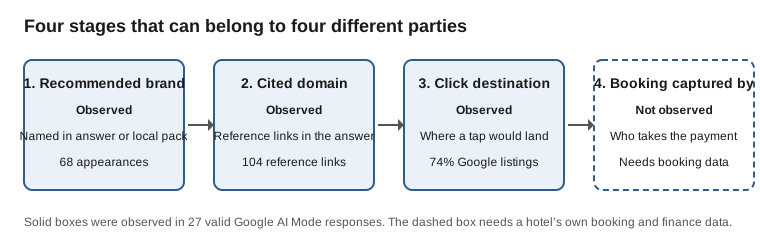
Most AI visibility reporting stops at the first stage. A hotel is pleased to be named, and the report counts mentions. A commercial director needs the fourth stage, because that is where commission, payment costs and the guest relationship are decided.
The two middle stages connect them. If the answer names your hotel but every link points to a listing or a third-party page, the recommendation still creates value, and some of that value goes to whoever owns the destination. Our earlier research on what Google AI Mode cites when Indonesians plan a trip mapped which domains get cited. This study follows the recommendation one step further, to the link a traveller would tap.
How the travel scenarios were observed
We wrote 20 travel scenarios before collecting anything. Ten were in English and ten in Bahasa Indonesia. They covered domestic trips and inbound trips from the United Kingdom, the Netherlands, Germany, Australia, Malaysia and Singapore. Destinations included Bali, Labuan Bajo, Yogyakarta, Lombok, Jakarta, Bandung, Bromo, Raja Ampat, Belitung and Lake Toba.
Each scenario stated dates, party size, budget and requirements, and asked where to book. One example is a family of two adults and two children aged 5 and 8 who want a Nusa Dua resort with a kids club from 14 to 19 July 2027 at about Rp 5 million per night. Another is a Bahasa Indonesia request for an Ubud private pool villa for a honeymoon at no more than Rp 4 million per night with breakfast.
The answers came from Google AI Mode through SearchAPI, a third-party collection service, with the location set to Jakarta, Indonesia. A third-party endpoint can differ from what a signed-in person sees in the consumer app, so treat these as observations of one collection method on one surface. We collected on 2 and 3 November 2026 and saved every response in full.
The planned design was 20 scenarios run five times each, within a cap of 100 responses. Collection stopped at 28 responses after a rate limit. The Nusa Dua family scenario and the Ubud honeymoon scenario were run five times each, and the other 18 scenarios once each. One response, a Raja Ampat homestay request in Bahasa Indonesia, was cut off in transit, so only its map results arrived. That leaves 27 valid responses.
Repeated runs of the same prompt are not separate travellers. They show how much a single answer varies, and we report them that way. With most scenarios run once, the numbers below describe this sample and should not be read as rates for Indonesian travel in general.
For every response we recorded the businesses in the map results, every reference link, and every link destination. We classified each destination as an official site, an online travel agency (OTA), a marketplace, metasearch, editorial, a map listing or other, using a domain table written before the counts. A marketplace here means a platform that sells many third-party operators' tours or rentals, such as an activities site.
Observed and inferred
Every claim in this article falls into one of two groups. Observed means it is in the saved answers. Inferred means it is our interpretation or something the data cannot show.
| Claim | Label |
|---|---|
| Which businesses the answers named and which links they carried | Observed |
| What the answers advised about where to book | Observed |
| Where a traveller would land after tapping a Google listing | Inferred, not tested |
| Which channel would take the booking | Not observed |
| Contribution per channel | Planning model only, no hotel data |
Where the recommendations send people
The answers produced 181 link destinations across the 27 valid responses, counting both the map results and the reference links. Google map listings made up 134 of them, or 74.0 percent. OTA pages accounted for 17 (9.4 percent) and official sites for 16 (8.8 percent). Marketplace and editorial pages had 5 each, other sources 3 and metasearch 1.
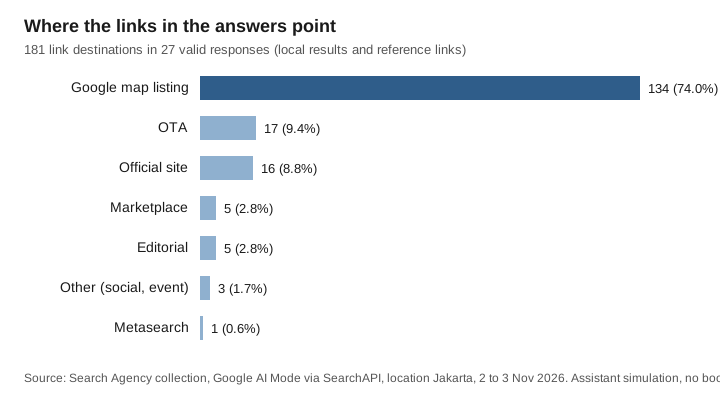
The reference links alone tell a similar story. Of 104 reference links, 57 (54.8 percent) pointed to Google's own place viewer, 17 (16.3 percent) to OTAs and 16 (15.4 percent) to official sites. Seven responses carried at least one OTA link, and nine carried at least one official-site link.
The gap between the brand and the link
Across the 27 valid answers, the map results named recommended businesses 68 times. We excluded landmarks such as Borobudur or Pink Beach and kept hotels, villas, resorts and operators. Those 68 appearances covered 52 different businesses.
In 8 of the 68 appearances (11.8 percent), the business's own site was cited or linked in the same answer. In 12 (17.6 percent), the answer linked an OTA page for that business. In 51 (75.0 percent), the only link attached to the business was its Google listing.
The written advice pointed the other way. In 24 of 27 valid responses, the answer suggested booking direct or checking the official site. In 22 of 27, it also named at least one OTA or marketplace. Agoda and Booking.com were each named in 18 responses and Traveloka in 9.
So the text frequently tells the traveller to go to the hotel, while the links mostly lead to a listing that Google controls. A hotel that wants the direct booking has to win again after the recommendation, on the listing or in a separate search for its own site.
Recommendation-to-destination table
The table below shows a selection of scenarios. The full list of 55 scenario and business pairs is in the evidence folder.
| Scenario | Language and runs | Businesses named | Own site linked | OTA page linked | Main destination |
|---|---|---|---|---|---|
| Nusa Dua family resort | English, 5 runs | 8 resorts across runs | Novotel, Renaissance | Grand Hyatt, Novotel, Renaissance | Google listings |
| Nusa Dua family resort | Bahasa, 1 run | Grand Hyatt, Novotel, Mulia | Grand Hyatt, Novotel | Grand Hyatt, Novotel | OTA and official |
| Ubud honeymoon villa | Bahasa, 5 runs | 9 villas across runs | None | None | Google listings |
| Labuan Bajo sea view hotel | Bahasa, 1 run | Meruorah, Loccal, Laprima | None | All three | Agoda and Booking.com |
| Mandalika race weekend | Bahasa, 1 run | Raja Hotel, Montana, Origin | None | All three | Traveloka, Booking.com, Agoda |
| Raja Ampat dive resort | English, 1 run | 3 resorts | Kri Eco, Raja Ampat Dive Resort | None | Official sites |
| Yogyakarta boutique hotel | English, 1 run | Aveta, Batik Cottage, Nueve | None | None | Google listings |
| Komodo day trip by speedboat | English, 1 run | Operators named in text | One operator | Marketplace listing | Tripadvisor, GetYourGuide |
Two patterns stand out. The answers varied a great deal between runs of the same prompt. The Ubud scenario named nine different villas across five runs, and the Nusa Dua scenario named eight resorts, with Grand Hyatt Bali appearing in four of the five. A single test of one prompt says little about how often a hotel is recommended.
Tours and packages behaved differently from hotels. In the five tour and package scenarios, an operator's own site was linked in four. Marketplace links to Klook, GetYourGuide or a Traveloka activity page appeared in three. Small operators with detailed pages on prices and inclusions, such as open trip pages for Bromo or Belitung, were cited directly.
The English and Bahasa versions of the Nusa Dua request produced different link sets. The Bahasa run linked official and OTA pages for two of its three resorts, while most English runs relied on Google listings. With one Bahasa run, that is a single observation and not a language effect.
What each channel retains
This section should rest on real contracts and transactions from participating hotels. We do not have permissioned finance data from any property, so we cannot report what any channel actually retains. What follows is a model and a planning tool, and every number in it is an assumption you replace with your own.
The model uses realized contribution, meaning what the hotel keeps from a stay after the stay has happened. It compares channels on the same basis. Comparing gross direct revenue with net OTA revenue makes the direct channel look better than it is, so both sides of the comparison must use realized net revenue.
| Term | What to include |
|---|---|
| Realized net revenue | Room revenue actually collected after channel discounts, cancellations and refunds |
| Distribution costs | Commission or fees paid to the channel, booking engine fees and payment processing costs |
| Acquisition costs | Paid search, metasearch bids, AI search work and other spend that produced the booking |
| Incremental servicing costs | Extra costs a channel creates, such as loyalty points or manual handling |
Channel contribution equals realized net revenue minus distribution costs minus acquisition costs minus incremental servicing costs. Your finance or revenue team should approve the exact accounting treatment before anyone uses the result in a budget decision.
Sensitivity table with planning assumptions
The grid below shows how the gap between a direct booking and a marketplace booking changes with two inputs. The commission rates and direct cost rates are arbitrary grid points chosen to show the arithmetic. They are planning assumptions, they are not market rates, and they say nothing about what any OTA charges. Enter your own contract terms.
Each cell shows the difference in contribution per Rp 1 million of realized net room revenue, with all other costs equal. A positive number means the direct booking keeps more.
| Planning assumption | Direct cost 5% | Direct cost 10% | Direct cost 15% | Direct cost 20% |
|---|---|---|---|---|
| Marketplace commission 10% | Rp 50,000 | Rp 0 | minus Rp 50,000 | minus Rp 100,000 |
| Marketplace commission 15% | Rp 100,000 | Rp 50,000 | Rp 0 | minus Rp 50,000 |
| Marketplace commission 20% | Rp 150,000 | Rp 100,000 | Rp 50,000 | Rp 0 |
| Marketplace commission 25% | Rp 200,000 | Rp 150,000 | Rp 100,000 | Rp 50,000 |
The direct cost rate is the total cost of winning and processing a direct booking, as a share of its revenue. It should include the booking engine, payment fees and the share of acquisition spend that produced the booking, including any AI search work. Many hotels underestimate it, because acquisition spend sits in the marketing budget and never reaches the channel report.
The table also hides a bigger question. A direct booking is worth the difference only if it replaces a marketplace booking. If the guest would have booked direct anyway, the AI search work produced no shift, and its cost belongs in the acquisition line with no offsetting gain.
When marketplaces add value
The answers we collected treated marketplaces as useful, and for good reasons. A hotel should weigh the same reasons before it decides to push travellers away from them.
Discovery comes first. An inbound traveller from Germany or Australia may never search for a small Lombok resort by name. A marketplace puts that resort in front of buyers who would not otherwise find it, and part of the commission pays for that reach.
Trust and conversion come next. Several answers recommended OTAs for free cancellation, clear breakfast terms and member discounts. A traveller who trusts the platform's cancellation promise may book sooner, and a hotel with a weak booking engine may convert better through a marketplace than through its own site.
Payment convenience matters for inbound guests. A marketplace that accepts the traveller's local card or wallet in their own currency removes friction a small property may not be able to remove itself.
Incremental demand is the test that ties these together. If a marketplace booking comes from a guest the hotel could not have reached, the commission buys revenue the hotel would not otherwise have. If it comes from a guest who already knew the hotel, the commission is a cost of letting the guest book where they were comfortable. Only your own booking and guest data can separate the two.
For tours and packages, the answers leaned on activity marketplaces and Tripadvisor listings to help travellers compare operators. A small operator gains credibility there that its own site cannot provide on day one.
When direct investment makes sense
Direct investment makes sense when the hotel can convert the traveller it already reached, and when doing so costs less than the marketplace alternative. Four checks decide whether that is true.
The first check is booking engine quality. Test the direct path on a phone with the exact request an AI answer would generate, such as a family of four for five nights in July. If the engine cannot show a family room with breakfast and a clear cancellation policy, the direct route will lose to a marketplace that can.
The second check is inventory and pricing. Travellers compare. If the direct rate is higher or the room types are fewer, a recommendation to book direct sends the traveller to a worse offer. Rate parity rules in your contracts shape what you can offer, so involve the revenue manager early.
The third check is customer retention. The strongest case for a direct booking is the guest record it creates. If the hotel has no plan to use that record for a return stay, much of the long-term value of the booking is lost.
The fourth check is measurement. Many Indonesian hotels run the website on one domain and the booking engine on another. Without cross-domain measurement, the analytics tool counts the visitor who moves from the site to the engine as two users, and the booking loses its source.
Google's documentation on setting up cross-domain measurement explains the requirement. Both domains must carry the Google tag with the same tag ID from the same web data stream, and the domains are listed in the tag settings. You can verify the setup by clicking through to the booking engine and checking that the destination URL carries the _gl parameter. If that parameter is missing, the report cannot tell you which bookings came from AI search, or from any other source.
The local signals matter here too. Because three quarters of the destinations in our sample were Google listings, the listing is often where the direct path starts. A complete Business Profile with rates and a working book link is part of direct investment. Our guide to hotel local SEO covers that work, and the GEO playbook for hospitality brands covers the pages that AI answers draw on.
What visibility cannot prove
A count of AI mentions or citations does not show booking share. Our sample observed that a hotel was named and which links appeared. It did not observe a single tap, a single session or a single reservation.
It also cannot show incrementality, meaning whether an AI recommendation produced a booking that would not have happened anyway. A guest who was already loyal to a hotel brand may ask an AI tool, see the brand named and book as planned. The recommendation appears in the logs, and it changed nothing.
The sample has further limits. It covers one AI surface through one third-party collection method, with location set to Jakarta. Most scenarios were run once, and the answers varied a lot between runs. The Bahasa Indonesia prompts returned with the interface language parameter set to English, which may have affected the answers. One response was lost in transit.
We did not test where a tap on a Google listing leads. A listing can show prices from several partners as well as the hotel's own site, and what it shows depends on the hotel's setup and on Google. That stage needs its own observation, ideally with real devices and real accounts.
Earlier Search Agency work on how hotel brands compete in travel search against Google and OTAs described the same pressure from a search perspective. This study adds evidence about the AI answer itself. Neither proves what share of bookings any channel captures.
The commercial decision
The decision is where to put the next rupiah of distribution effort, and the answer differs by channel and by property. A simple sequence keeps the decision grounded in your own numbers.
- Run the AI test on your own scenarios. Write ten requests your real guests make, with dates, party and budget, and record who is named and where the links point, several times each.
- Fix the listing first. If the answers send travellers to your Google listing, make sure that listing shows your rates and a working book link.
- Close the measurement gap. Set up and verify cross-domain measurement between your site and your booking engine before you judge any channel.
- Fill in the contribution model with real terms. Use your actual commission, payment, discount, cancellation and acquisition figures, approved by finance.
- Estimate incrementality. Compare periods, markets or room types where you changed direct effort, and ask guests how they found you.
- Decide per channel. Keep marketplaces where they bring demand you cannot reach, and invest in direct conversion where the guest already knows you.
Before any of this informs a budget, the gaps should be named honestly. We have no hotel's booking data, so the fourth stage remains unmeasured here. The sample is small, and repeated runs showed that one answer is a weak basis for any decision. Those are the reasons to measure your own property before acting on a general study.
If your marketing team reports AI visibility and your revenue team reports channel mix, the useful step is to look at both in the same meeting. Search Agency can help you review AI discovery and booking-channel economics together.
See where your brand stands in AI answers today, benchmarked against your competitors, no pitch required.

Who Owns Wrong AI Answers About Bank Products?
We checked 121 claims in 42 Google AI Mode answers about three savings accounts. Few were wrong, but many could not be verified because the banks' own pages disagreed.
Read post →
When AI Confuses Properties Within a Hotel Brand
Google AI Mode named the right hotel brand in all 35 answers we tested. Three answers still attached a fact to the wrong property or place.
Read post →
Does Prompt Language Change Which Brands Google AI Mode Recommends in Indonesia?
We asked Google AI Mode the same ten buyer questions in English and Bahasa Indonesia. Software answers shared a core of brands, travel answers shared almost none, and repeat runs in travel changed as much as language did.
Read post →