
Does Prompt Language Change Which Brands Google AI Mode Recommends in Indonesia?


In our matched test, English and Bahasa Indonesia versions of the same buyer question usually produced different brand lists in Google AI Mode, and the gap depended heavily on the category. Software and financial questions kept a shared core of brands across both languages. Travel and hotel questions shared almost nothing, but in travel the same question asked twice in the same language also changed most of the answer.
The sample is small. We completed 26 of 100 planned responses, so this article reports what one round of matched questions showed and where the evidence stops. It is a single-surface study of Google AI Mode, collected through a third-party API (SearchAPI), and it does not describe the consumer interface, ChatGPT, Gemini or any other assistant.
The question behind the experiment
Many regional marketing teams track AI visibility with an English prompt set and assume it describes their Indonesian buyers too. If the brands and sources change with the language of the question, that dashboard is measuring a different market from the one that buys.
The opposite assumption is also common. Some teams believe Indonesian-language content is automatically easier to win because there is less of it. We did not want to argue either side from opinion, so we asked the same commercial questions in both languages and recorded what Google AI Mode recommended and which pages it cited.
The decision this informs is practical. If the two languages return the same brands from the same sources, one measurement and content plan can serve both. If they diverge, Indonesian visibility needs its own prompts, its own tracking and possibly its own content budget. If the answer changes from one run to the next regardless of language, a single snapshot in either language tells you little.
How the questions were matched
We wrote ten buyer intents across three categories that match the accounts Search Agency works with, namely hospitality and travel, financial services, and B2B software. Each intent has one English prompt and one natural Bahasa Indonesia prompt with the same location, budget, duration and requirements.
We kept terms in English where Indonesian buyers keep them in English, such as serviced apartment, kids club, payment gateway, QRIS and coffee shop. Five of the ten pairs come from an earlier internal pilot, and every one of them was collected again under the protocol below. No pilot answer is counted here.
| Intent | English prompt | Bahasa Indonesia prompt |
|---|---|---|
| Serviced apartment, Jakarta | Which serviced apartments in Jakarta are suitable for a three-month business stay with a kitchen and laundry facilities? | Serviced apartment mana di Jakarta yang cocok untuk perjalanan bisnis selama tiga bulan, dengan dapur dan fasilitas laundry? |
| Family resort, Bali | Which family-friendly resorts in Bali have a kids club and a private beach for a five-night stay? | Resor ramah keluarga mana di Bali yang punya kids club dan pantai pribadi untuk menginap lima malam? |
| Labuan Bajo tour | Which Labuan Bajo tour operators offer a three-day family package with a liveaboard boat and a licensed guide? | Operator tur Labuan Bajo mana yang menawarkan paket keluarga tiga hari dengan kapal liveaboard dan pemandu bersertifikat? |
| Airport hotel | Which hotels near Soekarno-Hatta Airport are good for a one-night business stopover with an airport shuttle and a meeting room, under Rp 1.5 million per night? | Hotel mana di dekat Bandara Soekarno-Hatta yang bagus untuk transit bisnis satu malam dengan shuttle bandara dan ruang meeting, di bawah Rp1.500.000 per malam? |
| Savings account | Which banks in Indonesia offer a savings account with low monthly fees and no minimum balance for salaried employees? | Bank mana di Indonesia yang menawarkan rekening tabungan dengan biaya bulanan rendah dan tanpa saldo minimum untuk karyawan bergaji tetap? |
| Payment gateway | Which payment gateway is best for a growing online store in Indonesia that needs e-wallet, QRIS and virtual account support? | Payment gateway mana yang terbaik untuk toko online yang sedang berkembang di Indonesia dan butuh dukungan e-wallet, QRIS, dan virtual account? |
| Travel credit card | Which credit cards in Indonesia are best for frequent flyers who want airline miles and airport lounge access? | Kartu kredit mana di Indonesia yang paling bagus untuk orang yang sering terbang dan mau dapat miles maskapai serta akses lounge bandara? |
| Payroll and HR software | Which payroll and HR software is best for an Indonesian company with 50 employees that needs BPJS and PPh 21 calculations? | Software payroll dan HR mana yang terbaik untuk perusahaan di Indonesia dengan 50 karyawan yang butuh perhitungan BPJS dan PPh 21? |
| Accounting software | Which online accounting software is best for a small trading business in Indonesia that needs e-Faktur tax invoices and inventory tracking? | Software akuntansi online mana yang terbaik untuk usaha dagang kecil di Indonesia yang butuh e-Faktur dan pencatatan stok? |
| Coffee shop POS | Which POS system is best for a coffee shop in Jakarta with two outlets that needs QRIS payments and stock management? | Aplikasi kasir (POS) mana yang terbaik untuk coffee shop di Jakarta dengan dua outlet yang butuh pembayaran QRIS dan manajemen stok? |
The equivalence check was done by the Search Agency analyst who wrote the prompts, with a written note per pair. No independent bilingual reviewer has signed off yet, and two pairs carry small wording differences (perjalanan bisnis reads slightly more like a trip than a stay, and bersertifikat means certified where the English says licensed).
Collection details
Every call used Google AI Mode through SearchAPI with the location set to Jakarta, Indonesia and the country parameter set to Indonesia. English prompts used English as the interface language and Indonesian prompts used Indonesian, which the API accepted on every Indonesian call. Each call started a new conversation with no history.
The plan was five repetitions of every prompt in both languages, run in five blocks with the language order shuffled inside each block. That is 100 responses. We completed the first block and six calls of the second, for 26 responses, before collection was stopped to stay within the study budget. There were no technical failures, refusals or empty answers.
| Sample | Planned | Completed |
|---|---|---|
| Repetition 1, all 10 intents in both languages | 20 | 20 |
| Repetition 2 | 20 | 6 (family resort and Labuan Bajo in both languages, payment gateway and accounting in Indonesian) |
| Repetitions 3 to 5 | 60 | 0 |
| Total | 100 | 26 |
Because only the first repetition is complete in both languages, every English versus Indonesian comparison below uses repetition 1, which gives ten matched pairs. Repeated runs of the same prompt are not independent buyers, so we treat the intent as the unit of analysis and resample intents when we estimate uncertainty.
Brands were extracted by a script using a fixed alias table written for each intent. A brand counts as recommended when it appears on a place card, in a heading, or as the lead of a list item or comparison column. Booking platforms such as Booking.com, Traveloka and Tripadvisor, and payment methods such as GoPay or OVO, are not counted as brands. Overlap is measured with the Jaccard index, which is the number of brands both languages share divided by the number of distinct brands either language named, so 1.0 means identical lists and 0 means nothing in common.
Which recommendations changed
Across the ten matched pairs, the average overlap between the English and Indonesian recommended-brand lists was 0.30. Resampling the ten intents puts a 95 percent interval of roughly 0.14 to 0.45 around that figure. In plain terms, a typical pair of answers shared about a third of its brands, and no pair returned identical lists.
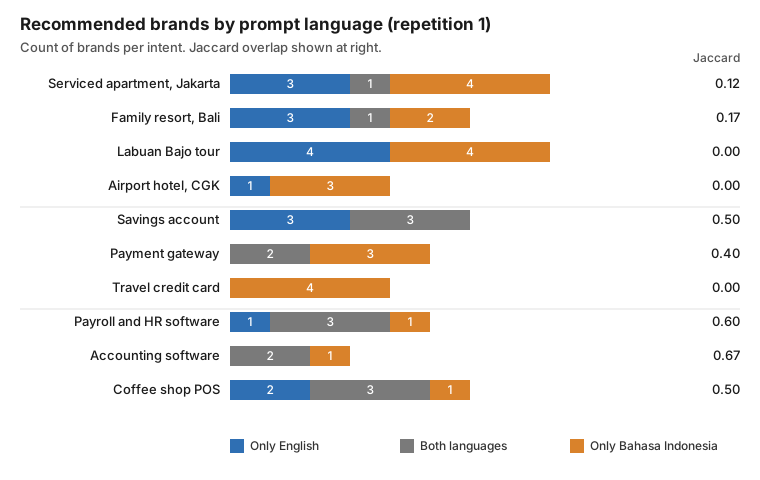
| Intent | Overlap | Named in both languages | Named only in one language |
|---|---|---|---|
| Accounting software | 0.67 | Mekari Jurnal, Accurate Online | Kledo (Indonesian) |
| Payroll and HR software | 0.60 | Gadjian, Mekari Talenta, GreatDay HR | Better HR (English), GajiHub (Indonesian) |
| Savings account | 0.50 | blu by BCA Digital, LINE Bank, SeaBank | Bank Jago, BNI, Bank Mandiri (English) |
| Coffee shop POS | 0.50 | Moka POS, Olsera, Pawoon | Majoo, Accurate POS (English), Qasir (Indonesian) |
| Payment gateway | 0.40 | Midtrans, Xendit | DOKU, Duitku, iPaymu (Indonesian) |
| Family resort, Bali | 0.17 | The Westin Resort Nusa Dua | Three other resorts (English), two others (Indonesian) |
| Serviced apartment, Jakarta | 0.13 | Fraser Place Setiabudi | Three (English), four (Indonesian) |
| Labuan Bajo tour | 0 | None | Four operators (English), four (Indonesian) |
| Airport hotel | 0 | None | One (English), three (Indonesian) |
| Travel credit card | 0 | None | See note below |
The travel credit card result is a data problem and should be read as missing. The English answer came back from the API with its list items stripped of card names, so only HSBC is named and only in passing, while the Indonesian answer named four cards from DBS, UOB and BCA. Leaving that intent out moves the average overlap to 0.33.
The Indonesian answers did not name fewer brands. In financial services they recommended four brands per answer on average against 2.7 in English, and in the other two categories the counts were within one brand of each other. The payment gateway pair shows the pattern clearly, with both languages naming Midtrans and Xendit and only the Indonesian answer adding DOKU, Duitku and iPaymu as options for smaller merchants.
The airport hotel pair shows a different kind of change. The English answer picked one hotel as the best option, priced well under the stated budget, and listed two alternatives in a sentence. The Indonesian answer recommended three different hotels in ranked sections, including one priced closer to the top of the same budget. Both answers fit the question, and they would send a buyer to different front desks.
Which sources changed
Cited sources moved more than brands did. The average overlap of cited domains between the matched answers was 0.12, with an interval of roughly 0.06 to 0.20, and four of the ten intents shared no cited domain at all.
We classified each cited page as Indonesian or English from the words in its title, using two short word lists that are published with the analysis script. After the run we read all 78 classified titles by hand, removed two words that appear in both languages, and found no remaining misreads. Eight titles that are only a brand name or mix both languages stay unclassified. Google place cards are counted separately because they have no page language.
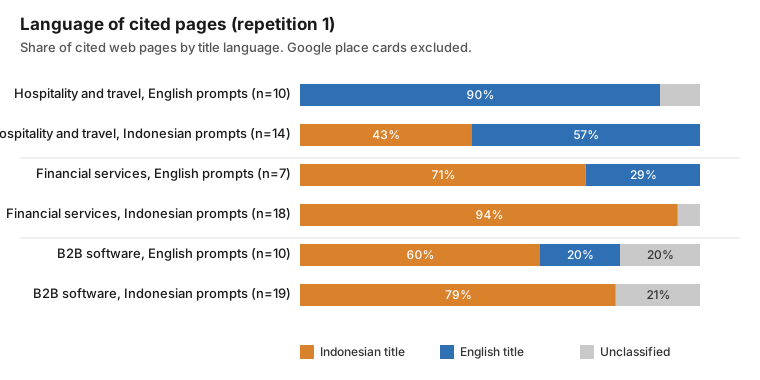
Indonesian prompts leaned on Indonesian pages, with 38 of 51 cited pages (75 percent) carrying Indonesian titles. English prompts were mixed, with 11 of 27 cited pages (41 percent) in Indonesian and 13 in English. That split hides a sharp category difference.
| Category | English prompts, Indonesian-titled pages | Indonesian prompts, Indonesian-titled pages |
|---|---|---|
| Hospitality and travel | 0 of 10 | 6 of 14 |
| Financial services | 5 of 7 | 17 of 18 |
| B2B software | 6 of 10 | 15 of 19 |
For banking, payments and business software, Google AI Mode cited Indonesian-language pages even when the question was asked in English. The English savings account answer, for example, cited three Indonesian articles from Kontan, Cermati and Pluang. Our earlier research on Google AI Mode citations in Indonesian banking looks at which sources banking answers rely on. For travel, English questions drew on English-language publishers, review sites and hotel group pages, while Indonesian questions brought in Traveloka, the Indonesian Tripadvisor site and Indonesian operator pages.
Language, location and ownership are three separate things, and the data treats them separately. Pages on .id or .co.id domains made up 22 percent of English-prompt citations and 35 percent of Indonesian-prompt citations. Pages from businesses we judge to be Indonesian, a list written by the analyst and not a verified ownership check, made up 52 percent and 69 percent. Several Indonesian companies publish on .com domains, and some foreign companies publish Indonesian-language pages on .id domains, so neither measure stands in for the other.
Where language mattered most
The category split is the main finding. B2B software averaged an overlap of 0.59, financial services 0.30, and hospitality and travel 0.07. In software, the same leading vendors appeared in both languages and the differences sat at the edges of the list. In travel, the two languages mostly named different hotels, resorts and operators.
Before reading that as a language effect, look at what happened when we asked the same travel questions twice in the same language. For the Bali family resort, the English answers overlapped 0.33 between the first and second runs and the Indonesian answers did not overlap at all. For the Labuan Bajo tour, neither language repeated a single operator from its first run. The cross-language overlap for those two intents was 0.17 and 0.
| Intent | English run 1 vs run 2 | Indonesian run 1 vs run 2 | English vs Indonesian, run 1 |
|---|---|---|---|
| Family resort, Bali | 0.33 | 0 | 0.17 |
| Labuan Bajo tour | 0 | 0 | 0 |
| Payment gateway | Not collected | 1.00 | 0.40 |
| Accounting software | Not collected | 0.67 | 0.67 |
In travel, a repeat of the identical prompt changed the brand list as much as switching language did, so this sample cannot separate a language effect from ordinary run-to-run variation. The one shared operator in the Labuan Bajo data, Komodo Family Tour, appeared in both languages only on the second run. For the two software and payment prompts we could repeat, the Indonesian answers were stable, which makes the differences we saw against English in those intents more likely to reflect the language of the question. Two repeated cells per category is still very thin evidence.
Answer format also varied in travel. Both English answers for the Bali resort named no property in the written text and placed every recommendation on a map card, while the Indonesian answers described properties in full paragraphs. A brand that appears only on a card and a brand described in the text are both visible to a buyer, but they are not the same kind of exposure.
What might explain the differences
The observations above come from the data. The explanations in this section are hypotheses, and this test was not designed to confirm any of them.
Source availability is the most likely driver in finance and software. Indonesian comparison articles, bank pages and vendor blogs dominate those topics, and the English answers cited them anyway. When both languages draw from the same pool of Indonesian pages, the same vendors tend to surface.
Travel has a deeper English-language source pool from international publishers, review sites and hotel groups, and those pages describe a different set of properties from the ones Indonesian travel sites list. That could explain why the travel source split was sharp. The high repeat variation suggests a second factor, which is that local and map results for hotels and operators may rotate between runs regardless of language.
Retrieval and wording may also differ. The Indonesian prompts use words such as terbaik and bagus that match the titles of Indonesian listicles, and the Indonesian answers often cited exactly those pages. We cannot tell from outside the system how Google translates or matches queries, and we make no claim about it.
What marketers should change
The right response depends on which pattern your category shows, and you should measure that before you act. This section is Search Agency's judgment based on the observations above.
If your category behaves like the software and finance intents here, with a stable shared core of brands, one prompt set can cover both languages for headline tracking. Add a smaller Indonesian set to catch the extra challengers that appeared only in Indonesian answers, such as the smaller payment gateways or accounting tools. Content in Indonesian matters even for English-language visibility in these categories, because the English answers cited Indonesian pages.
If your category behaves like travel, measure each language separately and run each prompt several times before you report anything. A single run in either language is closer to a sample of one than to a ranking. Track place-card presence on its own line, since in some answers it was the only place a property appeared.
If your results are inconsistent, with large differences in some intents and none in others, treat language as one variable among several and report results per intent. Averaging across intents hides the categories where the two languages agree and the ones where they do not.
For measurement, use the same discipline we applied here. Fix location and interface language for each arm, save the raw answers, count each brand once per answer, keep failures out of the denominator, and report the number of runs alongside every rate. The AI share-of-voice measurement guide explains why mention rate and competitive share should be reported separately, and the multilingual GEO guide for Bahasa Indonesia and Southeast Asia covers the content side.
What this test cannot establish
This is a small, single-surface sample. It covers 26 Google AI Mode responses collected through SearchAPI over two days, with only one complete matched round, so it cannot give brand-level frequencies, shares of voice or a stable ranking for any brand. Each brand result here rests on one or two answers.
The prompts were written by Search Agency and do not represent the full range of questions real buyers ask, and an appearance in a collected answer is not a verified impression by a human buyer. The API route may differ from what a signed-in user sees in the consumer interface, where history and account settings can change answers. Other assistants were not tested.
The test also cannot show that publishing translated or Indonesian-language content raises visibility. We observed which pages were cited, and we changed nothing on any website. One English answer lost its brand names in transit, and the bilingual equivalence of the prompt pairs still needs an independent reviewer.
What the test does show is enough to change how a team measures. In this sample, prompt language changed the recommended brands in every category, the size of that change depended on the category, and in travel the answer moved between identical runs almost as much as between languages. A benchmark built on your own buyer questions, with full repetitions in both languages, is the way to find out which pattern your category follows. Request a matched-language benchmark for your category.
See where your brand stands in AI answers today, benchmarked against your competitors, no pitch required.
AI Travel Recommendations Versus Marketplace Economics in Indonesia
Google AI Mode often tells travellers to book direct, yet most links in its Indonesian travel answers point to Google listings. A 20-scenario study plus a contribution model you fill in yourself.
Read post →
Who Owns Wrong AI Answers About Bank Products?
We checked 121 claims in 42 Google AI Mode answers about three savings accounts. Few were wrong, but many could not be verified because the banks' own pages disagreed.
Read post →
When AI Confuses Properties Within a Hotel Brand
Google AI Mode named the right hotel brand in all 35 answers we tested. Three answers still attached a fact to the wrong property or place.
Read post →