
How to Measure AI Share of Voice for Your Brand

Contents+
- 01What AI Share of Voice measures
- 02Entity share of voice and citation share of voice
- 03The formula and the discipline that protects it
- 04How to measure it manually
- 05Score the quality of each mention
- 06Let the AI define the competitive pool
- 07What a useful number looks like
- 08The mistakes that ruin the number
- 09Tracking AI Share of Voice with a tool
- 10Turning the number into work
AI answers do not have ranking positions. A model either names a brand in its answer or leaves it out, and that change breaks the rank tracking habit most enterprise SEO programs depend on. Boards now ask a question that rank tracking cannot answer, which is how often the brand comes up when a buyer asks ChatGPT for a recommendation in its category.
AI Share of Voice answers that question. It is the AI counterpart to the share of voice metric mature SEO programs already report for classic search results, adapted for a surface that writes an answer instead of returning a list of links. It shows whether the brand is part of the conversation when a model responds, or missing from an answer the prospect may never click away from.
The measurement itself is not technically complex. The part most programs skip is the discipline behind it, because they go straight to buying a platform before they understand what the number means.
What AI Share of Voice measures
AI Share of Voice measures how often AI answers mention or recommend your brand across a fixed set of buyer prompts. Teams use two versions of the calculation, and it helps to report both. Mention rate is the share of answers that name your brand at all. Share of voice, in the stricter sense, is your brand's mentions as a share of all brand mentions across those answers.
Suppose you run 200 prompt outputs across ChatGPT, Perplexity, and Gemini and your brand appears in 40 of them. Your mention rate is 20 percent. If those 200 answers name brands 500 times in total and 50 of those mentions are yours, your share of voice is 10 percent. Mention rate tells you how often you are present, and share of voice tells you how much of the conversation you hold against everyone else.
The metric belongs in an enterprise report because of what has happened to clicks. Pew Research tracked the browsing of 900 US adults in March 2025 and found that people clicked a traditional search result on 8 percent of visits when an AI summary appeared, against 15 percent when none appeared, and clicked a link inside the summary on only 1 percent. More of the decision now happens inside the answer, so the most direct way to read a brand's performance there is whether the model names it.
Entity share of voice and citation share of voice
Before measuring, decide which version of AI Share of Voice matters to you. The two versions answer different questions, and most programs need both, reported separately so nobody confuses them.
Entity share of voice counts how often a model names your brand as a recommendation, whether or not it links to you. In an answer such as "for maternal nutrition in Indonesia, brands like X and Y are well regarded", brand X counts as named. For most consumer and B2B categories this is the version that maps to demand, because the buyer reads the recommendation and acts on it even without clicking a link.
Citation share of voice counts how often your own content is cited as a source inside the answer. Content briefs, schema work, and the wider owned-media program all aim at this number. It tells you whether the pages you built are doing the persuading, or whether a third-party listicle is collecting the credit in the category you built.
| Metric | Question it answers | Best for |
|---|---|---|
| Entity share of voice | Is AI recommending my brand at all? | Demand-led programs and categories where being named in the answer is the goal |
| Citation share of voice | Is AI using my content as the source? | Content-led programs and teams investing in owned media and structured pages |
The formula and the discipline that protects it
The formula is the easy part.
Mention rate (%) = (answers that mention your brand ÷ total answers in your prompt set) × 100
The denominator has to stay honest. It includes every answer the team generated, including those where the brand did not appear. After a content push lifts half the prompt set, it is tempting to retire the prompts where the brand still loses. Those prompts are the ones the next content brief needs, so keep them in the set.
How to measure it manually
Most enterprise teams will eventually move this measurement from a spreadsheet to a dashboard, and the manual process should come first. A team that has never measured AI Share of Voice by hand will not know what its tool is measuring, and will miss the assumptions behind a number that moves in a quarter when the work did not. Run it in a sheet for the first three months, and automate it after that.
Block ninety minutes on the first working day of each month and repeat the same five steps every cycle.
- Lock the prompt set. Choose twenty to thirty buyer prompts based on real demand and buying-stage coverage, and freeze them for the year. The prompt set defines the measurement, so changing the list changes the metric and breaks the trend.
- Run every prompt in a clean environment, in a private window, logged out, with no chat history or saved memory. Models personalize on past behavior, and a logged-in account flatters the brand you are measuring.
- Cover at least three engines, ChatGPT, Perplexity, and Gemini, and add Google AI Mode for categories where people use it. Results differ enough between engines that none can stand in for the others.
- Run each prompt three to five times. Outputs vary between runs on every engine, and repeated runs separate a measurement from an anecdote.
- Log every result in one sheet, with one row per prompt, engine, and run. Record at least whether the brand was mentioned, whether its content was cited and at which URL, and every other brand that appeared.
Treat the first month as a baseline. The value arrives in months two and three, when you can see which prompts are moving and which are stuck, and the gaps tell you what to brief next. Our post on building an SEO dashboard people open covers how to present the results.
Score the quality of each mention
A passing mention in a list of eight brands is a smaller win than being named the main recommendation. Counting both as a single mention hides the most useful signal the measurement produces. Score every mention from 0 to 3 as you log it, and report the average score next to the mention rate.
| Score | What it means |
|---|---|
| 0 | Not mentioned at all |
| 1 | Listed among other options, with no detail |
| 2 | Mentioned in detail, with a specific strength or use case |
| 3 | Positioned as the main or default recommendation |
Two brands can both sit at a 25 percent mention rate and face different problems. A brand averaging 1.2 is being tolerated in lists, while a brand averaging 2.6 is being recommended. The first needs work that gives the model reasons to describe it in detail, and the second needs work that extends its reach to more prompts. The mention rate alone will not show which situation you are in.
Let the AI define the competitive pool
Most enterprise teams want to fix the competitor list before measuring, using the rivals already named in the strategy deck. Resist that, because one of the most useful outputs of the exercise is the list of brands the model surfaces that you did not expect.
Add every brand that appears in any answer to the tracking sheet. Models routinely name direct rivals, partners, substitutes, adjacent categories, and brands the strategy team had forgotten. That list is the model's working definition of your category, and it is often the most valuable finding of the first month, because buyers shop the category the model describes. Our analysis of how Google AI Mode answers Samsung queries in Indonesia shows how this plays out in one category.
Skip weighting brands by their position inside an answer. The order in which models list brands changes between runs for most prompts, so weighting by position adds false precision. Presence and quality are steady enough to measure.
What a useful number looks like
There is no universal benchmark for AI Share of Voice, and any vendor quoting one is guessing. The number means something when you compare it with your own earlier readings and with the competitive pool your measurement produced.
Three comparisons carry most of the value. Against the competitive pool, three rivals at 30 percent each against your 5 percent is a visibility gap that calls for new content. Against last month, a rise from 8 percent to 14 percent after a content push is strong early evidence that an AI search program is working. By prompt type, a strong number on informational prompts and a weak one on comparison prompts tells you exactly where the next brief belongs.
The mistakes that ruin the number
The common mistakes will look familiar to anyone who has run keyword rank reporting.
- Measuring while logged in inflates the number and shows progress that a new prospect never sees.
- Running each prompt once treats single answers as data, when outputs vary enough to need several runs.
- Tracking two hundred prompts produces a sheet the team abandons by month two, while twenty well-chosen prompts run consistently produce a real trend.
- Changing the prompt set every month measures a moving target, so you never see whether the work moved the brand.
- Counting mentions without scoring quality treats a footnote and a top recommendation as the same result.
All five come from the same habit of measuring too much with too little focus. Use fewer prompts, score them carefully, and run them on a schedule the team will keep.
Tracking AI Share of Voice with a tool
The manual method teaches the team what AI Share of Voice is and what moves it. After that, the spreadsheet becomes the bottleneck. StoryMint's AI Brand Performance tool, which our founder also runs, uses the same method and reports share of voice across a locked prompt set, raw brand mentions, citation rate, and average position, broken out by ChatGPT, Gemini, Perplexity, Google AI Overviews, and Google AI Mode. Given how much answer order varies, we read average position as a secondary signal next to presence and quality.
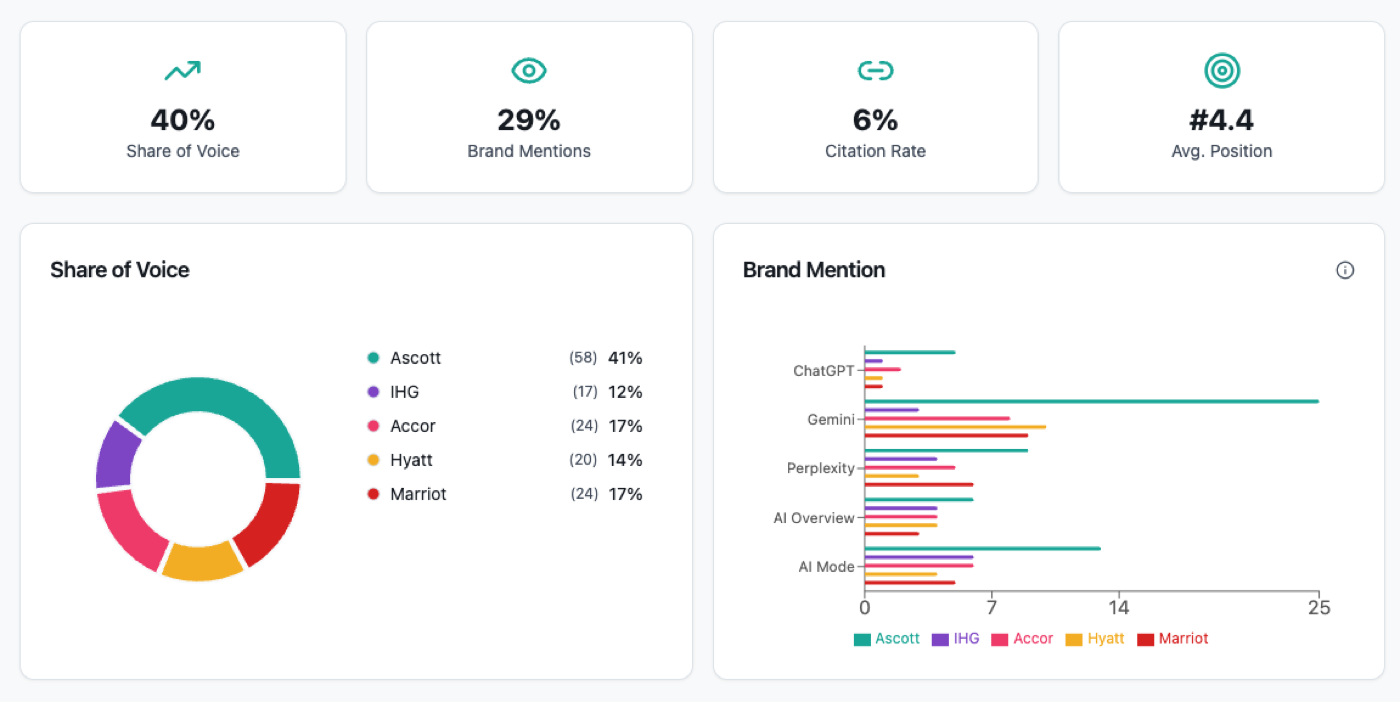
Source: StoryMint AI Brand Performance, sample view for a hospitality category, May to June 2026.
A tool matters after the third or fourth month because of volume. Twenty prompts across five engines at four runs each comes to four hundred queries a month, which one analyst can run but then has no time to read. A dashboard keeps the locked prompt set, the cross-engine view, and the open competitive pool, and removes the repetitive part of the work so the team can spend its time on judgment.
Whatever tool you choose, it must show the underlying answers as well as the headline percentage. A score you cannot trace back to the prompts and raw outputs is a score you cannot defend in a board meeting. Check that the tool lets you open the individual answers behind every number before you commit to it.
Turning the number into work
AI Share of Voice is a diagnostic, and its value lies in the next brief it produces. Prompts where your brand scores 0 or 1 while a tracked competitor scores 3 are the content priorities for the quarter. Pull the answer the competitor is winning, find the pages the model cites, study their structure, and build something better.
Prompts where your brand already scores 3 are won. Monitor them to defend the position, and move budget toward prompts where a competitor is winning, which is the most valuable reallocation the metric produces.
Prompts where no brand scores above 1 are open space in the category. For a focused team with a clear point of view, one well-structured page can earn a place in the answers for those prompts within a quarter. If you have never set a baseline for the prompts that matter to your business, our AI search audit produces one, covering the competitive pool the models see, your entity and citation scores, and the three prompts worth working on first. Most enterprise programs find at least one prompt on that first list they did not know they were losing.
See where your brand stands in AI answers today, benchmarked against your competitors, no pitch required.

How to Run ChatGPT Ads in Indonesia
ChatGPT ads are now open to Indonesian advertisers. We set up two campaigns in Ads Manager and documented every screen, from the first ad preview to the pixel and context hints.
Read post →
Augmented Visibility, How AI Recommendations Can Lead to Bad Business
AI assistants now build agency shortlists for buyers, and some of the sources behind them are paid rankings or lists an agency wrote about itself. What augmented visibility is, and how to check an AI-recommended agency before you sign.
Read post →
How 16 Indonesian Nutrition Brands Score on AI Search Authority
We scored 16 of Indonesia's biggest milk and nutrition brands on the graph signals that decide whether AI search names them. The category average was 19.9 out of 100, and no brand has built the foundation yet.
Read post →