
Google's AI Already Answers 88% of Indonesia's Child Nutrition Searches


We took 50 of the highest-intent questions parents ask about feeding and raising young children, then checked what Google actually shows. Nine in ten now return an AI Overview, and the category's most visible brand is cited in only half of them. Here is what that means for anyone selling to parents.
We ran this study ourselves. We pulled 50 of the questions that sit closest to a decision in the Indonesian children's nutrition category, the searches that come right before a purchase or a worried trip to the paediatrician, and we recorded what Google returned. The result is stark. Eighty-eight percent of those queries now produce an AI Overview, a written answer printed above the first link. The category has already shifted from a page of options to a single synthesised reply, and most brands cannot tell you whether they are inside it.
| What we measured | Figure |
|---|---|
| High-intent category queries analysed | 50 |
| Queries that return an AI Overview | 88% |
| Queries where a brand is cited in the answer | 44% |
| AI Overviews that name the leading brand | 50% |
| Queries needing new or improved content to compete | 40% |
What we looked at
We had no interest in vanity keywords. The 50 queries were the ones with real intent behind them, spread across three kinds of parent need. There were product research questions, like which growth milk suits a one year old. There were health worries, like the symptoms of cow's milk allergy or a toddler who suddenly refuses to eat. And there were development questions about sleep, milestones, and cognitive growth. For each query we logged whether Google generated an AI Overview, whether any brand was cited inside that answer, and what the answer pulled in around it.
The category is answered, not searched
Across the 50 queries, 44 returned an AI Overview. That is the moment the rules change. A parent who once skimmed ten links and formed their own view now reads one paragraph that Google has already decided is the truth. Under the stress of a child's health question, that paragraph is rarely questioned and rarely scrolled past. Whoever Google cites becomes, in that instant, the expert the parent trusts.
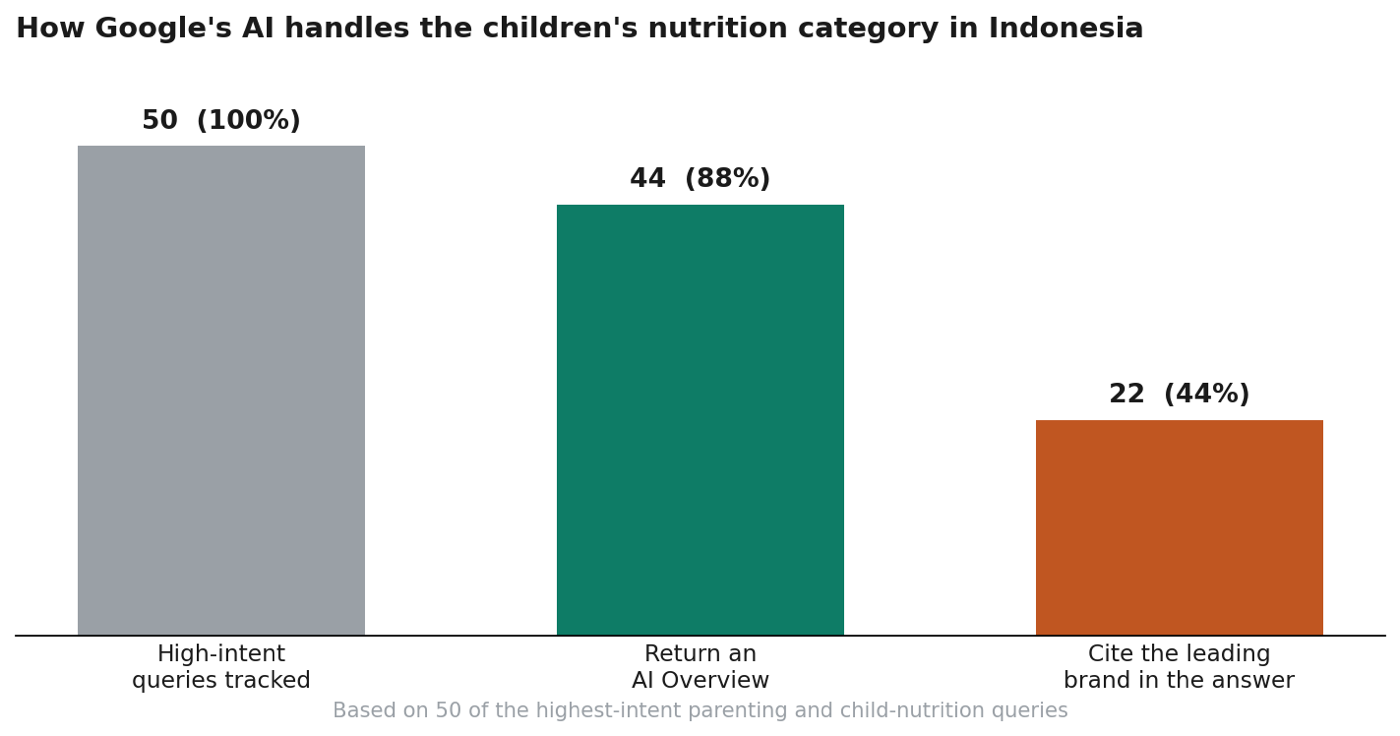
How AI Overviews handle queries related to kids nutrition
Being answered is not the same as being chosen
Here is the figure that should unsettle every brand in the category. When an AI Overview appeared, the most visible brand we measured was named in only half of them. Counted across all 50 queries, it surfaced 44 percent of the time. So even the brand with the deepest content library in the category is absent from one in every two answers a parent actually reads. The other half are being written from someone else's material, or from no brand at all, which means the trust those answers carry is flowing somewhere the brand cannot see.
Trust is the whole game in this category
Children's nutrition sits squarely in what Google classifies as Your Money or Your Life, the bucket of topics that can affect a person's health or safety. For those topics the AI is tuned to lean hard on signals of real expertise, experience, and authority. A glossy product page does not clear that bar. When the model chooses a source for a health answer about a baby, it is making a judgement about who can be trusted, and the brand it picks inherits that trust by association. This is why a citation here is worth far more than a top ranking ever was. The parent does not compare ten options anymore. They absorb one, and they absorb it at the exact moment they are deciding what to feed their child.
Why brands keep losing the answer
We audited the leading brands in the category against the signals AI engines rely on. The pattern was consistent and, for anyone willing to move, encouraging.
| AI readiness signal | Where the category stands |
|---|---|
| Scientific and ingredient credibility | Strong across the leading brands |
| Named experts and author credentials | Mixed, expertise is implied more than shown |
| Topic depth and clustering | Mixed, large libraries that are loosely connected |
| Interactive tools for parents | Mixed |
| Answer-first structure and FAQ or HowTo markup | Weak across every brand we audited |
| Off-site validation and community presence | Weak and largely unmanaged |
Everyone has invested in scientific credibility and a deep library of articles. Almost nobody has structured that library the way a model needs to read it. Summaries that lead with the answer, headings written as the questions parents type, and structured data that labels a passage as a clear question and answer are weak or missing right across the field. The content is built for a parent browsing on a phone, not for a machine trying to lift a clean, quotable passage. That is the open door. The first brand to re-engineer its existing content for extraction will start winning the answers the rest are leaving on the table.
One question becomes a thread
An AI Overview rarely stops at the first reply. It fans the original question into related sub-questions and follow-ups, so a search about a fussy eater pulls in the causes, the remedies, what to feed instead, and when to see a doctor. The answer is a thread, not a sentence. To be the cited brand you have to resolve the whole worry, not just the headline keyword. Thin content that targets one phrase loses to deep content that closes the entire loop a parent is anxious about.
What to do about it
The findings point to a clear way of working for any brand in a trust-driven category like this one.
Map the answers before you write anything. Pull the questions that matter in your category, read the AI Overviews they already produce, and note who gets cited. You cannot compete for an answer you have never studied.
Structure existing content for extraction. Lead each page with a direct summary, turn headings into the questions parents actually ask, and mark up questions and steps with proper structured data. Most of the gain comes from rebuilding what you already have, not writing more.
Show your expertise instead of implying it. Put named authors and qualified reviewers on health content, surface the research behind your claims, and date everything so it reads as current. In a Your Money or Your Life category, proof of authority is the price of entry.
Answer the whole worry, not the keyword. Build content that resolves the full thread of follow-up questions around a concern, so the AI can rely on a single source rather than stitching together several.
Track citation rate, not just ranking. Measure how often you appear inside the AI answers for your priority questions, watch it month over month, and treat it as the metric that matters most as more of the category moves into generated answers.
Work with Search Agency
We run this study for brands that need to know exactly where they stand inside AI answers, then we rebuild the content and the signals to move that share. If you sell to parents, or to any audience that now asks an AI before it asks you, we can show you which answers you are winning, which you are losing, and what it takes to turn that around. Get connected with our specialist today.
---
This analysis is drawn from our own category research into how generative search describes and cites brands in the Indonesian market, captured from Google in 2026. Brand identities have been withheld.
See where your brand stands in AI answers today, benchmarked against your competitors, no pitch required.

How DOKU Became the Most Visible Payment Gateway in Indonesian Search
DOKU was the better-known brand and the worse-ranked one. Eight months of technical repair and four content pillars later, it holds more Top 3 rankings than any payment gateway in the market.
Read post →
How to Fix Crawled and Discovered Currently Not Indexed Pages in Search Console
Google found these pages, sometimes even read them, and still left them out of the index. How to tell the two Search Console statuses apart, and which fixes actually move them.
Read post →
How to Run ChatGPT Ads in Indonesia
ChatGPT ads are now open to Indonesian advertisers. We set up two campaigns in Ads Manager and documented every screen, from the first ad preview to the pixel and context hints.
Read post →