
How to Run an SEO Campaign That Compounds

Contents+
- 01Start with people, not keyword tools
- 02Solve one specific problem at a time
- 03Find the gaps your competitors left behind
- 04Catch rising queries before the tools do
- 05Run the four steps as a cycle
- 06Map the first ninety days
- 07Stay consistent without going rigid
- 08Build the campaign around revenue, not rankings
- 09Measure the campaign when buyers ask AI first
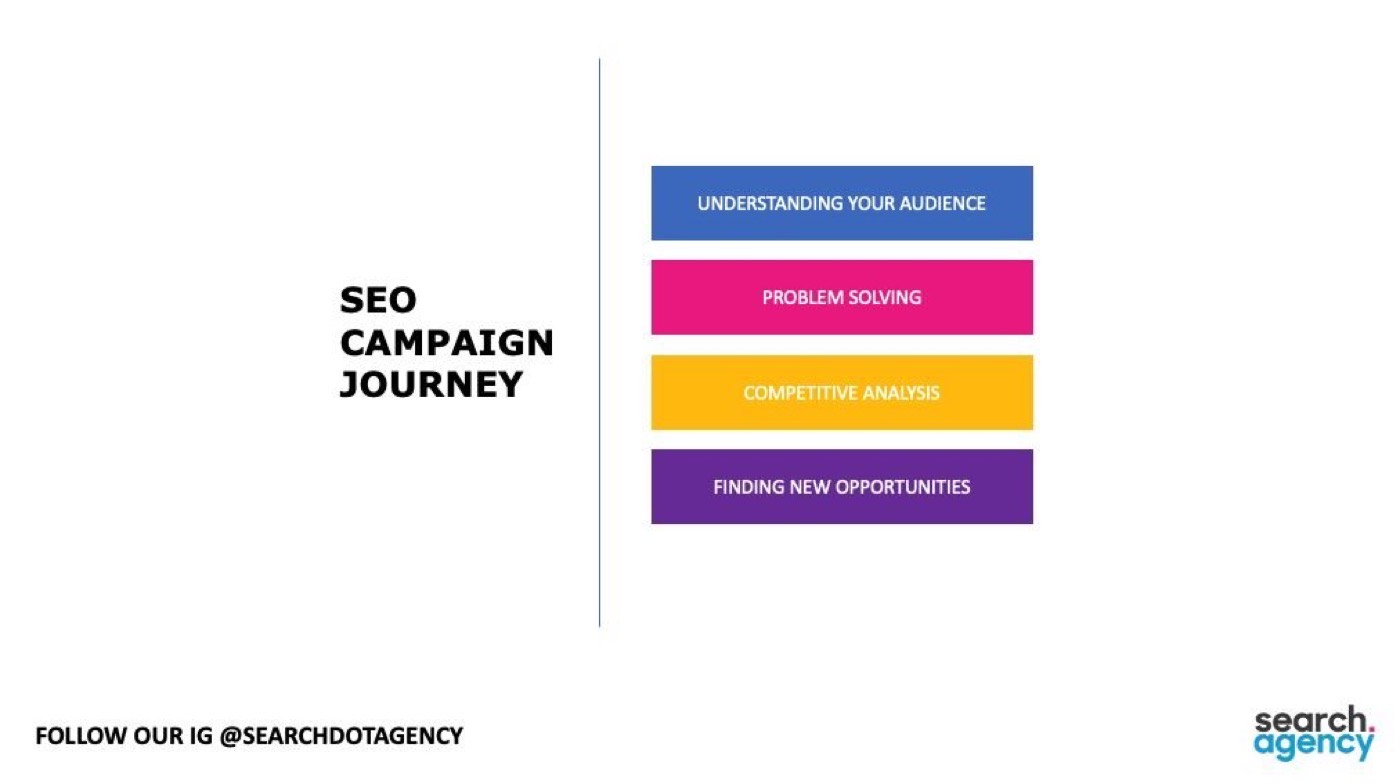
A good SEO campaign is a repeatable cycle, not a run of clever hacks. The teams that win rankings and revenue run the same four steps in order, over and over, until momentum builds. They listen to the language their buyers actually use, solve one specific problem at a time, publish where competitors left a gap, and catch rising questions before the keyword tools notice them. None of the four steps is difficult on its own. The difficulty is doing all four with enough discipline that the work compounds instead of resetting every quarter. This post walks through the cycle the way I run it with enterprise clients, and it ends where every campaign should, with a way to measure whether any of it moved the business.
Start with people, not keyword tools
A campaign that begins in a keyword tool starts one step too late. The tool tells you what people typed, but not why they typed it or what they were afraid of getting wrong, and that context is what separates content that ranks from content that converts. The better starting point is the language your buyers already use. Customer interviews, sales-call recordings, and support tickets are full of the exact phrases people reach for when a problem is urgent, and those phrases are worth more than a spreadsheet of anonymous search volumes.
Write down what you hear word for word, including the tone and the urgency behind it. A single sentence from a frustrated customer often tells you more about intent than a thousand rows of volume data, because it carries the moment the need became real. A simple way to make this repeatable is to tag every support ticket and sales call by the problem behind it, pull the verbatim phrases into one running document, and cluster the ones that keep recurring, so the topics that matter most rise to the top without you guessing at them. When those phrases sit in front of the content team, the briefs get sharper and the headlines almost write themselves, and the copy avoids the stiff keyword-stuffed phrasing that readers and search engines both distrust. This is also the raw material for owning the topics your buyers search rather than chasing whatever has volume this month.
Solve one specific problem at a time
Readers reward a page that fixes one clear thing, and they decide fast, because people scan web pages far more than they read them and leave the moment a page makes them hunt for the answer. An article that solves a single narrow problem, like choosing the right shipping calculator for a small store, gets bookmarked and shared long after it is published, because it did one job completely. A broad guide that touches ten things lightly rarely earns that kind of loyalty. In the early stage of a campaign, precision beats coverage every time.
Point each piece at one outcome the reader can reach in a few minutes. Trust builds when someone finishes a section and feels ready to act, and time on page rises for the same reason, because people stay until they get the answer you promised. Over a year, a library of sharp single-purpose pages outperforms a handful of bloated guides, and it does something the guides cannot, which is to make your site the place people return to whenever a specific obstacle shows up. Each of those pages is also a cleaner target to measure, which matters once you start judging the campaign by revenue rather than a keyword position you report every month.
Find the gaps your competitors left behind
Competitive analysis is most useful when you look for what is missing rather than what to copy. Map the pages your rivals rank for, then read them with a critical eye for thin answers, advice that has gone stale, and formats nobody has bothered to produce yet. A content gap analysis turns that reading into a list, the searches your competitors rank for and you do not, and those gaps are where a smaller brand can move fastest. Rank the gaps by how close each one sits to a buying decision rather than by search volume, because a low-volume page that catches someone comparing options is worth more than a high-volume page that catches nobody who ever buys.
The gaps are an opening for your own expertise. Publish the page they should have written, with real evidence, a clear structure, and the media that makes it easier to follow, and a modest brand can pass a much larger one that never did the extra work. Treat the map as a living document rather than a one-time exercise, because new gaps open every quarter as products change and old advice ages out. The teams that revisit the map on a schedule keep finding room to grow while their competitors assume the category is settled.
Catch rising queries before the tools do
Search demand shifts whenever a law changes, a new tool appears, or a news event pulls a topic into the open, and the earliest version of that demand rarely shows up in a keyword database first. It shows up in chat threads, community forums, and social comments, where people ask the new question in their own words weeks before it has enough volume to register in a tool. Google has said for years that about 15 percent of the searches it sees every day are ones it has never seen before, so a real slice of demand is always brand new and unclaimed.
Set up a few simple ways to watch that edge, using search autocomplete and Google Trends on one side and the forums, subreddits, and industry groups where your buyers actually talk on the other, and flag any unfamiliar phrase that spikes. Early notice lets you publish an answer in days rather than weeks. Getting a useful page live while curiosity is still climbing puts you at the front of the wave, and rivals who react later have to climb over the engagement you already earned. Speed only helps when the page is genuinely useful, so the goal is to be early and correct, not merely first.
Run the four steps as a cycle
The four steps do their real work when they run as a loop rather than a checklist you complete once. Each one feeds the next, so interviews produce new pieces, new pieces prompt a competitor to respond, that response reveals a fresh angle, and the trend watch keeps pulling in questions the interviews had not surfaced yet. The way to keep it manageable is to give each step its own cadence and let it run.
| Step | How often | What it produces |
|---|---|---|
| Talk to customers | Monthly | Real phrases and pain points for briefs |
| Audit and publish content | Weekly | Sharp single-problem pages |
| Review competitor gaps | Quarterly | A refreshed list of unclaimed topics |
| Skim query and social data | Daily | Early notice of rising questions |
A rhythm like this keeps the campaign from stalling in slow seasons, because there is always something to talk to a customer about, a page to sharpen, or a query to check. Progress stops flatlining once the work stops depending on bursts of motivation and starts depending on a schedule.
Map the first ninety days
The cycle needs a running start, and the first ninety days decide whether it gets one. Spend the opening month on research and quick wins, talking to customers, pulling the phrases that recur, and fixing the pages that already rank but convert poorly, since those repairs pay back fastest and buy the campaign credibility while the slower work builds. Months two and three are for publishing the first real cluster, a set of sharp single-problem pages aimed at the searches your buyers actually make, along with the competitor gaps worth claiming first.
Do not expect the revenue line to move much inside that window, because content and authority take time to compound, and a program judged too early gets cut right before it works. What you should see by the end of the first quarter is leading movement, more buyer-intent sessions, pages holding attention longer, and a handful of terms climbing, which tells you the engine is turning even before the headline number does. Set that expectation with everyone who watches the budget on day one, and the campaign survives long enough to pay.
Stay consistent without going rigid
Consistency does not mean running the same script no matter what the data says. When a page starts losing ground, the early move is usually a refresh, updating the copy and adding stronger internal links to hold the ranking before it slides further, rather than waiting for it to fall off the second page. Small corrections made early protect rankings that took months to earn.
When a page climbs faster than you expected, spend the momentum by turning it into other formats, a checklist, a short video, or a slide deck, so it reaches adjacent audiences without you starting from a blank page. A process that adapts to real signals proves it is listening as well as publishing, and that responsiveness is what keeps a campaign relevant as the questions change. If you want a fuller read on which signals actually deserve a reaction, we walk through how to tell whether SEO work is paying off separately.
Build the campaign around revenue, not rankings
For an established brand or a startup, an SEO campaign has to answer for a return, and a ranking on its own is not one. That starts with goals written in numbers the business already cares about, whether the target is qualified leads, sales, or defending share in the category, and every tactic underneath, from technical fixes to content to link building, should trace back to one of those numbers. We set the campaign up so that each activity has a clear line to a business outcome, and we tie every goal to a revenue number and a deadline before any pages get touched.
Measured this way, the case for SEO usually gets stronger the longer it runs. Well-run campaigns land between roughly 300 and 750 percent ROI once they mature, and organic tends to carry more of the load than the budget suggests, since one BrightEdge study put organic search at 53 percent of all site traffic against 15 percent for paid. The reporting is what holds the campaign together internally, because a program judged on organic traffic alone can look busy for a year while returning little, and one judged on leads and revenue tells you within weeks whether the four-step cycle is actually working. If you want to see where your own returns should land, we broke down what a strong SEO ROI looks like by industry.
Measure the campaign when buyers ask AI first
The last thing to build into the campaign is a way to count the value that no longer arrives as a click. A growing share of searches end on the results page, so a campaign measured only in sessions is tracking something that is shrinking underneath it. Zero-click searches sat near 68 percent in early 2026, a field study found Google's AI Overviews cut organic clicks by 38 percent on the queries where they appeared, and Pew Research found that people click a source link in only about 1 percent of searches where an AI summary shows up. Much of the influence your four-step cycle earns now happens inside an answer that never sends a visit.
So the campaign has to count how often it is the answer, alongside the clicks that still come through. That means tracking how often your brand is named across the major assistants, your share of citations against named competitors, the sentiment of how you are described, and the AI-attributed traffic that does arrive, and we publish the full measurement methodology openly rather than hiding it behind a black box. Before any of that, a handful of free checks will show how AI systems currently read your business, which is usually where the real to-do list comes from. The payoff for measuring early is real while the space is still uncontested. On one serviced-residence campaign we grew a hospitality brand's AI-answer audience from 7.4 million to 34.6 million in a single quarter by making it the most cited option for the questions its buyers were asking assistants, a result that never shows up in a clicks-only report. If your campaign feels stuck, the fastest restart is to pick one step in the cycle and act this week, and if you want a clear read on where your return is coming from before you touch a single page, that is what our AI visibility measurement is built to give you, starting with a free AI search visibility audit of where your brand stands today.
See where your brand stands in AI answers today, benchmarked against your competitors, no pitch required.

How to Use the Google Search Console MCP in Your SEO Process (6 Real Workflows)
Six Google Search Console MCP workflows we run on search.agency, each with the exact prompt, the tool it calls and the real output it returned.
Read post →
How DOKU Became the Most Visible Payment Gateway in Indonesian Search
DOKU was the better-known brand and the worse-ranked one. Eight months of technical repair and four content pillars later, it holds more Top 3 rankings than any payment gateway in the market.
Read post →
How to Fix Crawled and Discovered Currently Not Indexed Pages in Search Console
Google found these pages, sometimes even read them, and still left them out of the index. How to tell the two Search Console statuses apart, and which fixes actually move them.
Read post →