
Google I/O 2026: The 90-Day Playbook for the New AI Search Era

Contents+
- 01What Google announced
- 02The numbers Google did not put on screen
- 03The strategic shift: from link economy to relevance economy
- 04The mistake we are about to repeat
- 05The 30-day quick wins playbook
- 06The 60 to 90-day strategic plays
- 07What "good" looks like, end to end
- 08The new measurement stack
- 09Common mistakes to avoid
- 10What we are doing differently at Search Agency
Google I/O 2026
On May 19, 2026, Liz Reid walked the I/O stage and told the world that Search had just had its biggest upgrade in over 25 years. The keynote was framed as a celebration. Read closely, it was an obituary for the link economy that built modern SEO.
We have spent the last two days arguing that Google's AI Optimization Guide is not the whole map, and that Microsoft's grounding paper is the one to bring into client conversations. The I/O keynote is the third data point in that same series, and it confirms the trajectory we have been pointing at. The optimization work for the next two years is not "do better SEO." It is a layered set of moves across engines that do not share an index, a retrieval logic, or a citation model.
This post is the operator's version. What Google announced, what the data on our client GA4 dashboards actually says about the shape of the shift, what to do in the next 30 days, what to build in the next 60 to 90 days, what to measure, and the mistakes that will quietly cost brands the next two years.
What Google announced
The Search-specific announcements clustered into five blocks.
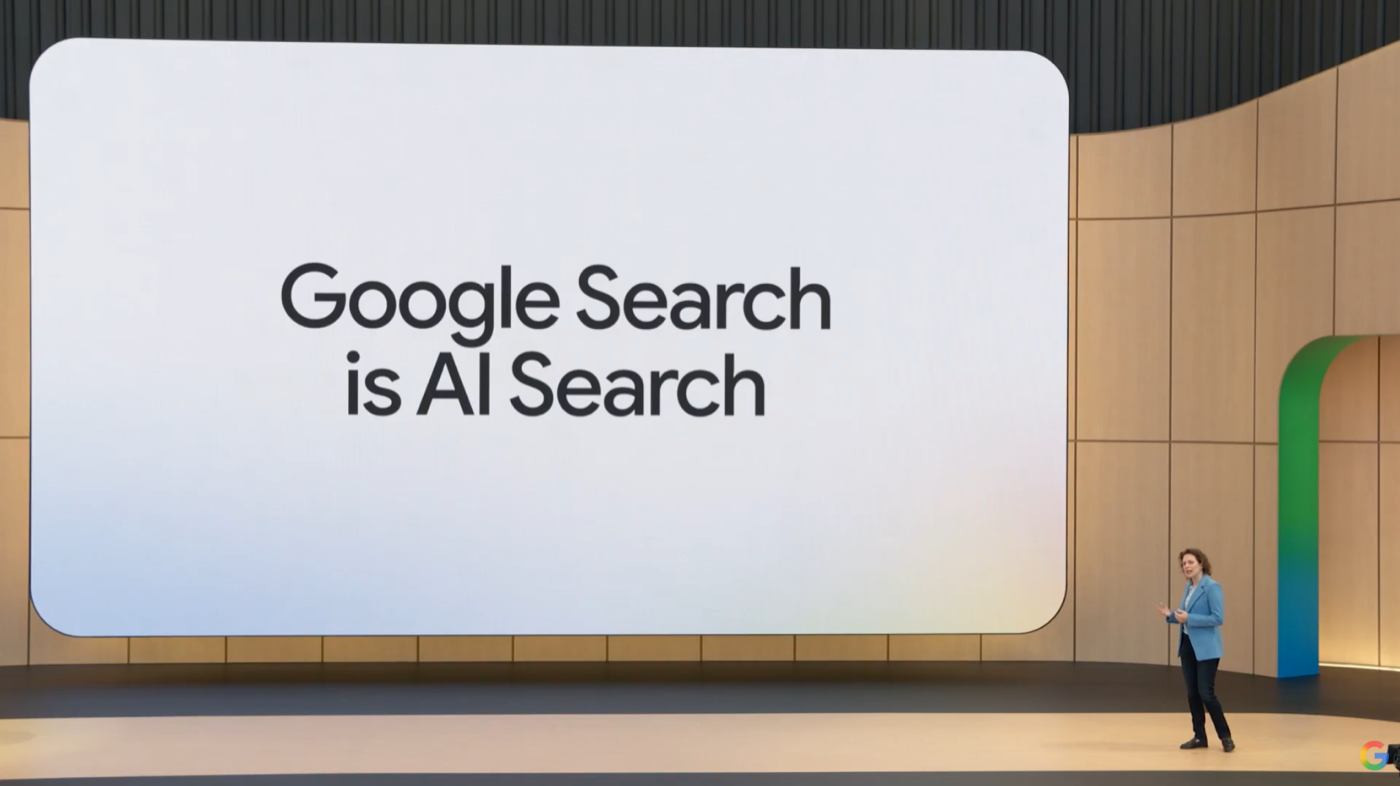
AI Mode is now the default surface. AI Mode crossed 1 billion monthly users, with queries more than doubling every quarter since launch. Gemini 3.5 Flash is now the default model in AI Mode worldwide. Total Search queries hit an all-time high last quarter. People are searching more than ever. They are just doing it inside AI Mode.
A new intelligent Search box. The box now expands dynamically for longer, conversational prompts, and accepts text, images, files, videos, or Chrome tabs as input. This is the biggest Search box change in over 25 years and it is rolling out now in every country and language where AI Mode is available.
AI Overviews and AI Mode are fused. Users can ask a follow-up question directly from an AI Overview and flow into a conversational back and forth with AI Mode. Context carries across the conversation.
Search agents are launching. Information agents now run 24/7 in the background, scanning the open web plus Google's real-time data, and surfacing changes that match a user's brief. Agentic booking expands to local experiences and services. For categories like home repair, beauty, and pet care, Google can now call businesses on behalf of the user.
Agentic coding and generative UI inside Search. Search can now build custom layouts on the fly, including dashboards and mini apps that persist across sessions. Planning a wedding, tracking a fitness routine, managing a move. Search can scaffold a tracker that pulls live data from reviews, maps, weather, and local sources.
Personal Intelligence in AI Mode also expanded to nearly 200 countries and 98 languages, with users opting in to connect Gmail, Google Photos, and soon Calendar.
The numbers Google did not put on screen
The keynote leaned hard on the volume story. The distribution story is uglier. AI Mode is showing a 93% zero-click rate (Semrush, Sep 2025, corroborated by Seer Interactive's 25.1M impressions study). As of March 2026, 48% of Google searches already surfaced an AI answer at the top of the page BrightEdge 9-Industry AI Overviews Tracker, +58% year over year. Google's organic CTR for informational queries with AI Overviews is down 61% from the pre-AI baseline. Publishers report search dropping from 44% to 37% of their total traffic across a three-year window.
Volume is growing. Click payout is shrinking. The base that funds the "Google is still 95% of search" argument is eroding underneath the argument.
This matches what we see in client data. For a Search Agency client whose business depends on a global, diverse audience, Q1 2026 AI traffic looked like this: 21,015 AI sessions, 36,500+ key events, 95% from ChatGPT, 55x year over year growth on ChatGPT alone, conversion rate on AI-referred traffic of roughly 14% versus 2.8% on traditional Google organic. The full breakdown sits in the post from May 19. The point that matters here is the shape. A 55x annual lift on the largest AI engine, off a non-trivial base, is the same curve mobile traffic drew in 2010 and social referral drew in 2013. The teams that built for those channels two years early won the decade. The teams that waited paid for the catch-up.
The strategic shift: from link economy to relevance economy
The model SEO operated under for two decades was straightforward. Publish a page, target a query, win a ranking, get a click. Conversion happens downstream of the click. The model Google just shipped is different. The user describes a need. AI Mode synthesizes an answer. Agents monitor that need across time. Generative UI assembles components from across the web into a custom interface. The click is optional. In many flows the click never happens.
What replaces the click as the unit of distribution is the citation, the data feed, the agent pickup, and the component selection. We call the resulting optimization frame agent-readability: the degree to which a brand's content, data, and infrastructure can be picked up cleanly by AI surfaces and agents and rendered as a trusted answer. None of these are won by the same playbook that won the click. And none of them are won by following Google's guidance alone, because four of the five major AI engines (ChatGPT, Perplexity, Claude, Copilot) do not retrieve from Google's index in the first place.
The mistake we are about to repeat
In 2023, when Google announced FAQ rich results would be limited to "well-known, authoritative government and health websites," the SEO industry stripped FAQ schema out of templates at scale. Three years later, the data shows pages with FAQPage schema are about 3.2x more likely to appear in Google AI Overviews than pages without it. The teams that ripped the schema out followed Google's headline and missed Google's actual statement, and they lost a meaningful chunk of citation eligibility.
The I/O keynote is going to produce the same effect at a larger scale. The takeaway being shared on LinkedIn already is some version of: "Google said AI Mode is just SEO, queries are doubling, focus on Google, ignore the rest." That reading is wrong, for the same reason it was wrong in 2023. Google publishes guidance about Google. The optimization work for the relevance economy is engine-aware, not engine-agnostic. The playbook below is built on that premise.
The 30-day quick wins playbook
Six moves your team should be executing in the next four weeks. None of them require new hires. All of them are testable and acceptance-criteria driven.
1. Schema audit and gap fix. Validate Product, Offer, LocalBusiness, Event, FAQPage, HowTo, Service, Article, and Organization schema across priority templates. Tools: Google Rich Results Test, Schema.org validator, Bing Markup Validator, Screaming Frog's structured data tab. Acceptance: 100% of priority templates render valid structured data, every Product page has accurate price and availability, every LocalBusiness has hours and service area, every Article has dateModified that reflects reality. Do not strip FAQ schema regardless of what Google says about rich results.
2. Bing Webmaster Tools hardening. This is the single highest-leverage move most SEO teams have ignored for years, and post-I/O it becomes load-bearing. ChatGPT retrieves through Bing. If your Bing presence is broken, you are invisible to the engine sending 95% of AI traffic into our client portfolios. Tools: Bing Webmaster Tools, IndexNow API, Screaming Frog Bing crawler. Acceptance: BWT account verified, sitemap submitted and clean, zero crawl errors on priority templates, IndexNow firing on every publish and major update.
3. Multimodal metadata pass. The new Search box accepts images, video, files, and Chrome tabs as input. Top 50 pages get image alt text rewritten (descriptive, entity-rich, not keyword stuffed), every video on the site gets a full transcript file uploaded, file metadata is audited. Tools: Screaming Frog image audit, YouTube transcript export, ImageMagick batch processing. Acceptance: zero "image" or "photo" generic alt tags on priority pages, every video over 30 seconds has a transcript, every downloadable file has descriptive metadata.
4. AI citation baseline. You cannot optimize what you cannot measure. Capture share of voice across AI Overviews, AI Mode, ChatGPT, Perplexity, Claude, Deepseek, Gemini, Copilot for your top 30 commercial queries. Tools: Otterly.ai, Profound, Peec.ai, AthenaHQ, or a manual prompt set if budget is tight. Acceptance: a baseline scoring sheet, refreshed weekly, that captures three signals per engine: cited or not, position in the answer, source link.
5. Google Business Profile hardening. Agentic booking and agentic calling roll out in the US this summer for select categories. Google will literally call your business on behalf of users. If your GBP is incomplete, you lose that surface to whichever competitor's profile is cleaner. Tools: Google Business Profile dashboard, Whitespark, BrightLocal. Acceptance: every business location has full hours including holidays, services taxonomy mapped, primary and secondary categories aligned with current Google taxonomy, booking integration live, response time under four hours, review velocity at or above category baseline.
6. Follow-up content map. AI Overview now hands off to AI Mode conversationally. For your top 20 pages, draft the next two to three questions a user would naturally ask after the first. Add internal links to the pages that answer them, or commission those pages. Tools: AnswerThePublic, AlsoAsked, Reddit threads in your category, your own customer support tickets. Acceptance: 20 priority pages each have a documented follow-up question map and at least one internal link to a follow-up answer.
The 60 to 90-day strategic plays
Five plays that change the shape of the brand's surface, not just the page.
1. Cluster around intent journeys, not single keywords. Pick your top five revenue-driving categories. For each, redesign the content architecture around a question chain: the entry question, the next two or three follow-ups, the decision question, the post-decision question. Internal linking maps to that flow. The output is fewer pages, deeper coverage, and a structure that AI Mode can walk through without losing context. This replaces the "one page per long-tail keyword" model that won 2015 and started losing in 2024.
2. Publish modular components, not just articles. Generative UI in Search assembles answers from components: calculators, comparison tables, decision matrices, live data widgets, interactive timelines. Ship one calculator, one comparison tool, and one decision matrix in the next 90 days. Make them embeddable, schema-tagged, and queryable. Tools: a basic React or vanilla JS build, schema.org Dataset and HowTo markup, an embed snippet that other sites can use. The brands that publish components become the brands Search composes when generative UI fires.
3. Editorial pivot to first-party evidence. AI surfaces cite original research, named expert quotes, and proprietary data at much higher rates than rehashed roundups. Commit to publishing one piece per month built on your own data: client outcomes (anonymized), original survey, internal benchmarks, named author bylines from operators on your team. Tools: your own analytics, Typeform or SurveyMonkey for proprietary research, an internal SME interview pipeline. The output is the kind of content the major engines actually want to ground against.
4. Engine-specific optimization tracks. Stop running one generic SEO playbook. Run four, lighter, in parallel. For ChatGPT, Bing-first hygiene plus IndexNow plus content that maps to commercial query patterns Bing weights highly. For Perplexity, an aggressive freshness program (substantive updates to priority pages every 30 days, since recency doubles Perplexity citation rate) plus Reddit presence in your top three subreddits, since Reddit is roughly 47% of Perplexity's top-cited domains. For Claude, named expert bylines, user-generated content surfaces, owned thought leadership with specific stances. For Google AI Overviews and AI Mode, the classical work the Google guide describes, plus the structural schema signals (FAQ, HowTo, Product) Google still uses even when no rich result fires.
5. Off-Google distribution build. With AI Mode at 93% zero-click and Personal Intelligence pulling from Gmail and Photos, the ceiling on Google organic traffic is real and falling. Treat owned and AI-engine demand as a budget line, not a side project. Branded search program, email list growth, podcast or YouTube presence, community building in your category, AI visibility tracking, and prompt-engineering audits across the major engines. The brands that build this surface in 2026 will compound through 2028. The brands that wait will be paying premium acquisition costs for traffic that used to be free.
What "good" looks like, end to end
To make the playbook concrete, here is how a single category line item, "best running shoes for flat feet," moves through the system over a 90-day window for a DTC footwear client.
Day 1 to 14, the existing pillar page is audited. Schema (Product, Review, AggregateRating, FAQ) is corrected. Image alt text is rewritten descriptively, not "running-shoe-flat-feet-2024.jpg." Video reviews on the page get full transcripts uploaded. Bing Webmaster Tools is reverified, IndexNow is wired to the CMS, the page resubmits. The follow-up question map captures the next three queries a user would ask after the first: "how do I know if I have flat feet," "stability vs motion control," "when should I replace my shoes." Each gets either an internal link to an existing page or a content brief.
Day 15 to 30, the baseline citation scan runs. The brand appears in 23% of AI Overview answers for the priority query, 11% in AI Mode follow-ups, 4% in ChatGPT (cited as a source), 0% in Perplexity, 7% in Claude, and 15% in Copilot. The Bing index health passes, but a freshness audit shows the page has not been substantively updated in 14 months. That goes on the queue.
Day 31 to 60, the engine-specific tracks fire. The page gets a substantive update with new model recommendations and a 2026 buyer's guide section, refreshed every 30 days going forward (Perplexity track). A 1,200-word original survey of 400 customers with flat feet is published as a companion page, with named author byline from the brand's running coach (Claude track). A comparison calculator (cushion vs stability score, embeddable) ships (generative UI track). Reddit's r/RunningShoeGeeks and r/flatfeet get authentic, non-promotional engagement from the running coach (Perplexity Reddit track).
Day 61 to 90, the citation scan reruns. AI Overview citation share climbs to 41%, AI Mode to 24%, ChatGPT to 19%, Perplexity to 14%, Claude to 17%, Copilot to 26%. Sessions from AI engines are still small in absolute terms but the conversion rate on that traffic is 12.4% against 2.6% on traditional Google organic for the same category. The page now generates more revenue per session through AI engines than through Google organic. The pattern repeats across the next four priority pages.
The new measurement stack
Sessions and ranking position move down the dashboard. Five metrics move up.
AI citation share. The percentage of your priority queries where the brand is named or linked in AI Overviews, AI Mode, ChatGPT, Perplexity, Claude, Deepseek, Gemini, and Copilot. This is the new "rank position" and the one number every weekly report should lead with. Track it weekly per engine.
Branded query growth. Branded impressions and clicks in Search Console, plus branded prompt mentions across the major AI engines. When the click economy contracts, brand becomes the most defensible demand signal you own. Track it monthly.
Engine-level traffic breakdown. GA4 default referral grouping does not split ChatGPT, Perplexity, Claude, Copilot, or Deepseek cleanly. Build a custom channel grouping with regex rules for the chat.openai.com, perplexity.ai, claude.ai, copilot.microsoft.com, and deepseek.com referrers. Track sessions, conversion rate, and revenue per engine. Without this, the AI traffic story stays invisible inside "Direct" and "Other."
Conversion rate from AI-referred traffic vs traditional organic. Across our client portfolio AI-referred traffic converts at roughly 14% against 2.8% for traditional organic. Perplexity-referred traffic converts at approximately three times the rate of standard Google organic for B2B portfolios. Report these side by side. The volume gap shrinks fast when you adjust for intent quality.
Assisted revenue from zero-click queries. Revenue attributable to queries where the user did not click but the brand was the cited or selected source. This needs a brand lift component, since you cannot attribute a non-click directly. Run periodic brand lift studies tied to AI citation share movement, and use the correlation as the proxy. The metric is imperfect and important. Better imperfect than absent.
Add two supporting health metrics: schema validation score (target 100% valid on priority templates) and freshness coverage (the percentage of priority pages with a substantive update in the last 30 days). Both are leading indicators for AI citation share.
Common mistakes to avoid
Treating Google's word as the universal playbook. Google publishes guidance about Google. ChatGPT, Perplexity, Claude, and Copilot do not retrieve from Google's index.
Ignoring Bing because traffic looks small. The Bing index powers ChatGPT, which is sending 95% of AI traffic to our clients. Bing organic traffic is the lagging metric. Bing index health is the leading one. Microsoft made this case better than anyone.
Stripping schema Google said it no longer rewards as a rich result. The 2023 FAQ schema episode is the case study. Schema does more work than rich results ever did. Keep it.
Measuring only sessions and rankings. If your weekly report still leads with those, you are invisible to the work that matters most this year. AI citation share is the new lead metric.
Skipping multimodal because "we are a text site." The new Search box accepts images, video, files, and Chrome tabs. Image and video metadata are now ranking inputs even if your front door is text.
Cutting content investment because "AI is going to write it anyway." AI surfaces ground against original, first-party, opinionated content with named expertise. The brands that cut original content investment in 2026 will find themselves out of the citation pool by 2027.
What we are doing differently at Search Agency
For our retainer clients, three things have changed since the keynote. Our audit framework now leads with agent-readability rather than ranking position. Our content briefs now include a citation-likelihood and follow-up-question map alongside the keyword brief. Our weekly reporting now leads with AI citation share and engine-level traffic breakdown, with classical organic sessions reframed as a contributing input rather than the headline number. Quarterly planning now includes engine-specific tracks rather than a single SEO roadmap.
The brands that publish original, structured, machine-actionable content and treat each major AI engine as its own optimization problem will own the next 12 months. The brands that depend on summarizable middle-funnel content and treat Google's guide as the universal map will quietly disappear from the new front door.
The link economy is contracting. The relevance economy is just starting. Build for the surface that is taking the queries, not the one losing them.
---
If you want a tailored agent-readability audit for your domains, with the 30-day quick wins prioritized for your specific stack and the 60 to 90 day strategic plays scoped against your category, get in touch. We run them for retainer and project clients.
See where your brand stands in AI answers today, benchmarked against your competitors, no pitch required.

How to Run ChatGPT Ads in Indonesia
ChatGPT ads are now open to Indonesian advertisers. We set up two campaigns in Ads Manager and documented every screen, from the first ad preview to the pixel and context hints.
Read post →
Augmented Visibility, How AI Recommendations Can Lead to Bad Business
AI assistants now build agency shortlists for buyers, and some of the sources behind them are paid rankings or lists an agency wrote about itself. What augmented visibility is, and how to check an AI-recommended agency before you sign.
Read post →
How to Set Up the Bing Webmaster MCP (Step by Step)
Connect Claude to your Bing Webmaster Tools account with an open-source MCP server, so you can pull index coverage and query data or submit URLs without leaving the chat. A step-by-step setup for technical SEOs who care about AI search visibility.
Read post →