
Microsoft AI Search Guide That Google Couldn't Write

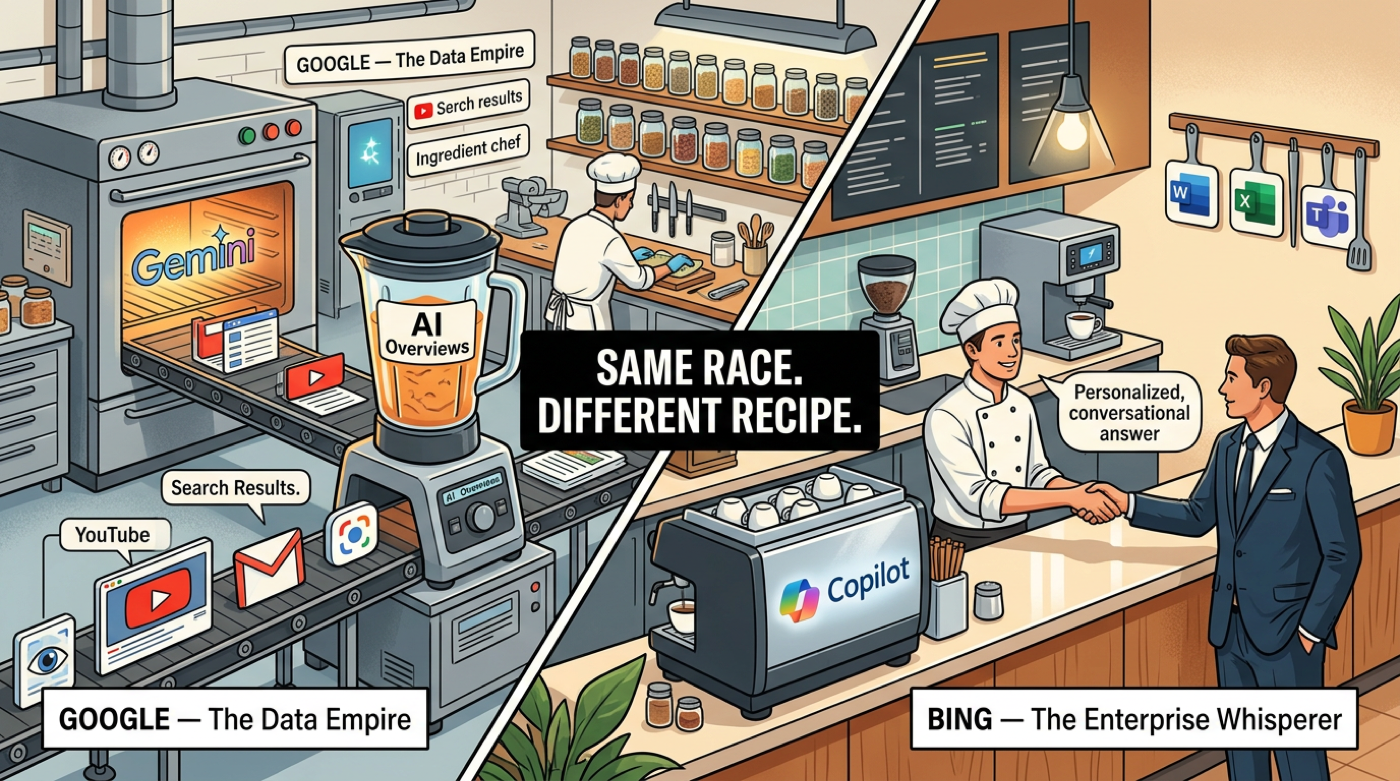
In the first half of May 2026, the two largest companies in web search published guidance on AI search that disagrees at the level of first principles. Google's guide spread across every SEO feed within hours. Microsoft's post came out first, drew far less discussion, and explains more clearly how AI answers are built.
On May 6, Krishna Madhavan, Knut Risvik, and Meenaz Merchant of Microsoft AI published a post on the Bing blog titled "Evolving role of the index: From ranking pages to supporting answers." It is one of the most useful pieces of writing on AI search published this year. Nine days later, on May 15, Google published its guide to optimizing for generative AI features, which says that optimizing for generative AI search "is optimizing for the search experience, and thus still SEO." We argued at the time that Google's framing leaves out most of the map.
Microsoft's post was written before Google's guide existed, yet it reads like a reply to it. One company describes the technical system it operates, and the other describes the business it needs to protect. Microsoft is not neutral either, but its explanation matches what the citation data now shows about how AI engines choose sources.
What Microsoft published on May 6
The subtitle of Microsoft's post, "Same Foundations. Different Optimization Problems.", carries the argument. Traditional search and AI answers share the same crawlers, quality signals, and understanding of the web. What sits on top differs depending on whether the system is ranking pages for a person to click or grounding facts that an AI will commit to in an answer.
Microsoft states the distinction directly. "A common misconception is that grounding replaces search. It does not. Grounding builds on the same foundational infrastructure ... but it adds a new optimization layer on top." The post then sets out the two systems side by side in one table.
| Dimension | Traditional search | Grounding for AI responses |
|---|---|---|
| Primary question | Which pages should a user visit? | What information can an AI system responsibly use to construct an answer? |
| Unit of value | The document (page) | Groundable information, meaning discrete, supportable facts with clear provenance |
| Role of the user | Human evaluates results and self-corrects | User sees a synthesized answer and verifies it by checking cited sources |
| Error dynamics | Imperfect ranking is tolerable and recovery is easy | Errors can compound across reasoning steps |
| Valid outcomes | Return ranked options | Answer when supported, abstain when evidence is insufficient |
| Accountability | Surface relevant options | Provide high-quality evidence that can support a committed answer |
The unit of value is the row that matters most for brands. Ranking works at the level of the page, while grounding works at the level of individual facts that can be extracted, attributed, and checked. A page can rank well and still be poor material for grounding if its facts are buried in prose that resists extraction. Another page can rank lower and get cited often because its facts are dense, sourced, and unambiguous.
The outcomes row matters too. A ranking system always returns options, and a person can skip the ones that do not fit. A grounding system either answers when the evidence supports it or abstains when it does not, because a slightly wrong ranking is recoverable and a slightly wrong grounded answer is a false statement delivered with confidence.
What Google's guide says
Google's guide, last updated in July 2026, is built around reassurance. It says optimizing for generative AI search is still SEO, and most of its advice is a list of things site owners do not need to do. It says there is "no requirement to break your content into tiny pieces" for AI, that structured data "isn't required for generative AI search," and that llms.txt files will "neither harm nor help" visibility because Google Search ignores them. It also says that seeking inauthentic mentions across the web "isn't as helpful as it might seem."
Some of that advice is sound. Google still recommends structured data as part of an overall SEO strategy, and its position on llms.txt matches ours. The gap is in what the guide leaves out. Grounding appears once, as a glossary term for retrieval-augmented generation, and the guide never describes the separate optimization layer that Microsoft names. The idea of a system that abstains when evidence is weak does not appear at all.
For a practitioner, the result is a document that tells you what to stop worrying about without explaining how answers are assembled. Microsoft's post fills that gap.
What the index has to measure for grounding
Microsoft's second table sets out what an index has to measure differently once it feeds answers instead of ranking pages. This is the part with the most consequences for how content is written.
| What to measure | In traditional search | In grounding |
|---|---|---|
| Factual fidelity | Ranking tolerates some mismatch, and the user can click through to interpret | Critical, because chunking and transformations must preserve the meaning and claims used in the answer |
| Source attribution quality | Attribution helps, but users choose what to trust | A core signal, because evidence needs clear provenance and carries varying evidentiary weight |
| Freshness | Stale content mainly reduces ranking usefulness | Stale facts can directly produce wrong answers |
| Coverage of high-value facts | Coverage is broad, and a missing document can often be recovered elsewhere | The facts and sources people ask about have to be retrievable and groundable |
| Contradictions / conflict | The system can rank one source above another and let the user decide | The system must detect and represent conflict, since silent arbitration risks confident wrong answers |
Factual fidelity becomes a hard constraint. When an index chunks and transforms a page, any distortion of a claim turns into a wrong answer, so content needs claims that survive being lifted out of context. Source attribution becomes a core signal, which means named authors, named sources, and visible citation trails work as retrieval inputs, beyond their value to human readers.
Freshness and conflict change in the same way. A stale page in a ranking is a weaker result, while a stale fact in a grounded answer misleads the reader directly. One industry analysis estimates that about half of Perplexity's citations come from content published in the current year, which fits a system designed to avoid stale facts. When two sources disagree, a ranking system can show both and let the reader decide, while a grounding system has to register the contradiction itself or risk asserting the wrong version.
Citation data shows ranking and grounding separating
If ranking and grounding were the same problem, the pages that rank would be the pages AI systems cite. The data shows a growing gap. An Ahrefs study of 863,000 keywords and four million AI Overview URLs found that only 38 percent of pages cited in AI Overviews also ranked in the top ten, down from 76 percent in its July 2025 study.
Other assistants show an even wider gap. A separate Ahrefs analysis of 15,000 prompts found that only 12 percent of links cited by ChatGPT, Gemini, and Copilot appear in Google's top ten for the same prompt, with Perplexity the exception at nearly one in three. Brandlight data cited in a May 2026 report from 5W put the overlap between top Google rankings and AI-cited sources at under 20 percent, down from 70 percent.
Google's own AI Overviews now draw most of their evidence from outside the pages its ranking system places in the top ten. That is the separation Microsoft described, measurable inside Google's own product.
The incentives behind each guide
Google's incentive is to keep AI optimization anchored to Google. Its business benefits when practitioners treat AI search as the same work that succeeds on google.com, so the guide functions partly as a reminder that the playbook still runs through Google's documentation, tools, and surfaces.
Microsoft's incentive points the other way. Bing has been a distant second in traditional search for years, but Microsoft's grounding infrastructure now serves AI products beyond Bing. In a June 2026 post, Risvik described the same infrastructure as powering Copilot and ChatGPT, among other systems. OpenAI has not named its search providers publicly, but ChatGPT's scale is clear, with OpenAI saying in July 2025 that users sent 2.5 billion prompts a day. The more grounding is treated as its own discipline, the more relevant Microsoft becomes.
Both companies are arguing for their own position, which is normal. Microsoft's commercial interest happens to line up with how the systems behave in the citation data, while Google's position requires treating two different problems as one. When we explain AI search to clients, Microsoft's technical description is the more useful document to work from.
Ranking work and grounding work
The optimization work now runs on two tracks. The ranking track is everything Google's guide describes, including technical SEO, helpful and original content, clean indexing, strong organic positions, and real expertise. Microsoft agrees that grounding builds on this foundation, so none of it can be skipped.
The grounding track adds five kinds of work on top of that foundation.
- Design information at the passage level. Lead each section with its claim, keep one idea per paragraph, and attach the supporting number or source to the sentence that makes the claim, so an engine can lift it without summarizing a whole section.
- Treat provenance as a discipline. Named authors, named sources, dated statistics, and inline citations are the signals Microsoft calls core to grounding, so put them on every page you want an engine to trust.
- Commit to freshness at the level of facts. Date the specific figures your audience asks about and review them on a schedule that matches how fast they change, beyond updating the date on the page.
- Remove contradictions across what you own and earn. Audit your site, profiles, and press coverage for conflicting claims about pricing, specifications, dates, and positioning, and reconcile them before an engine picks the wrong version.
- Take Bing seriously. Bing Webmaster Tools is a primary discovery surface for Copilot and for the infrastructure Microsoft says supports ChatGPT, and our guide to connecting Bing Webmaster Tools to Claude makes it easier to monitor.
None of these steps contradicts good SEO, and all of them go further than Google's guide asks. Our post on getting cited by AI search engines covers the citation side in more detail, and our third-party authority playbook covers the contradiction work across earned sources.
How we run the two layers for clients
At Search Agency we work the SEO foundation and the grounding layer as two separate streams, and we measure them separately because the engines treat them separately. Rankings and organic traffic tell us how the ranking track is performing. AI citations, the share of answers that name a client, and the sources those answers draw on tell us how the grounding track is performing.
Read together, the two documents give a fuller picture than either alone. Google describes the ground closest to its own product, and Microsoft describes the layer on top that ChatGPT, Copilot, Perplexity, and increasingly Gemini rely on. Build for both, and treat any advice that stops at "it is still SEO" as half of the guidance.
If you want to see where your brand stands in AI answers today, request an audit benchmarked against your competitors, or talk to us about adding the grounding layer to your search program.
See where your brand stands in AI answers today, benchmarked against your competitors, no pitch required.

How DOKU Became the Most Visible Payment Gateway in Indonesian Search
DOKU was the better-known brand and the worse-ranked one. Eight months of technical repair and four content pillars later, it holds more Top 3 rankings than any payment gateway in the market.
Read post →
How to Fix Crawled and Discovered Currently Not Indexed Pages in Search Console
Google found these pages, sometimes even read them, and still left them out of the index. How to tell the two Search Console statuses apart, and which fixes actually move them.
Read post →
How to Run ChatGPT Ads in Indonesia
ChatGPT ads are now open to Indonesian advertisers. We set up two campaigns in Ads Manager and documented every screen, from the first ad preview to the pixel and context hints.
Read post →