
Google's New AI Optimization Guide Tells You How Google Works. It Does Not Tell You About AI Search.

Contents+
- 01What Google's guide actually says, and why it makes sense for Google
- 02The FAQ schema episode is not a one-off, it is a pattern
- 03The other engines are not running Google's playbook, because they are not running Google's index
- 04What our client traffic actually looks like
- 05Why this matters more than it sounds
- 06What an honest AI optimization stack actually looks like
- 07The mental model to bring into every client conversation
Google just published its AI Optimization Guide, and within twenty-four hours the SEO industry treated it like the final word on how to be visible inside AI. The takeaway being shared on LinkedIn and in client decks is some version of: "Just do SEO. Google says it is still SEO. Forget AEO, forget GEO, forget llms.txt, forget structured chunking, forget everything else."
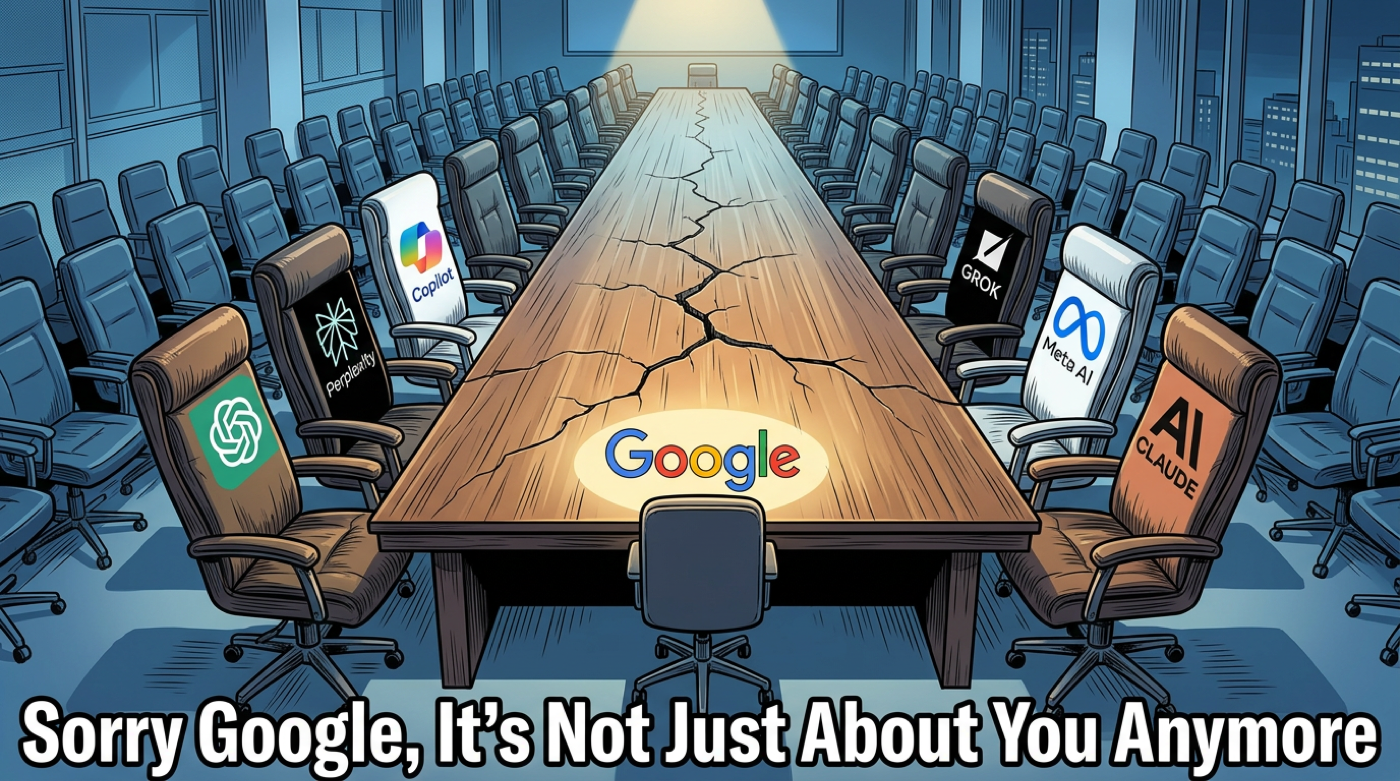
That reading is wrong. Not because the guide is wrong, but because the guide is about one engine, and the industry keeps mistaking one engine for the whole landscape.
This is the same mistake the SEO industry made in 2023, when Google deprecated FAQ rich results and a wave of practitioners ripped FAQ schema out of their templates. They were certain Google had ruled on it. They were wrong about what that ruling meant, and three years later the data shows the cost.
We are about to make the same mistake again, at a much larger scale, on a much more important question. This post is an attempt to stop that.
What Google's guide actually says, and why it makes sense for Google
Read the guide carefully. Google's argument is internally consistent and, for Google's own surfaces, almost certainly correct.
Google says that AI Overviews and AI Mode are "rooted in our core Search ranking and quality systems." It says generative features use retrieval-augmented generation against Google's Search index. It says structured data is not required for AI search. It says you do not need llms.txt files, content chunking, "inauthentic mentions," or special markup. It says, in a single direct sentence, "From Google Search's perspective, optimizing for generative AI search is optimizing for the search experience, and thus still SEO."
Every word of that is defensible inside Google's product. AI Overviews retrieve from the Google index, then ground responses against the same ranking signals that decide the ten blue links. If you do SEO well for Google Search, you are doing the foundational work for AI Overviews and AI Mode too.
But that sentence has a load-bearing qualifier that the industry keeps reading past: "From Google Search's perspective."
Google is not telling you how ChatGPT works. Google is not telling you how Perplexity works. Google is not telling you how Claude works. Google has no incentive to. The guide is exactly what it says it is: how to optimize for generative AI features on Google Search. Reading it as a playbook for the broader AI search landscape is a category error, and clients are going to pay for it.
The FAQ schema episode is not a one-off, it is a pattern
In August 2023, Google announced that FAQ rich results would be limited to "well-known, authoritative government and health websites." In May 2026, Google completed the deprecation: FAQ rich results no longer appear in Search, the rich result report is being removed, and support is leaving the Rich Results Test in June.
The dominant industry reaction was to remove FAQ schema from page templates. The logic, repeated in countless threads and decks, was: if Google does not reward it, why ship it?
Here is what the data actually shows three years later. Pages with FAQPage schema are about 3.2 times more likely to appear in Google AI Overviews than pages without it. FAQ structured data is cited at one of the highest rates of any markup type by ChatGPT, Perplexity, and Google AI Overviews. Google itself explicitly told the industry, in writing, that it would continue using FAQ structured data to better understand pages, even after the rich result was gone. The teams that ripped the schema out followed Google's headline and missed Google's actual statement, and they lost a meaningful chunk of citation eligibility in the process.
The lesson is not "always trust Google's documentation," and it is not "never trust Google's documentation." The lesson is more specific. Google publishes guidance about Google. When practitioners generalize that guidance to the broader search ecosystem, they break.
That is the lens to read the AI Optimization Guide through.
The other engines are not running Google's playbook, because they are not running Google's index
Here is what almost everyone reposting the Google guide is leaving out. The major generative engines do not share an index, do not share a retrieval pipeline, and do not share a citation logic.
ChatGPT search retrieves through Bing's index. That is not speculation: it is documented in Microsoft's IndexNow integration, in OpenAI's own product announcements, and in how SearchGPT responses populate. If a page is not crawlable by Bing, it does not exist for ChatGPT.
Perplexity runs its own crawler against a proprietary index of more than 200 billion URLs. The ranking layer applies entity-level authority, recency weighting, and source diversity filters that look nothing like Google's ranking system. Perplexity is also the most freshness-sensitive engine of the major four, with citation rates roughly twice as high for content published in the last thirty days compared with older content.
Claude defaults to Brave Search for its real-time retrieval, with separate behavior for documents passed in directly by developers. It cites blogs and user-generated content at two to four times the rate of other models in many verticals, particularly food, travel, and consumer products.
Google AI Overviews and AI Mode retrieve from Google's own index, which is where the AI Optimization Guide is directly authoritative.
When the same query is run across these four engines, only about 11% of cited domains overlap between ChatGPT and Perplexity. Roughly 71% of cited sources appear on only one platform. The same article that gets pulled into a ChatGPT response will frequently be invisible inside Perplexity for the same question, and vice versa. There is no universal "AI SEO." There is a layered set of retrieval systems with different mechanics, and you have to engineer for each.
What our client traffic actually looks like
We pulled the GA4 numbers from a Search Agency client whose business depends on a global, diverse audience. We will keep the brand anonymous, but the pattern is what matters, not the logo.
In Q1 2025, AI engines were a rounding error in this client's traffic. ChatGPT sent 361 sessions across three months. Gemini sent around 25. Perplexity, across all of its variants, sent about 250. Copilot sent roughly 80. Claude was below ten. Nobody on the team would have built a strategy around that volume, and they did not.
One year later, Q1 2026 looks completely different. The full breakdown by engine, side by side, is below.
| Engine | Q1 2025 Sessions | Q1 2026 Sessions | Growth |
|---|---|---|---|
| ChatGPT | 361 | 20,139 | 55x |
| Gemini | ~25 | 356 | 14x |
| Perplexity (all) | ~250 | 640 | 2.5x |
| Copilot | ~80 | 162 | 2x |
| Claude | less than 10 | 46 | New |
Now look at that mix through the lens of the Google AI Optimization Guide. Google's surfaces (Gemini and AI Overviews traffic, which lands as Google-source in GA4 and would mostly not show up as a separate engine in this breakdown) are part of the story, but they are not the dominant share of AI-referred traffic for this client. The single biggest AI driver is an engine that does not retrieve from Google's index at all. The second-fastest-growing engine after ChatGPT is Gemini, which does run on Google's stack. The third, Perplexity, runs on its own. The fourth, Copilot, runs on Bing with Microsoft's own retrieval and answer layers stacked on top. The fifth, Claude, runs on Brave plus a heavy dose of user-validated content.
A practitioner who treated Google's guide as the master playbook would have optimized hard for the second largest channel in this stack and would have left the largest one (ChatGPT, 95% of AI sessions) to chance. That is the cost of mistaking one engine for the landscape.
Why this matters more than it sounds
The temptation, reading numbers like 21,015 sessions in a quarter against the millions of Google organic visits most enterprise sites still pull, is to dismiss AI search as a side channel that does not deserve dedicated attention. We hear this in every conversation with a head of marketing who has been doing this for fifteen years.
The dismissal misses two things.
The first is the trajectory. A 55x year-over-year lift on the largest AI engine, off a non-trivial base, is not a side channel. That curve has the same shape as mobile traffic in 2010 and the same shape as social referral in 2013. The teams that started building for those channels two years before the rest of the market won the next decade. The teams that waited paid for the catch-up.
The second is the conversion quality. Across multiple measurement frameworks, AI-referred traffic is converting at roughly 14% versus 2.8% for traditional organic. Perplexity-referred traffic converts at approximately three times the rate of standard Google organic for B2B clients in independent agency portfolios. These are not casual browsers. They are people who already had their question answered by a synthesis layer and chose to click through anyway, which makes them a more qualified audience than a typical SERP click. The volume gap shrinks fast when you adjust for intent quality.
The third point, which gets less airtime, is structural. Google's organic CTR for informational queries with AI Overviews is down 61% from the pre-AI baseline. Publishers report search dropping from 44% to 37% of their total traffic across a three-year window. The base that funds the "Google is still 95% of search" argument is eroding underneath the argument. Even if you only cared about Google, the rational response is to diversify into the channels that are growing while Google's organic share is shrinking.
What an honest AI optimization stack actually looks like
Once you accept that the landscape is layered, the optimization work changes shape. It is not "do SEO, ignore the rest," and it is not "panic and bolt on every new acronym." It is a small number of moves, each tied to a specific engine's actual mechanics.
For Google's AI surfaces, the AI Optimization Guide is correct as written. Strong technical SEO, helpful and non-commodity content, clean semantic HTML, indexed and crawlable pages, E-E-A-T signals. Pages that rank in the top ten organically are about 65% more likely to be cited inside an AI Overview than pages outside the top ten. The classical work is the foundation, exactly as Google says.
For ChatGPT, the controlling variable is Bing's index, not Google's. If your Bing Webmaster Tools account is neglected, if you are not submitting to IndexNow, if your Bing crawl errors have been ignored for two years because the team only watched Search Console, you are invisible to ChatGPT regardless of how well you rank on Google. Treat Bing as a first-class citizen.
For Perplexity, recency is the dominant variable. Content published or substantively updated in the last thirty days has roughly double the citation rate of older content. A page-by-page freshness program, not a wholesale republish, moves Perplexity visibility more than any other single intervention. Reddit appearance also matters disproportionately: Perplexity cites Reddit at about 47% of top-cited domains. If your brand has no presence in the relevant subreddits, you are missing the surface Perplexity leans on most.
For Claude, user-generated content and blog citation patterns dominate. Review surfaces, owned thought-leadership content, and named author bylines all carry more weight than they do on the other engines. This is where the brand reputation work pays off most directly.
For Google AI Overviews, the FAQ schema example tells you what to do: keep the structural signals Google explicitly says it still uses, even when Google says they no longer trigger a visible rich result. The schema is doing more work than the SERP feature ever was. Strip it at your own cost.
Across all four engines, the structural moves that travel well (clean extractable paragraphs under question-shaped headings, statistics with named sources, direct quotes from named experts, fluent declarative sentences that survive verbatim quotation) raise citation rates in every system. That is the layer where the universal advice lives. It is much smaller than the industry pretends.
The mental model to bring into every client conversation
Google's AI Optimization Guide is a good document about Google. It is not a guide to AI search. Anyone presenting it as the full map is either misreading it or has not looked at where the traffic and conversions are coming from.
The complete landscape is layered. Different engines run different indices, use different retrieval logic, and cite different source types. The SEO work that wins on Google is necessary but not sufficient. The teams that win the next two years will be the ones who treat each engine as a real channel with its own mechanics, instrument for it in GA4, and stop assuming that Google's word is a universal ruling.
The FAQ schema story is the warning label on this entire conversation. When Google ruled, the industry overgeneralized, and the cost did not show up until three years later when AI citation patterns made the removed schema valuable again. The cost of overgeneralizing the AI Optimization Guide will show up faster, because the channels that the guide does not cover are growing in real time, not waiting in the wings.
The Search Agency position is the same one we have held for two years now. SEO is necessary. SEO is not the whole job. AI search is a layered system, and the layers do not collapse just because one of the largest players in the layer publishes a tidy document.
If your strategy stops at Google's guide, you are optimizing for one engine in a landscape of five, and the engine you are optimizing for is not even the largest source of AI referrals for most of the businesses we work with. Fix that before the next quarterly review.
Sources:
See where your brand stands in AI answers today, benchmarked against your competitors, no pitch required.

How to Use the Google Search Console MCP in Your SEO Process (6 Real Workflows)
Six Google Search Console MCP workflows we run on search.agency, each with the exact prompt, the tool it calls and the real output it returned.
Read post →
How DOKU Became the Most Visible Payment Gateway in Indonesian Search
DOKU was the better-known brand and the worse-ranked one. Eight months of technical repair and four content pillars later, it holds more Top 3 rankings than any payment gateway in the market.
Read post →
How to Fix Crawled and Discovered Currently Not Indexed Pages in Search Console
Google found these pages, sometimes even read them, and still left them out of the index. How to tell the two Search Console statuses apart, and which fixes actually move them.
Read post →