How Indonesian Businesses Can Claim Their Profile in ChatGPT Business Hub


Contents+
- 01What Businesses in ChatGPT is
- 02What an Indonesian business can use today
- 03How to claim your business in ChatGPT
- 04Who inside the company should hold the claim
- 05What the insights numbers count
- 06What claiming a profile does not change
- 07Business Agents and ads are limited to the United States
- 08What to prepare while OpenAI reviews your claim
You claim your business in ChatGPT through Business Hub, a dashboard that OpenAI opened in beta on 10 November 2026. You sign in to ChatGPT, find your business, prove that you represent it, and then pass an identity check. Once that is done, you can correct the details ChatGPT shows about your brand and see how often it mentions you and sends people to your website.
Most of the launch coverage was written for American online stores, because the headline feature is a chat agent that speaks for a brand inside ChatGPT, and that agent is only open to US businesses for now. The parts that matter to an Indonesian business are the profile and the numbers behind it. I started the claim for Search Agency from Indonesia the day after launch, so the steps and the screenshot here come from our own account and from OpenAI's documentation.
What Businesses in ChatGPT is
Businesses in ChatGPT is OpenAI's name for a set of tools that let a company manage how it appears inside ChatGPT. The closest comparison is Google Business Profile, which has let companies manage their listing on Google Search and Maps for years. TechCrunch described the launch as ChatGPT becoming a little more like Google, and that is a fair way to explain it to a management team that has never heard of it.
The launch has three parts, and they are worth separating because they have different rules. The first is the business profile, which is the page a person sees when they click on your business in a ChatGPT answer. The second is the insights dashboard, which reports how people come across your business in ChatGPT. The third is the Business Agent, a chat assistant that answers customer questions on behalf of the business.
All three are managed from one place called Business Hub, which sits in the ChatGPT sidebar and at chatgpt.com/business-hub. OpenAI says ChatGPT reaches 1.2 billion people each week, according to The Next Web's report on the launch, which explains why a profile there deserves the same attention a Google listing gets. OpenAI's own summary is on its Businesses in ChatGPT page and in the launch announcement.
What an Indonesian business can use today
An Indonesian business can apply to claim its profile and, once verified, manage its information and view insights. The Business Agent is the part that stays closed for now. OpenAI's announcement says any eligible business located where ChatGPT is available can claim through Business Hub, while its launch post limits the agent to eligible ecommerce and online service businesses in the United States.
| Feature | What it does | Status for Indonesian businesses |
|---|---|---|
| Business profile | Shows your business details and a verified badge when someone opens your business from a ChatGPT answer | Open to claim, subject to eligibility and verification |
| Insights | Reports mentions, profile views, website clicks, and discovery topics | Available after the claim and identity check are approved |
| Product feed | Lets you supply products with current prices and availability | Part of the verified profile, most useful to online sellers |
| Business Agent | Answers customer questions in a labelled chat that is separate from ChatGPT's own answers | Limited to eligible US ecommerce and online service businesses |
| Sponsored agent | Uses the Business Agent as the destination for ChatGPT Ads | Tied to the agent, so not available here yet |
The word "eligible" carries real weight in OpenAI's wording. Its help article on setting up a business says a claim is possible where ChatGPT is available and the required verification is supported, and OpenAI has not published a list of countries or business types. I would treat any agency or vendor that promises a guaranteed approval with caution, because nobody outside OpenAI knows the full rules yet.
On cost, OpenAI lists no price for claiming a profile, and VentureBeat reported that both the profile and the agent are free at launch. A claim does not require an advertising account or an enterprise contract with OpenAI.
How to claim your business in ChatGPT
The claim takes six steps, and two of them are separate approvals that people tend to confuse. OpenAI first approves your claim over the business, and then a verification partner called Persona checks the identity of the person making the claim. You need both before you can publish anything.
- Sign in to ChatGPT with the account that should manage the business, which for most companies means a work email address.
- Open Business Hub from the sidebar and search for your business by name, or add it if it is not listed.
- Prove your connection to the business with one of the methods OpenAI offers, which launch documentation lists as a business phone number, a business email address, a DNS record on your domain, or a Shopify store.
- Wait for OpenAI to review the claim.
- Complete the identity check with Persona, which asks for a government-issued ID.
- Edit your business information and publish the changes once both approvals are in place.
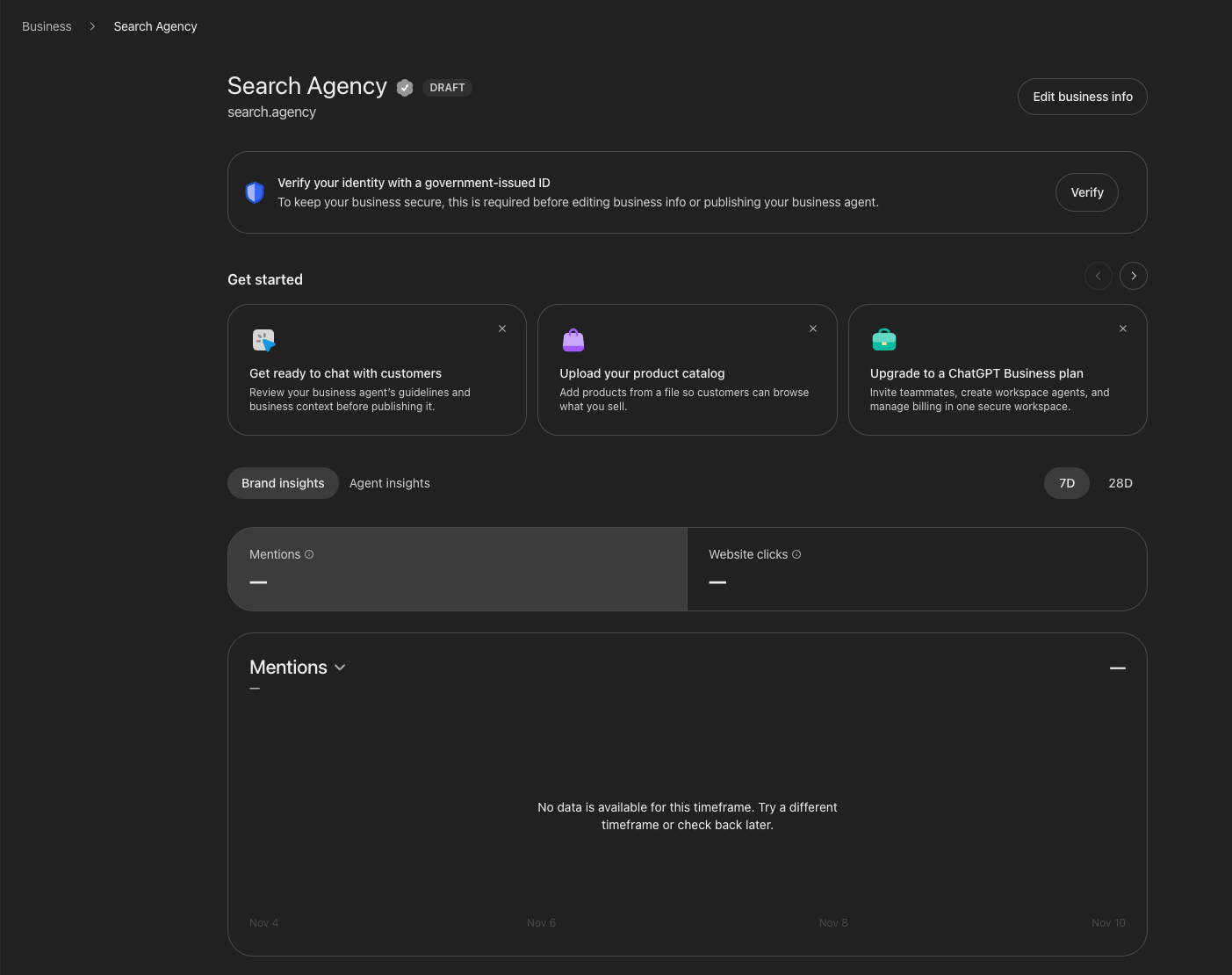
Our own account shows where the process pauses. After the claim, the Search Agency profile appeared in Business Hub with a Draft label and a banner asking me to verify my identity with a government-issued ID. The banner states that this is required before editing business information or publishing a business agent, so the profile cannot be changed until the check is complete.
The same account also shows an Agent builder and a Products menu in the sidebar. I have not tested whether an Indonesian business can publish an agent from there, and OpenAI's stated eligibility says it cannot yet, so I would read those menus as a preview of what will open later.
Who inside the company should hold the claim
The person who claims the profile should be an employee with the authority to represent the business, using a company account. The identity check is personal, which means a named individual submits their own ID, and the profile is then tied to the account they used. A claim made from a personal Gmail address or by a staff member who leaves next quarter creates the same recovery problem companies already know from lost Google Business Profile logins.
For the same reason, I do not think an agency should claim a profile on a client's behalf. We are asking our clients to make the claim themselves, while we prepare the business information and report on the insights. The ownership stays with the brand, and the agency does the work around it.
In a larger company the first question is which team owns this at all. It could sit with digital marketing, corporate communications, or the team that manages the website, and the answer affects who approves the wording on the profile. I wrote about that decision in who owns AI search inside an enterprise, and a Business Hub claim is a practical reason to settle it.
What the insights numbers count
Business Hub insights report four things about how people meet your business in ChatGPT. The dashboard in our account offers a 7 day and a 28 day view, with separate tabs for brand insights and agent insights.
- Mentions show how often ChatGPT referred to your business.
- Profile views show how many times people opened your business profile.
- Website clicks show how many visits ChatGPT sent to your site.
- Discovery topics show the common themes of the answers where your business appeared.
The definition of a mention is narrower than most people expect. OpenAI's help article says that for an online business, a mention counts when ChatGPT references the business's website. An answer that names your brand without pointing to your site may therefore go uncounted, which means this number will not match the brand mention counts from third-party tracking tools. Both numbers are useful, and they measure different things.
Two more limits are worth knowing before you promise this data to your management. The figures are aggregated, and OpenAI states that it does not share users' conversations or Business Agent chats with businesses, so you will see totals and topics and never the questions themselves. Early write-ups of the help documentation also note that insights only appear once there is enough activity, and our own dashboard was blank on the first day.
Website clicks are the number I expect to matter most in reporting, because they can be compared with the ChatGPT referral traffic you already see in your analytics. We ran a test on our own site to see whether AI citations produce qualified demand, and first-party click data from OpenAI will make that kind of analysis easier to repeat.
What claiming a profile does not change
Claiming a profile does not make ChatGPT recommend your business more often. OpenAI says ChatGPT will keep making independent recommendations and comparisons, and VentureBeat's coverage notes that a claim carries no guarantee of better placement or more sales. The profile controls what people see after they click on your business, while the answer that led them there is still written by the model.
The profile is also only one of the sources ChatGPT draws on. OpenAI's profile policy says a profile may include information from other sources and that OpenAI does not verify every detail a business supplies. If your website, your marketplace listings, and old press articles disagree about your products or your branches, the model can still repeat the wrong version in an answer.
Hotel groups are a common case, and I covered it in when AI confuses properties within a hotel brand. Banks face a stricter version of the same problem, which I discussed in who owns wrong AI answers about bank products. A verified profile helps with accuracy, and the work of getting your brand into the answer in the first place stays the same as before.
Business Agents and ads are limited to the United States
A Business Agent is a chat assistant that answers questions using information the business provides, and for now only eligible US ecommerce and online service businesses can publish one. When such a business appears in a ChatGPT answer, a person can open its profile and start a conversation with the agent. OpenAI labels that conversation clearly and keeps it separate from ChatGPT's own answers.
The agent is also an advertising product. A business can sponsor its agent and use it as the destination for ChatGPT Ads, and The Next Web reported that OpenAI says paying does not change how often ChatGPT recommends a business. If your team is already buying ChatGPT Ads, our note on the retirement of Max Bid and Max CPC covers a bidding change that arrives on 1 January 2027.
OpenAI has said it plans to expand both the profiles and the agents to more markets and business categories. I would not build a 2027 plan around an agent launch date for Indonesia, because none has been announced. The sensible preparation is the same information an agent would need later, which is accurate product details, prices, and policies that are kept up to date on your own website.
What to prepare while OpenAI reviews your claim
The waiting period after a claim is the best time to record a baseline. Before the profile goes live, ask ChatGPT the questions your customers ask about your category and save the answers with the date. Do this in both Indonesian and English, since the language of a prompt can affect the brands an AI assistant names, a question we examined in whether prompt language changes brand recommendations. Without that record, you will have no way to tell what changed after the claim.
The second job is to agree on one version of your business details. A short list is enough for most companies.
- The legal name and the brand name, written the same way everywhere.
- A one paragraph description of what the business sells and who it serves.
- The official website, customer service contacts, and operating hours.
- Current products or services with prices where you publish them.
That list should match your website, your structured data, and your Google and Bing listings before it goes into Business Hub. If you have not reviewed how your site is exposed to AI systems recently, our walkthrough of Bing's AI training and grounding controls is a useful companion, since Bing's index supports more than one AI assistant.
The third job is to add the claim date to your reporting calendar, so that any later movement in ChatGPT referral traffic can be read against it. This is also a natural point to review the wider plan. Our post on what an AI search audit should change in your marketing plan explains how we connect findings like these to budget decisions. If you would like us to prepare the baseline and the business information for your claim, that work is part of our AI search service, and you can reach the team through the contact page.
See where your brand stands in AI answers today, benchmarked against your competitors, no pitch required.
Related reading
All posts →
In Google's AI Mode, the source getting cited most is Google itself
A study of 50,000 commercial keywords found Google has become the second most-cited source inside its own AI Mode, by pulling from its own Business Profiles and Knowledge Panels. That rewrites the local SEO playbook.
Read post →
How to See What Your Business Really Needs in AI Search
Before you buy a tool or hire someone to "do GEO", run the free checks that show how AI systems read your business. What comes back is your real to-do list.
Read post →
The Brand Risk Almost Nobody Is Defending In AI Search
AI tools can repeat a wrong or hostile claim about your brand to every buyer who asks. Here is how the attacks work and how to defend the narrative.
Read post →