
Why GA4 Hides the Buyers ChatGPT Persuaded


Contents+
- 01How a ChatGPT answer becomes an organic Google visit
- 02What the GA4 AI Assistant channel counts and what it misses
- 03What the research says about AI-influenced visits
- 04What our own GA4 showed on search.agency
- 05Why the economics of influence change the budget decision
- 06Signals that show AI influence outside the AI Assistant channel
- 07How Search Agency measures and builds AI search influence
Most of the buyers ChatGPT persuades never show up in GA4 as AI traffic. They read the answer, close the app, search the brand name on Google a few days later and land on the website as an organic visit. Similarweb found that 56% of visits influenced by a ChatGPT recommendation arrived through search, compared with about 40% of ordinary visits.
That gap matters because many business owners now open the AI Assistant channel in GA4, see a fraction of a percent of sessions, and decide that AI search can wait until next year. The figure in that row is accurate for what it measures, which is clicks on links inside an AI answer. It tells you very little about how many people the answer convinced, because most of that influence is sitting in your Organic Search and Direct rows under a different label.
How a ChatGPT answer becomes an organic Google visit
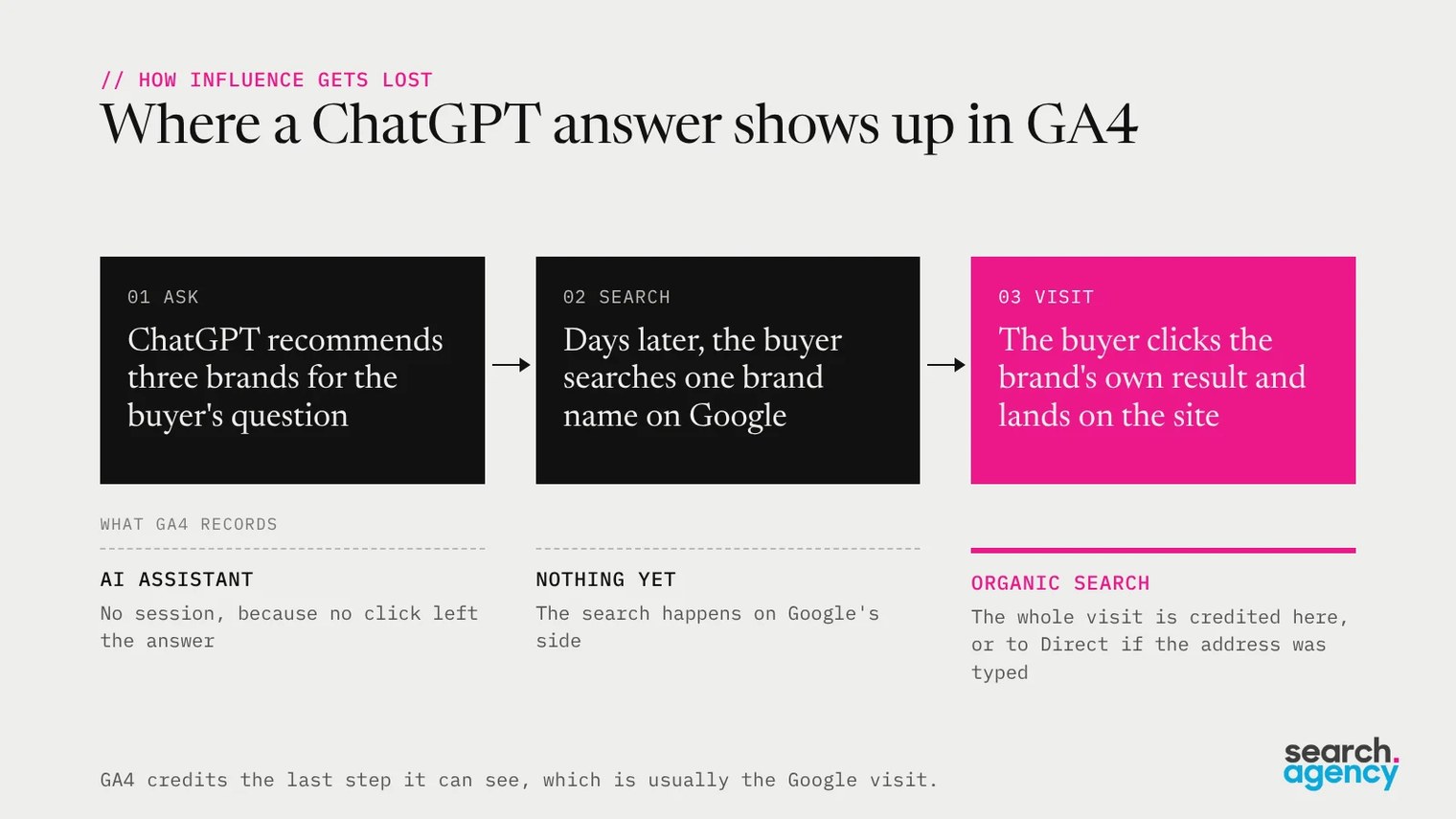
The path from an AI answer to a sale rarely runs through a single click. For a considered purchase, the sequence usually runs through five steps.
- A buyer asks ChatGPT a category question, such as which payroll software suits a company of 50 people in Jakarta.
- ChatGPT names three brands and explains how they differ on price, features and support.
- The buyer closes the chat to think about it, often on a phone during a commute.
- A day or a week later, they type one of those brand names into Google, sometimes on a laptop at work.
- They click the brand's own result, and GA4 records the session as Organic Search, or as Direct if they typed the address.
People take that detour through Google because search is where they check what an assistant told them. A Nielsen Norman Group study found that users turn to traditional search when they need accuracy, control and trusted sources, while AI helps them narrow down vague questions with many requirements. The two habits sit side by side. Similarweb reported that 95% of ChatGPT users also use Google, a share that held through May 2026.
So the influence and the visit happen in different places, on different days and often on different devices. Analytics tools record the last step they can see, which is the Google click or the typed address. We covered the idea of an influence layer in our earlier piece on measuring SEO influence in the age of AI search, and the same logic now applies to every brand that ChatGPT names in a category answer.
What the GA4 AI Assistant channel counts and what it misses
Google added an AI Assistant channel to the Default Channel Group in May 2026. Sessions from recognised assistants such as ChatGPT, Gemini and Claude now get their own medium and their own row in acquisition reports, with no custom setup required. That is a real improvement over the custom channel groups many teams built by hand, which we described in our GA4 measurement framework for the AI search era.
The channel decides where a session belongs by reading the referrer, the piece of information a browser passes along to say which site sent the visitor. When that referrer is missing, the session falls into Direct. Links opened from mobile apps often lose it on the way to the browser. ChatGPT adds a tracking tag to most of its links, which helps, yet in October 2026 that tag and the referrer both disappeared during the GPT-6 rollout, and ChatGPT traffic dropped while Direct rose on many sites. Adobe's Cedric Huesler later reported that it was a bug and the tags came back, but the week showed how fragile the whole count is.
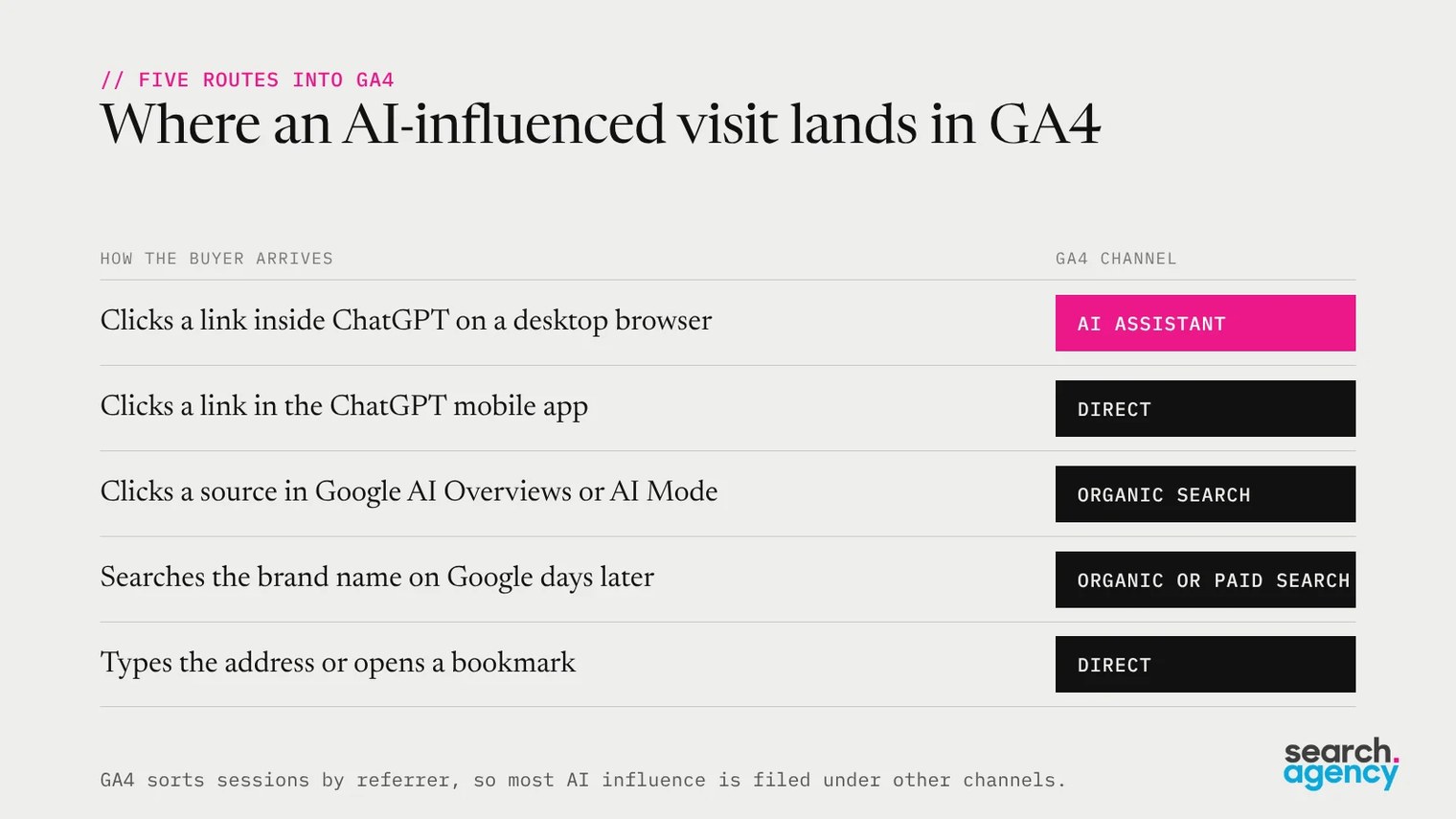
Google's own AI products never reach the channel at all. Clicks from AI Overviews and AI Mode pass a google.com referrer. GA4 files them under Organic Search. Search Console counts AI Mode clicks, yet it blends them with ordinary search data, a limit we looked at in Search Console's generative AI report. Put together, the same AI-influenced buyer can land in five different places.
- A click on a link inside ChatGPT on a desktop browser lands in AI Assistant.
- A click from the ChatGPT mobile app can land in Direct when the referrer is stripped.
- A click from a Google AI Overview or AI Mode answer lands in Organic Search.
- A branded Google search a few days later lands in Organic Search, or in Paid Search if your brand ad wins the click.
- A typed address or a saved bookmark lands in Direct.
What the research says about AI-influenced visits
The number most business owners see is small. SE Ranking's 2026 study found that AI platforms account for 0.32% of all website traffic, roughly one visit in every 312, with ChatGPT sending about three quarters of it. On its own, that figure makes AI search look like a rounding error next to Google.
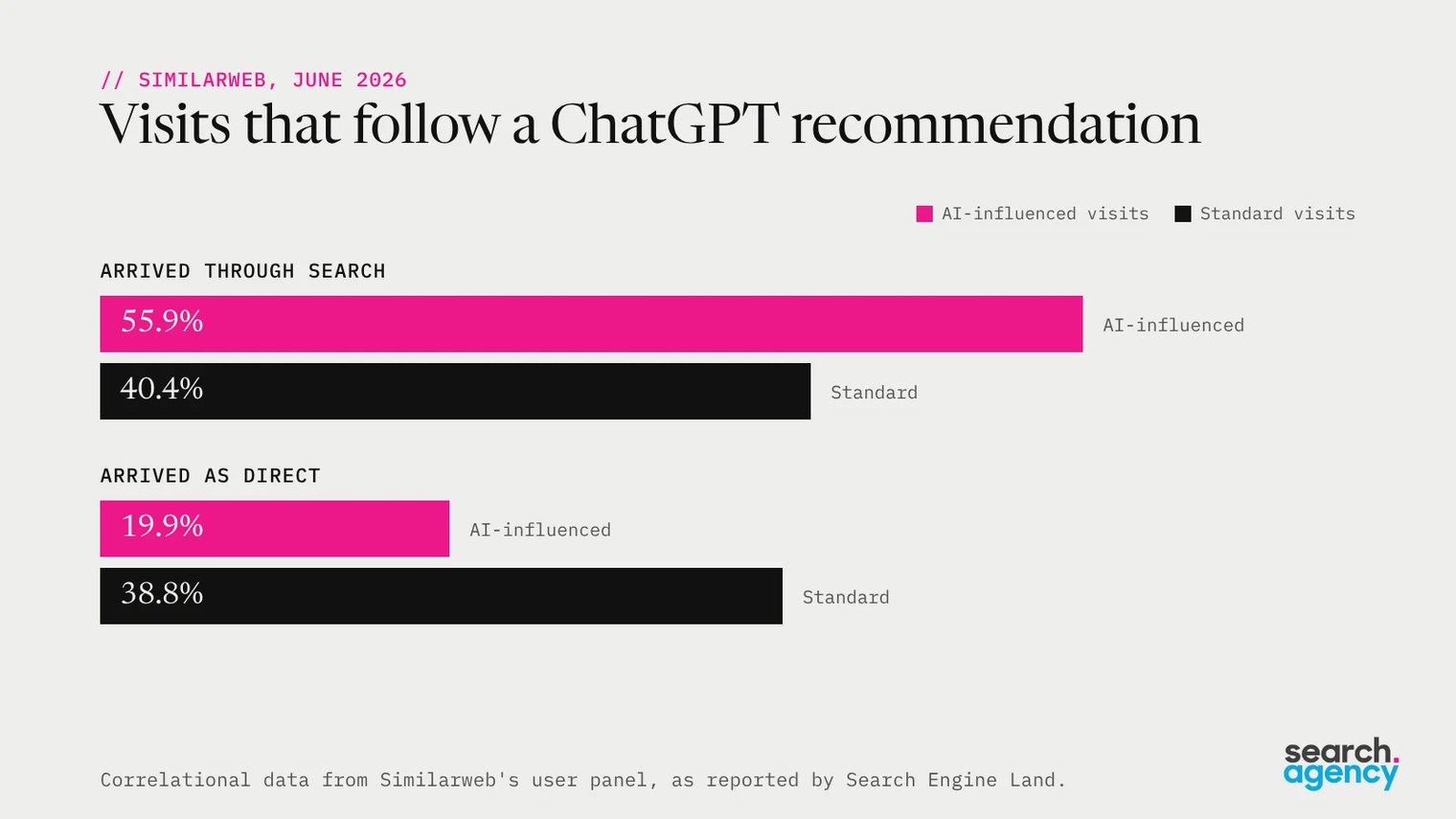
Similarweb's June 2026 study looked at the visits that follow an answer instead of the clicks inside it. It tracked users in finance, travel and beauty who asked ChatGPT a category question, and it excluded anyone who had visited the brand before or named the brand in the prompt. Brands that ChatGPT recommended were 2.5 times more likely to receive a visit within seven days, and when the answer recommended a competitor, the visit went to that competitor. Search Engine Land's summary of the report adds the channel split, where search brought 55.9% of AI-influenced visits against 40.4% of standard visits, and Direct brought 19.9% against 38.8%. Influenced visitors also viewed about twice as many pages and stayed about twice as long.
Those numbers come from Similarweb's own user panel and are correlational. They show a pattern without proving cause. The pattern still fits Indonesia closely. ChatGPT held 81% of AI chatbot usage in Indonesia in June 2026, while Google still took almost 94% of the combined Google and ChatGPT share. Indonesian buyers ask the assistant and finish on Google, which is the exact route that hides the assistant's role.
What our own GA4 showed on search.agency
Earlier this month we published a test on our own site that asked whether AI citations produce qualified demand. Since GA4 started collecting data in December 2022, 601 of our 132,793 sessions came from recognised AI referrers, or 0.45%. The share rose to 2.32% of sessions in weeks 27 to 44 of 2026, which is growth, but still a small slice of the site.
Over the same comparison, branded Google clicks rose from 199 to 348, and direct sessions grew from 254 in April to 1,632 in October. Weekly AI referrals and branded Google clicks moved together with a correlation of 0.47 across 44 weeks. Our paid search bursts, webinars and ordinary SEO work were all running in that period as well. We credited none of the branded or direct growth to AI, and the study ended with the verdict that the data could not tell.
The lesson for a business owner sits in what we would have concluded from the AI Assistant row alone. We would have judged AI search on 0.45% of sessions, while the two rows most likely to carry its influence were growing much faster. The responsible reading is that the AI Assistant number is a floor, and that the rest of the effect needs a different kind of measurement to see.
Why the economics of influence change the budget decision
Budgets tend to follow whatever the channel report says. A channel credited with a fraction of a percent of sessions gets a fraction of the attention, while organic search collects credit for demand that started somewhere else. The person signing off on next year's plan sees organic search performing well and AI search barely registering, and both conclusions rest on the same misattribution.
The first cost of that misreading lands on the answer itself. Similarweb found that when ChatGPT recommended a competitor, the visit went to the competitor, and a brand that is left out of the answer never receives the branded search at all. No report shows a visit that never happened. The loss stays invisible until sales start asking why enquiries in a category are slowing down.
The second cost lands on the branded results page on Google. A buyer who searches your name after an AI recommendation may find a marketplace listing, an old review or a competitor's ad above your own site, and the demand the answer created leaks away before it reaches you. This is why we treat AI visibility and classic SEO as one system, a point we argued in why you still need to rank in traditional search. The answer creates the intent, and your search presence decides whether you collect it.
Signals that show AI influence outside the AI Assistant channel
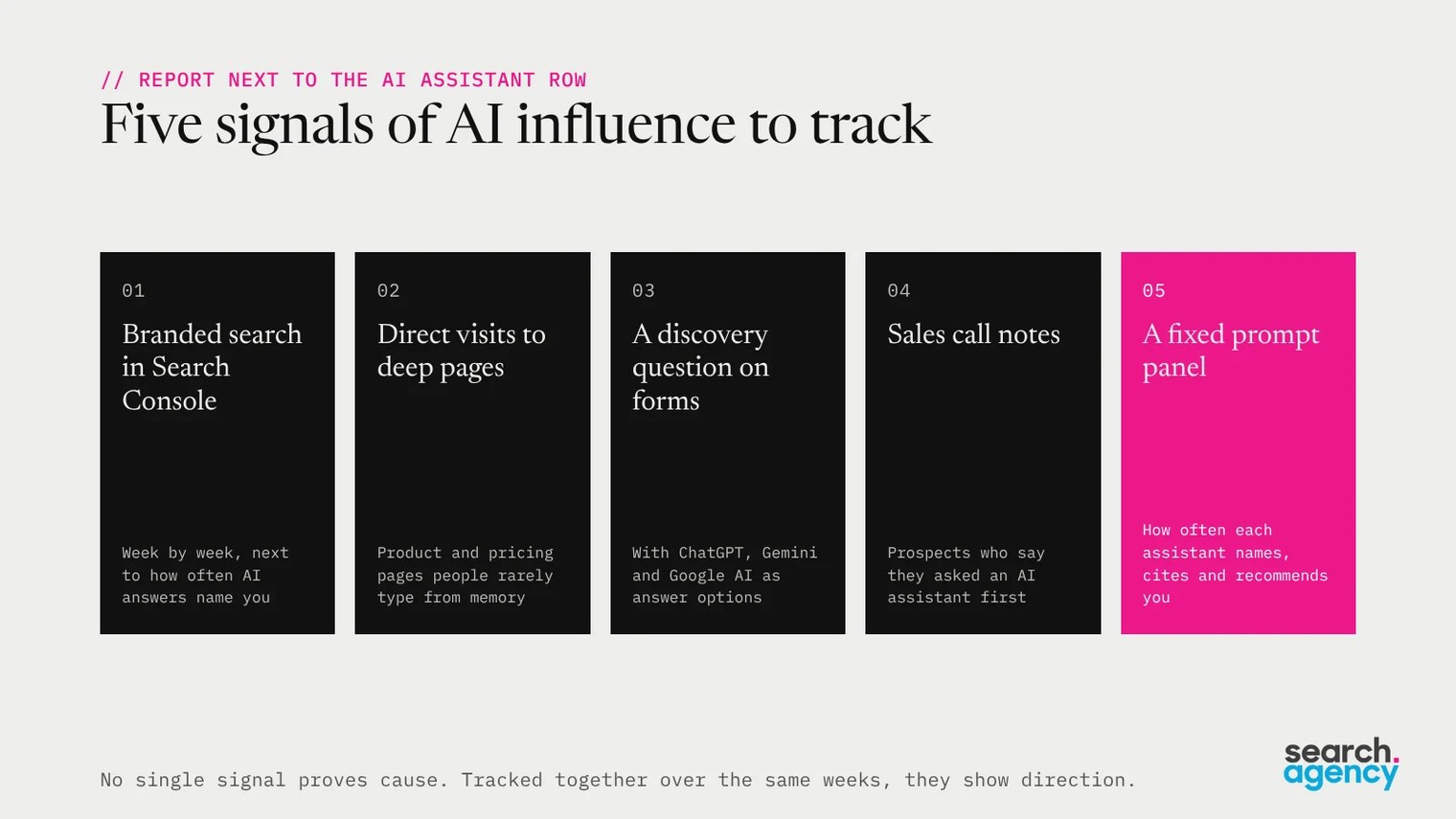
None of these signals proves cause by itself. Read together and tracked over the same weeks, they show whether AI answers are moving demand toward you or away from you, which is the question a budget holder needs answered.
- Branded search impressions and clicks in Google Search Console, compared week by week with how often AI answers name your brand.
- Direct sessions that land on deep pages such as product, pricing or location pages, which people rarely type from memory.
- A "How did you first hear about us?" field on enquiry forms that lists ChatGPT, Gemini and Google's AI answers as options.
- Sales call notes in which prospects mention asking an AI assistant before they contacted you.
- A fixed set of buyer prompts, run on a schedule, that records how often each assistant names, cites and recommends you against named competitors.
The prompt set is the piece most companies are missing, because it measures the answer directly instead of guessing at it from clicks. Our guides on measuring AI share of voice and measuring your brand's visibility in AI search cover how to build one. It also helps to agree on these definitions with your agency before the work starts, which is the purpose of a search measurement contract.
How Search Agency measures and builds AI search influence
Our AI Search Reporting starts with a named set of buyer prompts that we agree with you and then freeze, weighted across branded, category, comparison, problem-solving and recommendation questions. We run those prompts every week in clean sessions on ChatGPT, Gemini, Perplexity and Google AI Overviews by default, and report mention rate, citation share, recommendation rate, share of voice, a published visibility score, and AI-attributed traffic that includes modeled branded-search lift. That last figure is labelled correlational in every report, because the evidence above does not support anything stronger.
Measurement shows where your brand stands in the answers, and the GEO and AEO work changes what those answers say. We run it on Total Graph Authority, which builds the first-party, social and third-party sources that assistants read before they recommend a brand. The branded results page is part of the same scope. A buyer who searches your name after an AI recommendation should find your site above any marketplace listing or competitor's ad.
If your AI Assistant row looks too small to matter, our free AI search audit shows how often the answers that shape your buyers name you, and which competitors they name instead. It covers 20 prompts and three competitors, and you receive a 15-page report with a 30-minute walkthrough within five business days.
See where your brand stands in AI answers today, benchmarked against your competitors, no pitch required.
Related reading
All posts →
How to Measure Your Brand's Visibility in AI Search
To measure your brand's visibility in AI search, you test the real prompts your buyers use across ChatGPT, Gemini and Perplexity, then record whether your brand appears, how it is described, and who is cited instead of you. Tracked over time, those three data points become a clear picture of your AI share of voice and whether your GEO work is paying off.
Read post →
A GA4 Measurement Framework for the AI Search Era
Most GA4 setups measure traffic and stop there. When AI answers absorb the click, the visits you do get matter more and need measuring more carefully. Here is a GA4 setup that reports intent and quality across discovery, interaction and conversion.
Read post →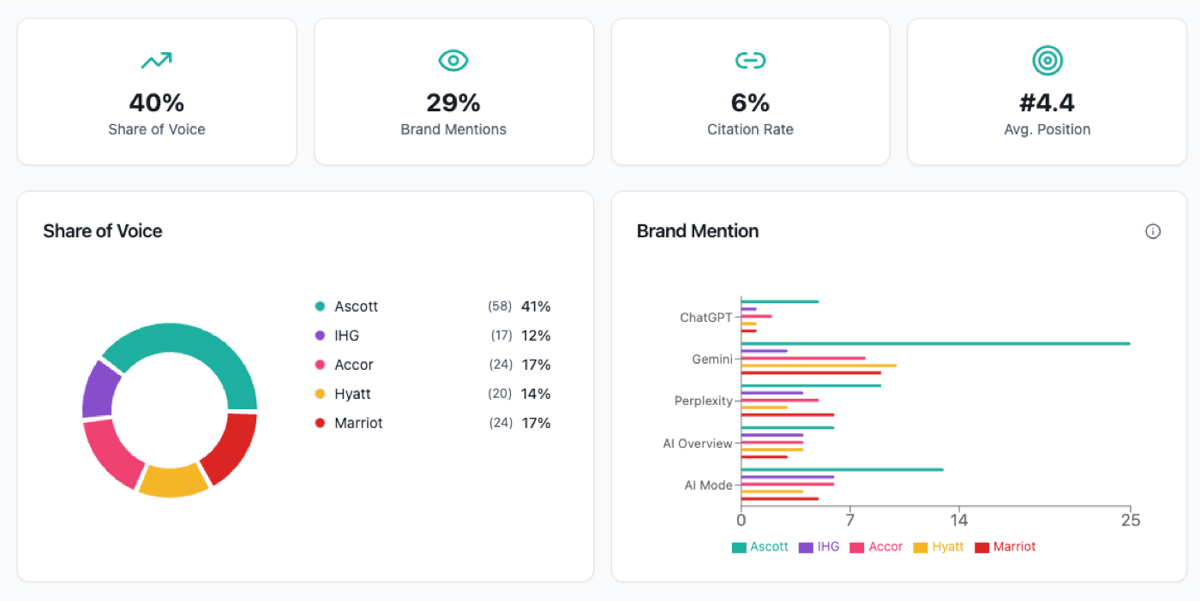
How to Measure AI Share of Voice for Your Brand
AI Share of Voice shows how often ChatGPT, Perplexity, and Gemini name your brand. Inside the measurement discipline that replaces rank tracking.
Read post →