
Three Factors an AI Citation Audit Caught on a Post That Scored 83

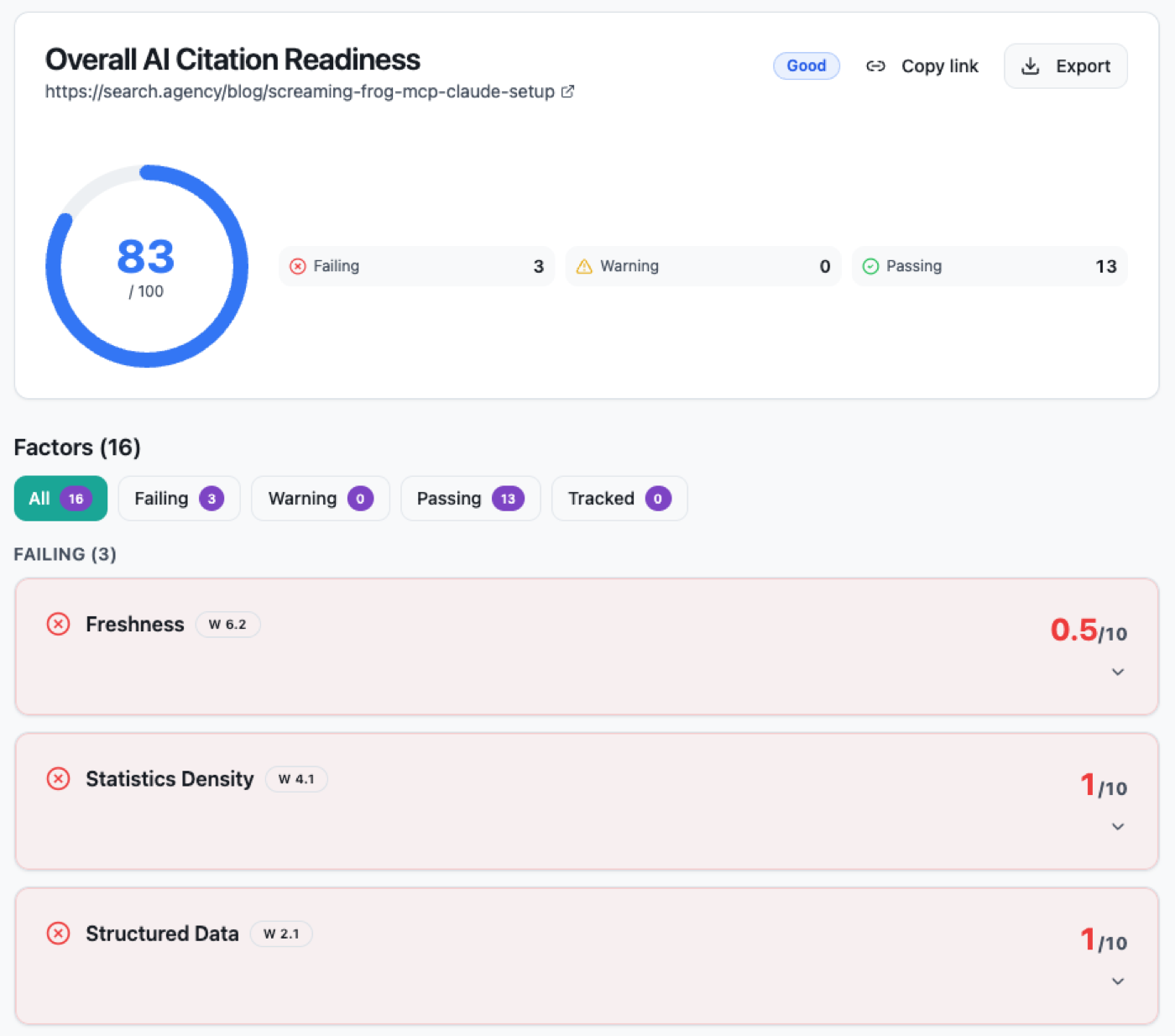
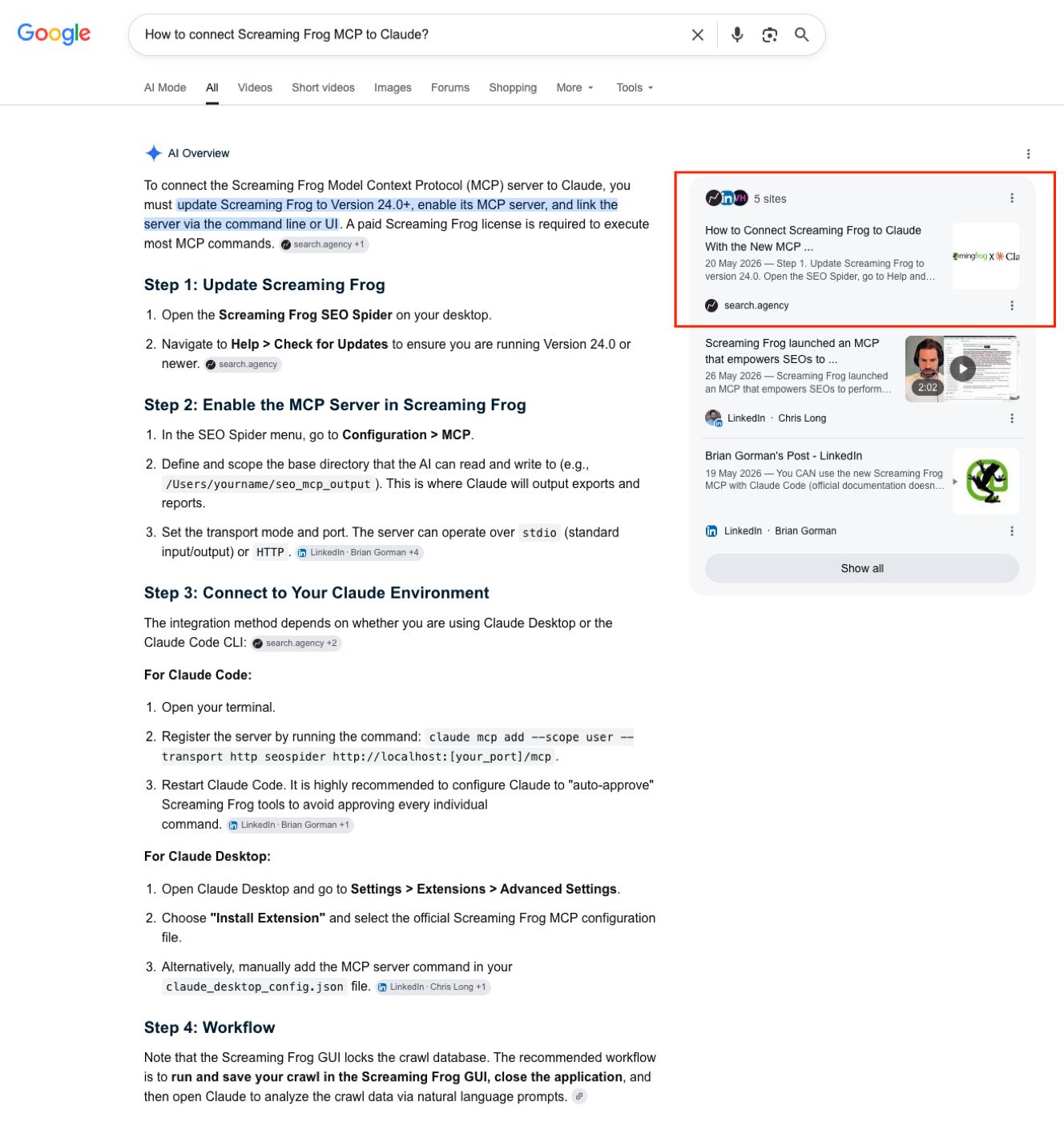
The prompt was "How to connect Screaming Frog MCP to Claude?", the page was our setup tutorial at search.agency/blog/screaming-frog-mcp-claude-setup, and the tool was StoryMint's AI Citation Audit, which scores how likely a single page is to be cited by an AI engine when a user asks a specific question. The result was an 83 out of 100, a Good rating across sixteen factors with thirteen passes, no warnings, and three failures. The three failures are the whole reason to run an audit like this. AI Citation Readiness is not a measure of how trustworthy or original a page looks in general. It is a measure of whether the retrieval stack inside an AI engine will reach for that exact page when answering that exact question, and the failures are usually the cheap mechanical things that quietly keep a page out of an answer it would otherwise win.
| Failing factor | Weight | Score / 10 | What is missing |
|---|---|---|---|
| Freshness | 6.2 | 0.5 | No visible update date or datePublished/dateModified in markup |
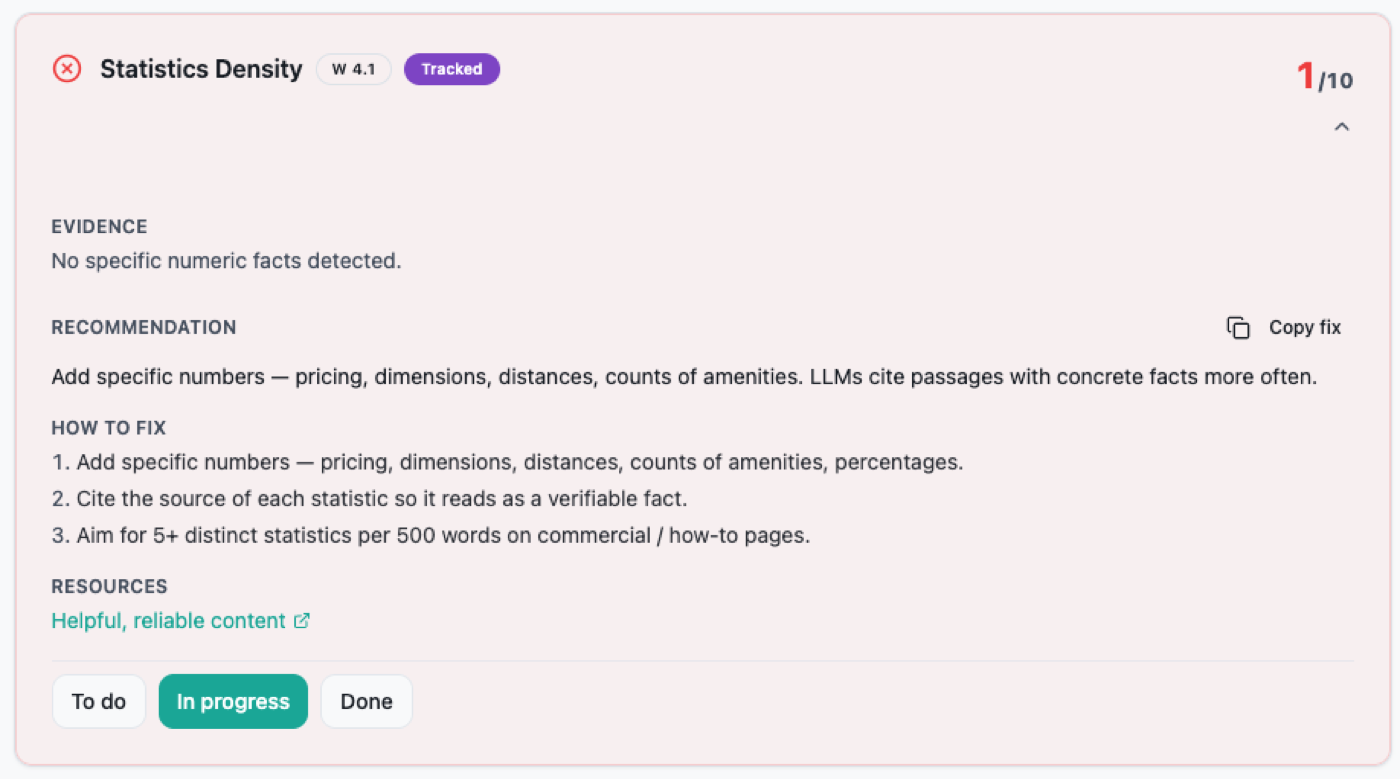
| Statistics Density | 4.1 | 1 | No specific numeric facts detected in the body |
| Structured Data | 2.1 | 1 | No structured data markup detected on the page |
What an AI Citation Audit is actually measuring
The per-prompt framing matters because it changes what an 83 means. A trust-and-authority audit looks at the page in general, who wrote it, what proves it, what an engine would believe about the site behind it. A citation audit narrows the question. Given a prompt, will the retrieval and ranking stack inside an AI engine reach for this page, and if it did, could the engine cleanly lift an answer from it? Those are mechanical questions, not editorial ones. Retrieval cares about freshness signals, structured data, distinct numeric facts, and whether the answer sits near the top of the page in a self-contained passage that survives chunking. A page can be authoritative and miss every one of those, and the engine will go and cite the page that did not. The engineering side of being cited by AI engines is a different discipline from the trust side, and a citation audit is the most direct way to measure it.
Most of the score is already earned
Thirteen factors passed and most of them tell the same story: the page is structured the way an AI engine wants to read. The query and the page's answer match at 10 of 10, the answer sits near the top at 10, content visibility is 10, the page cites sources cleanly, and on URL accessibility every major crawler that matters here, GPTBot, ClaudeBot, PerplexityBot, Google-Extended, and Googlebot, is explicitly allowed. The self-contained passages factor, the most heavily weighted in the whole audit, came in at 8 of 10. Entity Richness scored 8 and Factually Specific scored 9, which is the audit's way of saying the page names the things it talks about clearly and grounds them in concrete claims rather than vague description. Most of the work is already done by writing a clear, answer-led, well-structured tutorial. The remaining seventeen points fall in three specific places, and none of them require touching the body of the post.
The three factors that lost seventeen points
Freshness, scored at 0.5, is the deepest of the three. AI engines treat date signals as a primary input on tutorial and how-to content, because the underlying tools change underneath the post. A page with no visible publish date, no last-updated stamp, and no datePublished or dateModified in its markup reads as undated, and retrieval treats undated as out of date. For tutorial content, dateModified carries more weight than datePublished, because what an engine really wants to know is when the instructions were last verified against the underlying tool, not when the post was first written. The fix is two pieces of the same change: render a clear updated date in the page so a human can see it, and add an Article schema block carrying datePublished and dateModified so an engine can act on it. On any post about a fast-moving integration, freshness is also a content policy as much as a markup one. The page needs a real refresh cadence, not just a timestamp that ticks forward.
Statistics Density, scored at 1, sits next. The tool's rule of thumb is at least five distinct statistics per 500 words on commercial and how-to pages, and the principle behind it is consistent across every retrieval study worth reading: passages anchored by specific numbers get lifted more often than passages of clean prose, because numbers read as verifiable facts an engine can hand back to a user with confidence. On a setup tutorial that is the easiest of the three to fix. Name the version numbers of the tools involved, count the available MCP tools, give the install time and the typical config file size, state the supported file formats by count, quote the exact flags and ports. It is not fabrication. It is encoding what we already know in the form an engine reads as fact.
Structured Data, also scored at 1, is the lowest-weighted of the three, and the fastest to close. The page ships without parseable markup, which means a crawler has to infer the page type, author, dates, and section structure from layout alone. Adding a single JSON-LD block, Article at minimum, with author, datePublished, dateModified, headline, and articleBody filled, gives retrieval a clean object to work with and quietly fixes most of the Freshness gap at the same time. It is a one-time edit that lifts the page's retrieval signal across every prompt it is eligible for, not just the one this audit ran.
Why an 83 is the score that should worry you
An 83 looks like a finished page. It is not. Three factors at near-zero on a sixteen-factor audit means the page is leaving its highest-leverage retrieval signals on the floor while looking healthy in the dashboard. Tackled by descending weight, those three failures alone would push the score into the mid-nineties, and more importantly, would change the page's standing in an actual AI answer from eligible to be cited to actively preferred. Citation readiness is not a trust score. It is a measure of whether an engine can see, parse, and lift you, and the gap between an 83 and a 94 separates a plausible source from the one the answer is built from.
Where your own 83 is hiding
Most pages you have already shipped have their own version of this score, a respectable headline number with two or three mechanical failures quietly keeping them out of citations they would otherwise win. StoryMint's AI Citation Audit takes any URL on your domain and any prompt you care about being cited for, runs it across all sixteen factors, and returns the same kind of factor-by-factor teardown it returned for ours. You can point it at a page you have already shipped and see exactly which mechanical signals are leaving citation share on the table. The instructive thing about our three failures is what they have in common: none of them require a rewrite. They require a date, some numbers, and a single block of schema.
See where your brand stands in AI answers today, benchmarked against your competitors, no pitch required.

How to Run ChatGPT Ads in Indonesia
ChatGPT ads are now open to Indonesian advertisers. We set up two campaigns in Ads Manager and documented every screen, from the first ad preview to the pixel and context hints.
Read post →
Augmented Visibility, How AI Recommendations Can Lead to Bad Business
AI assistants now build agency shortlists for buyers, and some of the sources behind them are paid rankings or lists an agency wrote about itself. What augmented visibility is, and how to check an AI-recommended agency before you sign.
Read post →
How 16 Indonesian Nutrition Brands Score on AI Search Authority
We scored 16 of Indonesia's biggest milk and nutrition brands on the graph signals that decide whether AI search names them. The category average was 19.9 out of 100, and no brand has built the foundation yet.
Read post →