
When to Merge Pages and When to Keep Them Separate


Contents+
Two URLs start trading places for the same query, one of them quietly losing a position it used to hold, and the team reaches the same verdict almost every time. Cannibalization. Merge them. A week later one page is redirected into the other, the report shows a problem closed, and nobody asks whether it was the right page, or even the right problem.
Sometimes the merge was correct. Often it was a guess dressed up as a fix, and an expensive one, because combining two pages is among the hardest SEO moves to walk back. A decision that resists reversal deserves more than a reflex. The question worth asking is almost never whether two pages overlap, since pages overlap all the time. It is whether they are doing the same job for the same reader, which is a different diagnosis with a different cure.
What actually happens when two URLs chase one query
When two of your pages qualify for the same query, Google shows one and keeps the other waiting. The relevance and the links you have earned end up divided between them instead of stacked behind a single URL, and the page Google decides to surface can change from one query to the next and one week to the next. Teams read that swapping as instability, and the instability is what makes the merge button feel urgent.
The engineers who work on Search are more relaxed about this than most marketers, and they are worth hearing out before you reach for a redirect. John Mueller has dismissed the cannibalization panic in plain terms, pointing out that two pages ranking for one query is "not really a problem" and that pages "aren't duplicates just because they happen to appear in the same search results page." His real objection is that the word itself is lazy, a catchall slapped onto any low-ranking page on a similar topic, a label that names a symptom while hiding the cause sitting behind it, whether that cause is a thin page, an unfocused one, weak internal linking, or copy that genuinely duplicates another URL.
That difference is the whole game, because the remedy flips depending on what is actually wrong. Two thin pages collapsed into one produce a single stronger page and the symptom clears. Two strong pages serving real, separate needs collapsed into one destroy coverage you were right to build, and you will not get it back cheaply.
The question is intent, not topic overlap
The test that matters is not whether two pages cover the same topic but whether they answer the same intent. Topic overlap is ordinary and usually harmless. Two articles can both explain crawl budget, or both touch on invoicing, without competing for anything, because the reader who lands on each one wants something the other does not give.
Put every URL through one question. If a single searcher read both, would one feel like a repeat of the other? A definition and a how-to on the same subject answer different questions asked at different points in the journey. A category page and a buying guide for one product line serve a browser and a researcher. Neither pair is cannibalizing anything; each is covering a subject at more than one depth, which is the mechanism that builds topical authority in the first place.
Harmful cannibalization is far narrower than the casual use of the word suggests. It is two pages built for one intent, chasing one click, where no reader would have a reason to want both. That single arrangement is the one where merging is the obvious answer. Everything outside it earns a second look.
Signs the two should become one
A few signals, read together rather than one at a time, point cleanly toward consolidation.
The clearest is two URLs surfacing for the same cluster of queries while the page that ranks keeps changing. Filter Search Console to the query, watch which URL collects the impressions, and if the winner rotates from one week to the next, Google is telling you it cannot decide which page to trust, and that indecision is costing you position. A measurement layer that tracks which URL actually earns the clicks answers this far better than memory or instinct, and it should carry the decision.
Around that core signal sit the usual companions. Thin or near-identical content, where two posts make the same points at the same depth. Split backlinks, where outside links land on both URLs instead of reinforcing one. Weak standalone performance, where neither page ranks close to what the topic plainly deserves. When several of these line up at once, the case is real, and one authoritative page will almost always beat two half-strong ones, while also tidying crawl efficiency and pooling the internal links that were previously spread across two destinations.
This is the same shape AI answer engines reward. A single well-sourced page is easier to quote than two competing versions of one argument, so a clean consolidation tends to lift visibility in AI assisted answers at the same moment it firms up classic rankings. Both pull the same way.
Finding the candidates without a manual audit
Reading those signals by hand is the slow part. On a small site you can export Search Console, pivot the queries, and eyeball which URLs are splitting impressions in an afternoon. On a few hundred pages it stops being an afternoon and starts being the reason the audit never happens, which is how thin, competing posts quietly pile up for years.
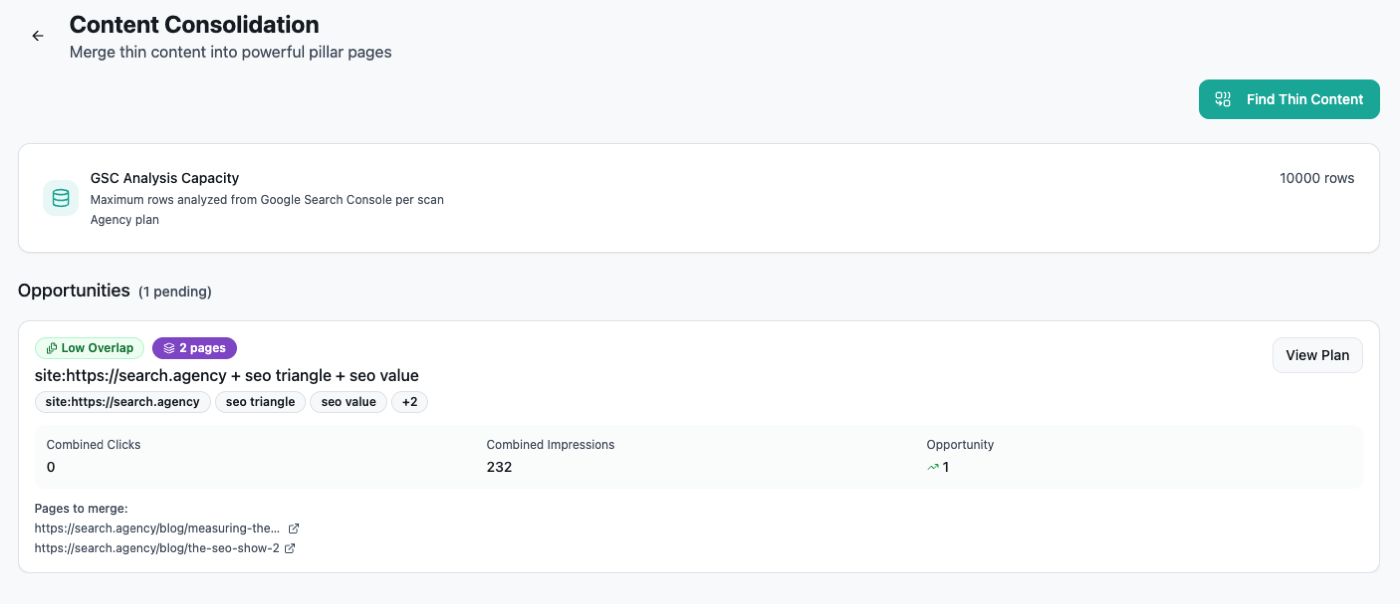
This is the gap the Content Consolidation tool we built into StoryMint / https://storymint.id closes. Point it at your Search Console and it scans the query data, then surfaces the clusters where more than one page is competing for the same set of queries, each one scored for how much the pages actually overlap and stacked by opportunity rather than by hunch. For every cluster it shows the combined clicks and impressions, names the specific URLs that are splitting the demand, and flags the page with the stronger history as the recommended base to keep. What used to be a vague sense that two posts might be fighting becomes a ranked list of the pairs that demonstrably are, drawn straight from your own performance data.
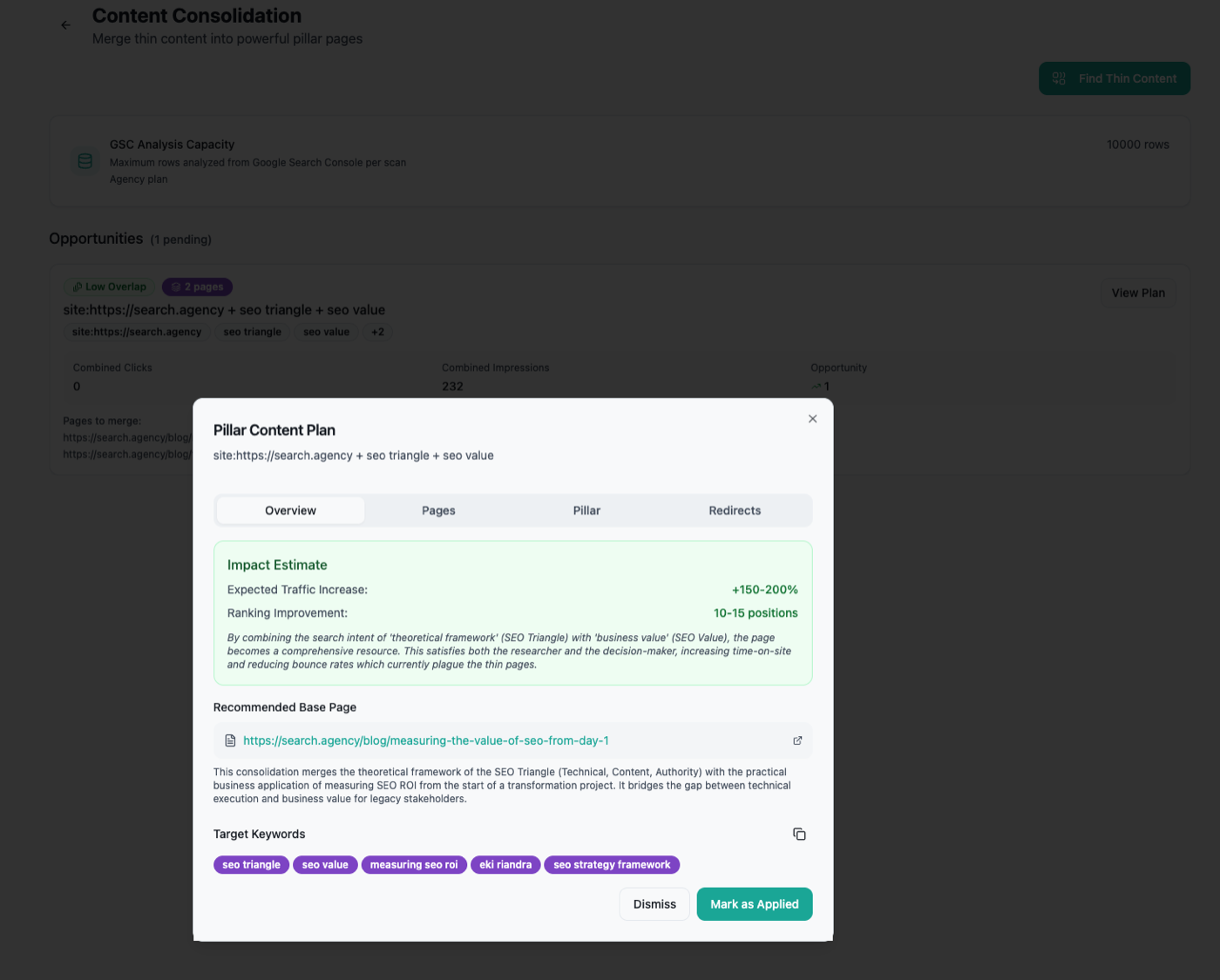
The tool finds and ranks the candidates; the intent test is still yours to apply. A cluster it surfaces might turn out to be two pages doing two jobs, in which case you leave them alone. What it removes is the tedious half of the work, the finding, so the judgment half gets the attention it deserves. For a team sitting on years of overlapping posts, it is the fastest honest way to see where the real consolidation work actually is.
Signs they should stay apart
The opposite case carries more weight than it looks, because a wrong merge is permanent in a way a wrong decision to wait is not.
Keep two pages apart when each ranks well for its own distinct set of queries. Sharing one term while each owns a separate body of demand is not a conflict, it is two pages each doing a job. Keep them apart when they answer clearly different intents, an informational guide on one side and a commercial page on the other, where folding them together forces a single URL to serve two audiences and usually serves neither well. Keep them apart when each pulls real traffic, links, or conversions on its own, because merging a page that already performs trades equity away to solve a problem you do not have.
Location pages are the cleanest example of pages that look like duplicates and must never be treated as such. A landing page for Jakarta and one for Surabaya can share ninety percent of their structure and still earn independent existence, because they answer one intent in two places. Collapse them and you erase the geographic signal that local rankings stand on, which is exactly why distinct, well-built location pages remain the backbone of local search visibility.
When the call is genuinely close, let the asymmetry settle it. Keeping two pages that should have merged costs you a tidy quarter and can be fixed next month. Merging two pages that should have stayed apart costs you a rebuild from scratch and the slow work of re-earning links from zero, which can run to a year you do not get back.
How to merge without throwing away what the pages earned
Once the decision is made, the execution decides whether the value survives the move or leaks out of it.
Choose the survivor on purpose, and resist the urge to keep the better-written page. The URL worth keeping is usually the one carrying the stronger backlink profile and the longer ranking history, because copy can be rewritten in an afternoon and the trust an aging URL has banked cannot be transferred at all. Then merge rather than delete. Lift the genuinely useful passages, examples, and sections out of the page you are retiring and fold them into the survivor so the combined page ends up more complete than either was alone. A merge that throws away half of the retired page is a deletion with better manners.
With the content combined, redirect the retired URL to the survivor using a permanent 301. Google treats a redirect as the strongest signal that the target should become canonical, ahead of a rel=canonical annotation, which in turn outranks leaning on sitemap inclusion, and a server-side 301 passes those signals fastest and cleanest. Then repoint internal links so that every link which pointed at the retired URL now points straight at the survivor, since Google asks you to link consistently to the URL you treat as canonical, and stale or chained internal links blunt the consolidation you just performed. If the cluster came out of the StoryMint tool, the redirect pairs are already drafted there, ready to hand to whoever owns your server config.
Finally, treat the merge as something to measure, not a ticket to close. Watch the survivor's impressions and average position for the target cluster over the following weeks, confirm the redirect resolves in a single hop instead of a chain, and check that the retired URL drops out of the index as the survivor climbs. A consolidation nobody verifies is just a hope with a 301 attached.
A consolidation, start to finish
Picture a personal finance site running two articles that quietly compete on one idea. The first is three years old, built around "how to start investing," with a healthy backlink profile and examples that have aged into irrelevance. The second is newer and cleaner, written around "investing for beginners," reads well, and has almost no external links pointing at it. Both flicker for the same queries, and neither cracks the top five.
The lazy move keeps the newer, nicer page and deletes the old one, quietly torching three years of links in the process. The right move runs the other direction. Keep the older URL as the survivor for its equity, lift the cleaner structure and the updated examples out of the newer article into it, 301 the newer page into the old one, and repoint the internal links that used to feed it. A few weeks later the consolidated page, now both authoritative and well written, settles into the top three for the cluster the two URLs had been splitting, and the week-to-week flicker stops. That is the shape of the compounding gains visible across documented client work, where the win came from a sharper decision rather than from publishing more.
Most consolidation calls fail in the diagnosis, not the execution, in the moment a team sees two pages near one query and hits merge before asking what each page is for. Pages overlap constantly, and overlap on its own is not a fault. The skill is telling two pages doing one job badly apart from two pages doing two jobs well, and acting only on the first.
The edit you cannot quietly undo
Merging the wrong pages costs more than tolerating a slightly untidy sitemap, because the links and the history of a retired URL do not come back on request. Search Agency runs consolidation as a diagnosis first and an edit second, working from intent and performance data so the pages that should merge do, the pages that should stand alone keep standing, and the result lands as measurable gain instead of quiet loss. That judgment is the core of our SEO work.
See where your brand stands in AI answers today, benchmarked against your competitors, no pitch required.

How DOKU Became the Most Visible Payment Gateway in Indonesian Search
DOKU was the better-known brand and the worse-ranked one. Eight months of technical repair and four content pillars later, it holds more Top 3 rankings than any payment gateway in the market.
Read post →
How to Fix Crawled and Discovered Currently Not Indexed Pages in Search Console
Google found these pages, sometimes even read them, and still left them out of the index. How to tell the two Search Console statuses apart, and which fixes actually move them.
Read post →
How to Set Up the Bing Webmaster MCP (Step by Step)
Connect Claude to your Bing Webmaster Tools account with an open-source MCP server, so you can pull index coverage and query data or submit URLs without leaving the chat. A step-by-step setup for technical SEOs who care about AI search visibility.
Read post →