
What the Total Graph Authority Course Teaches in 10 Modules and 66 Lessons


Contents+
- 01Why AI search needs a method before it needs tactics
- 02What the ten modules cover
- 03The audits you learn to run on each graph
- 04How the scorecard turns an audit into a 90-day plan
- 05How results are measured when answers keep changing
- 06The working files that come with the course
- 07Who the course suits and who should skip it
- 08Lessons, exams and the certificate
- 09Price and how to start
The Total Graph Authority course is a self-paced online program that teaches a team how to audit, score and improve the way AI assistants describe and recommend a brand. It runs on Fighter Bootcamp, the training arm of Search Agency, and it covers ChatGPT, Gemini, Perplexity, Google AI Overviews and Google AI Mode.
I developed Total Graph Authority at Search Agency as the method our team follows on AI search campaigns, and until now it was published only as a whitepaper. A paper explains a model well, but it does not show a strategist what to open on Monday morning or which number to report at the end of the month. The course fills that gap with 66 lessons, 10 module exams and four working files, and the whole track takes about 10 hours of reading.
Why AI search needs a method before it needs tactics
Most AI search advice arrives as a list of tactics, such as adding schema, publishing FAQ pages or chasing mentions on forums. Tactics without a method leave a team with no way of knowing which one their brand needs first, and no way of telling whether last month's work changed anything. The first module of the course deals with that problem by walking through eight published findings about how AI assistants behave, then drawing four working principles from them.
Two pieces of public research show why this matters. SparkToro and Gumshoe ran 12 prompts through ChatGPT, Claude and Google AI a combined 2,961 times and found less than a 1 in 100 chance of getting the same list of brands twice. A single screenshot of an AI answer therefore proves little, and any honest report has to be built on repeated runs.
An Ahrefs study of 75,000 brands found that branded web mentions had the strongest correlation with visibility in AI Overviews at 0.664, while the number of pages on a site sat at 0.17. Publishing more pages on your own domain is the weakest lever in that data set, and what the wider web says about the brand is the strongest. A method has to cover both sides, which is why Total Graph Authority looks at what a brand says on its own domain, what independent sites say about it and what real users say in public.
What the ten modules cover
The curriculum moves from evidence to model, then from audit to campaign. Modules one and two explain why the method exists and how its parts fit together. Modules three to six teach the audit of each component, and modules seven to ten turn those audits into a scored plan, a work program and a monthly reporting routine.
| Module | Lessons | Reading time | What you learn |
|---|---|---|---|
| 01 Why AI Search Needs a Different Method | 7 | 61 min | Eight published findings and the four principles drawn from them |
| 02 The TGA Model | 6 | 56 min | Three sources of trust, five graphs and the retrieval layer |
| 03 The Entity Graph | 6 | 54 min | What a brand is believed to be, audited on four indicators |
| 04 The Content Graph | 6 | 55 min | Covering buyer questions with pages an answer can quote |
| 05 The Link Graph and the Retrieval Layer | 6 | 55 min | Links that carry trust, crawler access and indexation |
| 06 The Citation and Interaction Graphs | 7 | 63 min | Who mentions the brand and whether people come looking for it |
| 07 Scope, Baseline and Scorecard | 7 | 66 min | The prompt panel, the baseline audit and the 90-day plan |
| 08 Running the Work | 7 | 63 min | Fixing the entity, building pages, earning mentions and video |
| 09 Measure, Monitor and Validate | 8 | 74 min | Eight outcome KPIs and the intervals around them |
| 10 Running a Campaign | 6 | 56 min | Roles, calendar, checklists and the working files |
Readers who want the model without the operating detail can stay with the blog. The original Total Graph Authority post explains the idea, and the bakso cart version explains it in language a child could follow. The course starts where those posts stop, at the point where someone has to do the work and show results for it.
The audits you learn to run on each graph
Total Graph Authority describes a brand through five graphs and a retrieval layer. The entity graph holds what a brand is believed to be, the content graph holds the pages an assistant can quote, the link graph holds the links that carry trust, the citation graph holds the mentions in sources that assistants rely on, and the interaction graph holds the signs that people look for the brand by name. The retrieval layer decides whether an assistant can reach and read the pages at all. I covered the reasoning behind each one in the post on the five graphs.
The course turns each graph into an audit with named indicators, so two people auditing the same brand should arrive at close to the same scores. The audits taught in modules three to six include the following.
- Profile consistency and category framing for the entity graph, plus a check of knowledge bases and a no-search probe that shows what a model says about the brand from memory.
- A content audit built on the Topic Ownership Matrix, with a lesson on writing a passage that an answer can lift and quote.
- Internal link checks and the referring domain gap against competitors for the link graph.
- Crawler access and indexation checks for the retrieval layer, with a lesson on what each check proves and what it does not.
- A priority source list for the citation graph and four tests a mention has to pass before it counts.
- Branded demand, reviews and video for the interaction graph.
Some of these build on work we have already published. The content audit uses our Topic Ownership Strategy, and the crawler access checks can be run by hand or with Agent View, our free Chrome extension that compares what a visitor sees with what an AI crawler can read. Each graph module also has a lesson on failure patterns, which helps a team trace a wrong description in an AI answer back to the source that caused it.
How the scorecard turns an audit into a 90-day plan
An audit produces a long list of findings, and a long list is hard to act on. Module seven teaches how to fix the scope of a campaign on a single sheet, build a prompt panel across five buyer intents, and run that panel on five AI engines under a written protocol. The protocol matters because answers vary between runs, so the way a panel is run has to stay the same every time for the numbers to be comparable.
The evidence then goes into a scorecard of 20 indicators. Each component receives its own score, and the diagnosis rules point to the component that deserves attention first. A brand with a strong content graph and a weak citation graph needs a different first quarter from a brand whose pages are blocked to AI crawlers, and the scorecard makes that difference visible to a client or a management team in one page.
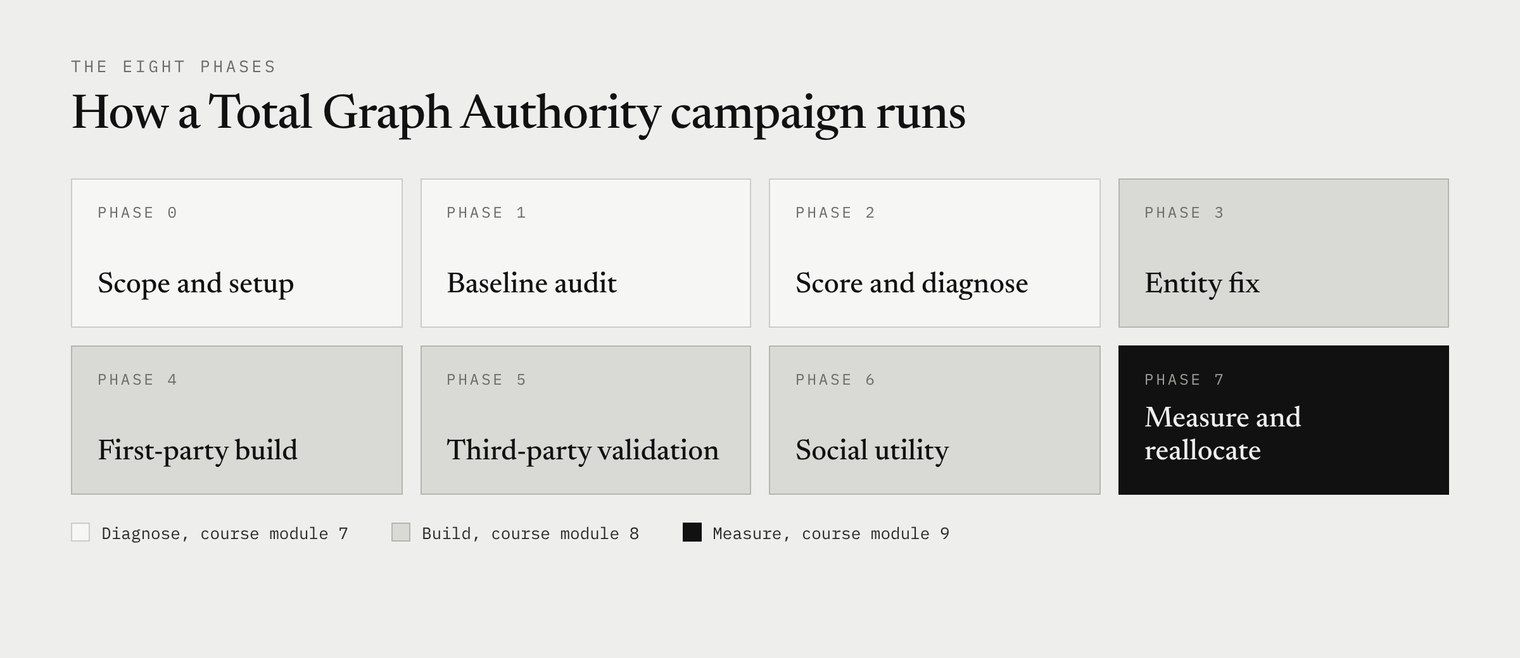
The component scores add up to a 100-point total, and the course is open about the status of that number. The total stays provisional until it has been tested against client data, so the lessons teach students to read component scores first and treat the total with care. Module eight then covers the build phases in order, starting with an entity fact sheet that every later page, profile and pitch has to agree with.
How results are measured when answers keep changing
Reporting is the part of AI search work that most teams find hardest to defend. A mention rate that moves from, say, 22 percent to 26 percent can be a real gain or ordinary variation between runs, and a report that cannot tell the two apart will eventually lose the trust of the person paying for the work. Module nine is the longest in the course for that reason, with eight lessons and 74 minutes of reading.
Students learn to keep three measurement layers apart, calculate eight outcome KPIs, and put an interval around each one so that a change is only reported as a change when it falls outside the noise. The module also covers a monthly cycle with a rule for moving effort between components, a list of monitoring items with triggers, and a lesson that reads six months of results from a sample company.
The course does not promise that a brand will be recommended by AI assistants. Answers vary, engines change, and the last lesson of module nine is a plain account of the limits of the method. I would rather a student finish the track knowing where the evidence is strong and where it is thin than leave with more confidence than the research supports.
The working files that come with the course
Four working files are included, and module ten walks through them one by one.
- A campaign runbook that sets out roles, phase owners, the first 12 weeks and the weekly, monthly and quarterly checklists.
- An audit workbook, explained tab by tab in its own lesson.
- A sample monthly report.
- A sample review deck for client or management meetings.
The sample report and workbook use a fictional Indonesian skincare brand, and the prompts in the panel are written in Bahasa Indonesia. A prompt panel should be written in the language buyers use. In our own small test of Google AI Mode, the brands recommended for the same questions in Indonesian and in English had little in common, so an English-only panel can give an Indonesian brand a misleading picture.
With these files a team does not have to design its own templates before starting a first campaign. The full method paper remains free on the whitepaper page for anyone who wants the reasoning and the evidence levels behind each component.
Who the course suits and who should skip it
The course was written for four groups of readers. SEO and content leads will use it to add AI search to work they already run, and agency teams will use it to deliver that work for clients in a consistent way. Digital PR and outreach specialists will find the citation graph lessons closest to their daily work, and marketing leaders can use the scorecard and reporting modules to judge a proposal before they fund it.
Students need to know basic SEO terms such as indexing, internal links and backlinks, and no coding is involved. Someone who is new to search altogether will find the pace hard, and would do better to begin with our page on what GEO is or with the AI Search Playbook, another Fighter Bootcamp track that explains how AI search works and how to make pages citable. Total Graph Authority assumes that knowledge and concentrates on the operating method, with a scorecard, owners and exit checks for each phase.
The format will not suit everyone either. Every lesson is text with diagrams and there is no video, all lessons and exams are in English, and nobody teaches live. Companies that prefer a trainer in the room can look at our corporate training, and brands that want the work done for them can request an audit from our team.
Lessons, exams and the certificate
Each lesson is an 8 to 10 minute read that is comfortable on a phone, with a check question at the end and a private notes box. The short format means a module fits into about an hour, and a student who reads one module on each working day finishes the track in two weeks.
Every module ends with a 10-question exam. The pass mark is nine correct answers, retakes are unlimited, and passing one module unlocks the next. The bar is high on purpose, because a method only produces comparable audits when the people using it have understood it in the same way.
Passing all ten exams earns a Total Graph Authority certificate of completion with a unique credential ID. Anyone can check that ID on the public verification page, and the certificate can be downloaded and shared on LinkedIn.
Price and how to start
The course is part of the Fighter Bootcamp all-access membership, which costs Rp 99,900 for three months, or about Rp 33,300 a month. The membership covers all lessons, exams and certificates on every track, including Topic Ownership Strategy, AI Search Playbook, Audience-First Copywriting and AI for Marketing Work.
Three months is enough time to finish Total Graph Authority and apply it to a real brand while the lessons are still open for reference. A sensible route is to complete the first two modules in week one, run the audits on your own brand during modules three to six, and use the working files to produce a first scorecard before the membership ends.
The first lesson, What Total Graph Authority is, is open to everyone and takes eight minutes to read. The full curriculum and the membership are on the Total Graph Authority course page.
See where your brand stands in AI answers today, benchmarked against your competitors, no pitch required.
Related reading
All posts →
Total Graph Authority explained to a five-year-old
A bakso cart, a helpful neighbour and a locked alley gate show how brands earn recommendations from AI assistants, in language a child could follow.
Read post →
Total Graph Authority, How Brands Get Cited by AI
AI answers change run to run, so being cited once proves little. Total Graph Authority lines up first-party, third-party, and social so you stay in the answer, with examples you can copy.
Read post →
The five graphs an AI assistant reads before it decides to cite you
Backlinks are one connection an AI model follows. Here are the other four graphs that decide whether you get named in the answer.
Read post →