
Rand Fishkin Is Half Right About the End of Great Content

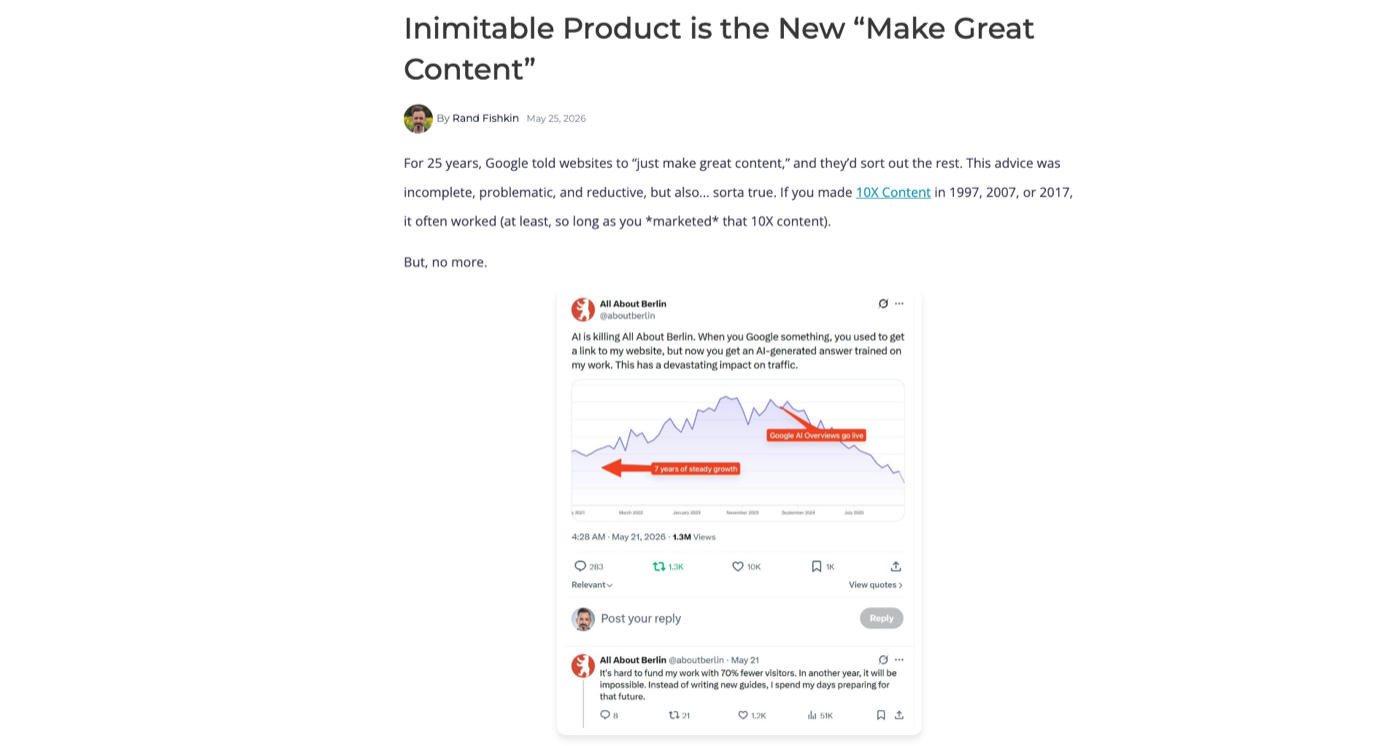
Rand Fishkin's "Inimitable Product is the New Make Great Content" is the right diagnosis with the wrong prescription for B2B. The 25-year-old loop where great content drove organic traffic and organic traffic drove growth is breaking, and his framing of why is accurate. The conclusion that companies should pivot to inimitable products instead of content does not survive contact with the enterprise SaaS market, where the inimitable product is already the company. What changes for those buyers is not whether to publish, but what publishing is for.
The diagnosis is solid
Rand's argument starts where everyone in search already knows we are. Google has stopped being a directory and started being an answer machine. AI Overviews, AI Mode, and whatever lands next are designed to keep the answer inside the SERP, so the click that publishers used to convert into a session, a signup, a customer increasingly never happens. The retailer and the manufacturer are now the same entity. If your business model depended on Google sending traffic in exchange for content, the loop has broken.
That much is not news for anyone reading the trades. The clarity Rand brings is the framing. "Just make great content" was the canonical advice for anyone trying to grow on search, and it worked from roughly 1999 to roughly 2022. It stopped working when Google decided that being the destination was a stronger position than being the index. The implication, which Rand spells out, is that content as a defensible asset class is dying. The artifact that was the product has become the input the destination uses to compose its own product.
Anyone who builds a media business in 2026 needs to internalize that and act on it. Anyone who builds an ad-funded blog, a course-driven info site, or an affiliate stack on the back of informational queries needs to internalize it twice. That cohort is the one Rand's piece is directly addressed to, and for that cohort, his prescription to build something inimitable that AI cannot disintermediate is correct.
Where the prescription stops working
The piece breaks down when it tries to extend the same advice to every business. Rand's recommended response is to build an inimitable product, by which he means a physical good, software, service, or experience that AI cannot replicate. The implicit assumption is that the reader is currently a content business and needs to become a product business. That assumption fits a SparkToro reader who runs a one-person agency or a Substack. It does not fit the median enterprise B2B buyer.
Salesforce, Snowflake, ServiceNow, Workday, Atlassian, Datadog, MongoDB, every serious enterprise software company you can name already has an inimitable product. That product is the company. They are not media businesses pretending to be SaaS. They have always been platforms first and publishers second, and the content they ship has always been marketing for the platform. Telling them to build an inimitable product instead of content is solving a problem they do not have.
The problem they do have is different. Their content used to do two jobs at once. The first was capturing demand at the top of the funnel through organic search. The second was building category authority through educational publishing. AI Overviews compress the first job dramatically, because the answer now happens before the click. The second job is being absorbed into the training data and the retrieval layer. Neither job is dying. Both are changing.
Content as the product versus content as marketing for a product
Content was always one of two things. Either content was the product, or content was marketing for a product. Rand's argument flattens those two cases into one, and then prescribes the same answer for both. The reframe enterprise SEO buyers need is to separate them.
Content as the product is dying, and Rand is right about that. Bloomberg knows it, which is why the terminal pays for the content rather than the other way around. The New York Times knows it, which is why a games platform with a news business attached has been doing better than a news business with everything else attached. Every B2B media brand that survives the next three years will survive because it figured out a non-content product to anchor the operation.
Content as marketing is not dying. Its function is changing. It used to be "rank to capture demand." Now it is "exist so you get cited, referenced, repeated, and built into the training data and the retrieval layer." Same artifact, different job. The companies that win the AI answer layer between now and 2029 will be the ones that kept publishing with intent while everyone else read Rand's post, panicked, and stopped.
The detail that makes the reframe sharp is the difference between two questions. When a procurement team asks ChatGPT "best enterprise CRM for a manufacturing company with 5,000 seats and a Salesforce migration risk," the model returns two or three named recommendations. Whether your brand is one of those three is downstream of what the model learned about your category, where it has seen you cited, and what it thinks you are known for. Those signals are content signals. They are not display ads, they are not paid placements, and they cannot be brute-forced by spending more on the ad network. They are earned by being the source the model trusts.
What this changes about how you sell SEO
The pitch every SEO agency has been making for fifteen years no longer holds for enterprise buyers. "We will get you to rank for these fifty keywords" is selling the wrong outcome. The keyword list still matters as an input, but the buyer outcome is being recommended when someone asks an AI about your category, not appearing at position three on a SERP that increasingly never gets a click.
The KPI shift that follows is the real change. Sessions move from the headline metric to a leading indicator. Share of voice in answer engines, branded search volume, direct visits, and pipeline influence become the metrics that procurement and the CMO actually want to see. The cheapest way to measure whether a brand is winning in the AI answer layer is to measure whether more people are searching the brand name unprompted, because that is what gets caused by being cited and recommended.
The output deliverable changes with it. The thing an enterprise SEO program should be producing is not a ranking report. It is a citation share dashboard. Which prompts mention you, which prompts mention competitors, what the AI is saying about you, where your share of recommendations is improving, and what specific authority and content moves caused the improvement. We publish the methodology behind that kind of measurement openly, including the four KPIs we report monthly and the formulas we use to compute them, so buyers can evaluate the rigor before they engage a vendor. The summary version is that prompt-level tracking, citation share of voice, sentiment, and AI attributed traffic become the new scoreboard.
Where Rand is fully right
The piece is exactly correct for one cohort of businesses, and they should read it carefully. Publishers whose moat is content, course creators whose lead magnet is content, affiliate sites whose income is content, newsletters whose paid tier is content, agencies whose differentiator is content thought leadership without a service underneath. For all of those models, the inimitable product framing is the most important thing they will read this year.
What Rand is saying to that cohort is, the train you were on has stopped, and the next station does not exist on the current line. You will need a non-content product attached to the operation or the operation will fail. A consultancy whose only output is articles needs to become a consultancy whose articles sell a service. A creator whose only output is essays needs to become a creator whose essays sell a course, a tool, a community, or a piece of software. The pivot is hard and it is mandatory, and the agencies advising those clients should be advising them to do it now rather than after the revenue compresses.
What he is not saying, but should be, is that for the enterprise software and services market, the move is the inverse. The product already exists. The content needs to be repointed at a new job. The two halves of his argument apply to different audiences, and treating them as a single prescription costs the bigger half of the market the advice it actually needs.
Why you do not ignore traffic
The one piece of Rand's advice not worth adopting wholesale is "ignore traffic." Traffic is still the cheapest, fastest proof signal that your indexing, crawlability, topical authority, and on-page work are functioning. If organic traffic to your priority pages is dropping at a rate that exceeds the broader AI Overviews compression baseline, something is broken on the technical side that needs fixing before any AI strategy can help. Traffic is the engine readout. The car still has an engine even if the speedometer no longer tells you where you are going.
The right move is to demote traffic from goal to leading indicator and add new leading indicators on top. AI citation appearances, citation share of voice against named competitors, branded search lift modeled against a control period, direct sessions, social referrals, and the rate at which third-party platforms cite or quote your content. None of those replace traffic. They sit above it.
A buyer reading Rand's piece and concluding that they should let their organic traffic compress is making a different version of the same mistake as the buyer who reads it and panics about content. The old metric is still informative. It is no longer sufficient.
The implications for agencies and for the buyers hiring them
This piece is more of a tailwind for the right agency than a threat. The agencies in trouble are the ones still selling "we will get you ranked for fifty keywords." Those agencies are about to spend the next two years watching their pitch deck argue against the lived experience of every prospect they meet. The agencies with a future are the ones telling enterprise buyers, your category is being rewritten by retrieval models, the buying decision is forming inside AI answers before anyone clicks anything, and our job is to make sure you are the source the model pulls from when that happens.
That pitch is closer to what brand strategy used to mean than to what classic SEO used to mean. Which is part of the reframe. Search marketing is converging with brand marketing in the AI answer layer, because share of voice in an AI recommendation is brand share by another name, expressed in a new medium. The right SEO agency in 2026 is selling brand presence, citation visibility, and pipeline influence, and using technical SEO and content as the input that produces those outputs.
For Search Agency clients, that work looks like AI visibility audits, prompt-level citation tracking, content engineered for retrieval rather than ranking, and a measurement framework that lets a CMO put the dashboard in front of a board. The piece Rand wrote is useful in client conversations because it sharpens the question. Whether the brand has an inimitable product is rarely in doubt for the enterprise buyers we work with. Whether they are present in the answers their customers are asking AI is the question we get hired to solve. That is the entire pitch for our AI Search service, and it is the reframe Rand's piece almost reaches but does not quite land for the B2B half of the market.
See where your brand stands in AI answers today, benchmarked against your competitors, no pitch required.

How DOKU Became the Most Visible Payment Gateway in Indonesian Search
DOKU was the better-known brand and the worse-ranked one. Eight months of technical repair and four content pillars later, it holds more Top 3 rankings than any payment gateway in the market.
Read post →
How to Fix Crawled and Discovered Currently Not Indexed Pages in Search Console
Google found these pages, sometimes even read them, and still left them out of the index. How to tell the two Search Console statuses apart, and which fixes actually move them.
Read post →
How to Run ChatGPT Ads in Indonesia
ChatGPT ads are now open to Indonesian advertisers. We set up two campaigns in Ads Manager and documented every screen, from the first ad preview to the pixel and context hints.
Read post →