
One Google Business Profile Decides Whether AI Recommends Your Shop

Contents+
- 01Complete every field
- 02Write a description that answers a real question
- 03Choose categories with precision
- 04List your services and products in full
- 05Post updates regularly
- 06Collect and respond to reviews
- 07Add real photos every month
- 08Seed and own the Q&A section
- 09Keep your name, address, and phone identical everywhere
- 10Read your insights and adjust
- 11When the basics are not enough
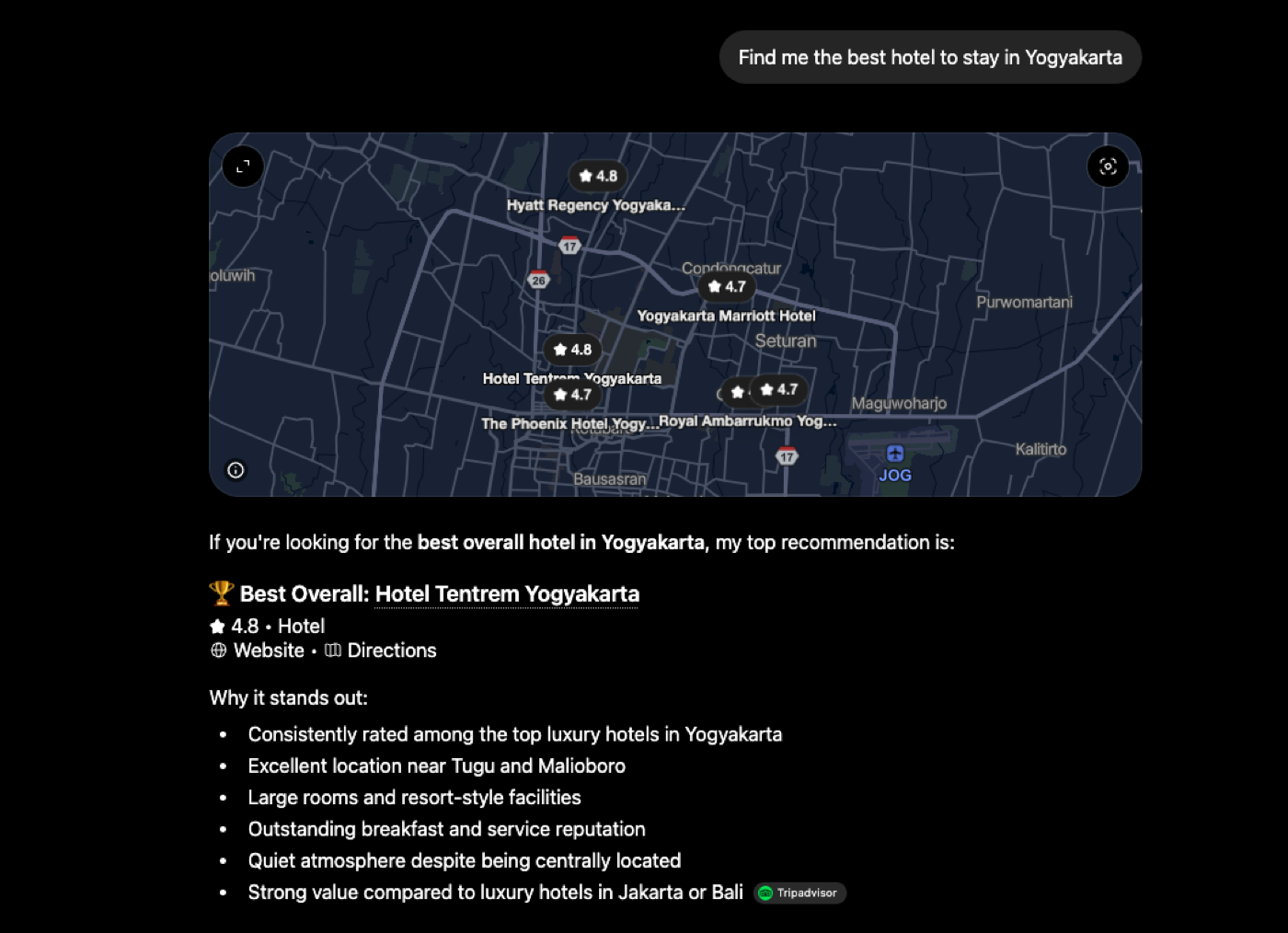
Ask ChatGPT where to get a phone screen fixed in South Jakarta, and it will name a few shops. Ask Gemini for a bakery that delivers wedding cakes, and it will pick favorites. Those answers are not guesses. They are assembled from structured sources, and your Google Business Profile is one of the richest the model has on you.
This used to be a Google Maps game. Now the same profile feeds the assistants people ask before they ever open Maps. None of the ten tactics below needs a budget or a developer. They need an afternoon and the discipline to keep them current.
1. Complete every field
AI systems trust structured data, and an empty field reads as low confidence. Fill all of it: name, address, phone, website, hours, service area. Add the attributes that separate you, wheelchair access, free parking, halal kitchen, outdoor seating. Each one is a fact the model can match against a query.
Consistency is the catch. If your site says you close at 9 and your profile says 10, the system sees a conflict and trusts you less for it. Audit the details every quarter so seasonal hours and new services do not drift out of sync.
2. Write a description that answers a real question
Your description is not a brochure. It is an answer waiting for a question. Picture what someone types into a chatbot: "where can I fix a cracked screen near me," "which bakery in South Jakarta does wedding cakes." Write to those.
Name your location, your core services, and the specific problem you solve. Keep it under 750 characters, put the important part first, and cut anything that sounds like an ad. Promotional copy is the easiest thing for a model to discount.
3. Choose categories with precision
Your primary category carries the most weight, so it should name what you actually do most. A coffee shop that also sells pastries leads with Coffee Shop, not Bakery, if coffee pays the rent. Secondary categories pick up the rest.
| Business | Primary category | Secondary to add |
|---|---|---|
| Coffee shop that sells pastries | Coffee Shop | Cafe, Breakfast Restaurant |
| Hardware store that cuts keys | Hardware Store | Locksmith |
| Bakery that delivers wedding cakes | Bakery | Cake Shop, Wedding Bakery |
Look at what competitors use, then add only what genuinely applies. A category you do not serve is a query you will disappoint, and disappointed queries are how rankings erode.
4. List your services and products in full
This is the field most businesses skip, which is exactly why it is worth doing. The Services and Products sections let you spell out every offering by name, with its own short description. AI systems read those as a menu of what you can answer for, far more specific than a category label.
If you do screen repair, list screen repair, battery replacement, water damage, charging port, each as its own item. The more precisely you name what you do, the more queries you can be matched to.
5. Post updates regularly
Posts are mini-announcements that signal an active business. They no longer vanish after seven days the way the old guidance claimed. They now stay visible for months and slide behind a "view previous updates" link rather than disappearing, so the value is less about beating a timer and more about a steady drumbeat that says you are open and paying attention.
Use them for weekly specials, new arrivals, events, holiday hours, a glimpse of the team mid-shift. Give each post one clear call to action and, where it fits, a link to the right page on your site. Write it like you talk, not like a flyer.
6. Collect and respond to reviews
Reviews move AI recommendations more than most owners think. A steady flow of recent ones tells a system that real people keep choosing you. Ask at the moment of satisfaction, a card at checkout, a message after the visit.
Replying matters as much as collecting. Thank positive reviewers by name and pick up the detail they mentioned. Meet a bad review with a calm acknowledgment and an offer to fix it offline. Models read sentiment, and a careful reply is a signal that you stand behind the work.
7. Add real photos every month
Recent photos pull more engagement in Maps and local results, and they tell the model what you actually look like. Upload your storefront, your interior, your products, your people. A clear smartphone shot beats a polished stock image every time, because stock photos describe nothing true about you.
Give files descriptive names before you upload, "jakarta-noodle-shop-interior" over "IMG_4523." It is a small edge, not magic. The bigger lever is simply showing up with fresh, real, local images on a schedule.
8. Seed and own the Q&A section
The Q&A on your profile is public and permanent, and anyone can post there, including people who get your hours wrong. So get there first. Write the ten questions you actually hear and answer them yourself. That builds a clean reference an assistant can quote when it summarizes you.
Check it monthly. A wrong answer left standing becomes the answer, and on a permanent surface that is expensive to undo.
9. Keep your name, address, and phone identical everywhere
This is the backbone of local AI grounding and the dullest item on the list. Your name, address, and phone should read character for character the same on your site, your profile, your social pages, and every directory you sit in. "Jl. Sudirman No. 5" in one place and "Jalan Sudirman 5" in another are two facts to a machine, and two facts that disagree.
Pick one format, write it down, and fix every listing to match it. Discrepancies are the quiet reason a profile underperforms a stronger one next door.
10. Read your insights and adjust
Google Business Profile hands you free analytics: which terms surface you, whether people call or ask for directions, which photos get looked at. Most owners never open it.
Read it like a brief. If a service you treat as a side line pulls more searches than your headline offer, that is the market telling you where to point your description, your posts, and your next photo. Let the data move your effort, not your assumptions.
When the basics are not enough
Ten tactics will take a single location a long way. Multi-location brands, competitive categories, and visibility across ChatGPT, Gemini, and Google AI Overviews are a different problem, one of structure and measurement rather than effort.
That is the work we do. Our Local SEO service builds and maintains this foundation across every location you run, and ties it to how AI assistants actually cite you. Talk to us when you are ready to make the profile do more than exist.
See where your brand stands in AI answers today, benchmarked against your competitors, no pitch required.

How DOKU Became the Most Visible Payment Gateway in Indonesian Search
DOKU was the better-known brand and the worse-ranked one. Eight months of technical repair and four content pillars later, it holds more Top 3 rankings than any payment gateway in the market.
Read post →
How to Fix Crawled and Discovered Currently Not Indexed Pages in Search Console
Google found these pages, sometimes even read them, and still left them out of the index. How to tell the two Search Console statuses apart, and which fixes actually move them.
Read post →
How to Set Up the Bing Webmaster MCP (Step by Step)
Connect Claude to your Bing Webmaster Tools account with an open-source MCP server, so you can pull index coverage and query data or submit URLs without leaving the chat. A step-by-step setup for technical SEOs who care about AI search visibility.
Read post →