
Our Travel Industry Study Finds Two Thirds of Google AI Mode Citations Do Not Rank in the Top 10


Two thirds of the domains Google AI Mode cites in its travel answers are not in the top ten organic results for the same query. That is the headline finding from the first 15 queries of an AI citation study Search Agency is running across the travel industry, starting with Indonesian trip-planning. It changes how enterprise SEO teams should think about who is actually getting found when an AI surface sits on top of Google.
The data in this first look covers 15 Bahasa Indonesia queries that real travelers ask, captured via SearchAPI against both Google AI Mode (Google's always-on AI answer panel, accessed through the `udm=50` URL parameter) and the classic Google top ten for the same query, with Indonesia locale and language. Those 15 queries produced 141 AI Mode citations covering 101 unique domains, and 143 top-ten organic results across 79 unique domains. The full study scales to 150 queries, but the patterns at this sample size are already directional enough to act on.
Who the two surfaces actually point to
The most-cited domains in AI Mode and the most-ranking domains in classic Google overlap, but the shape is different.
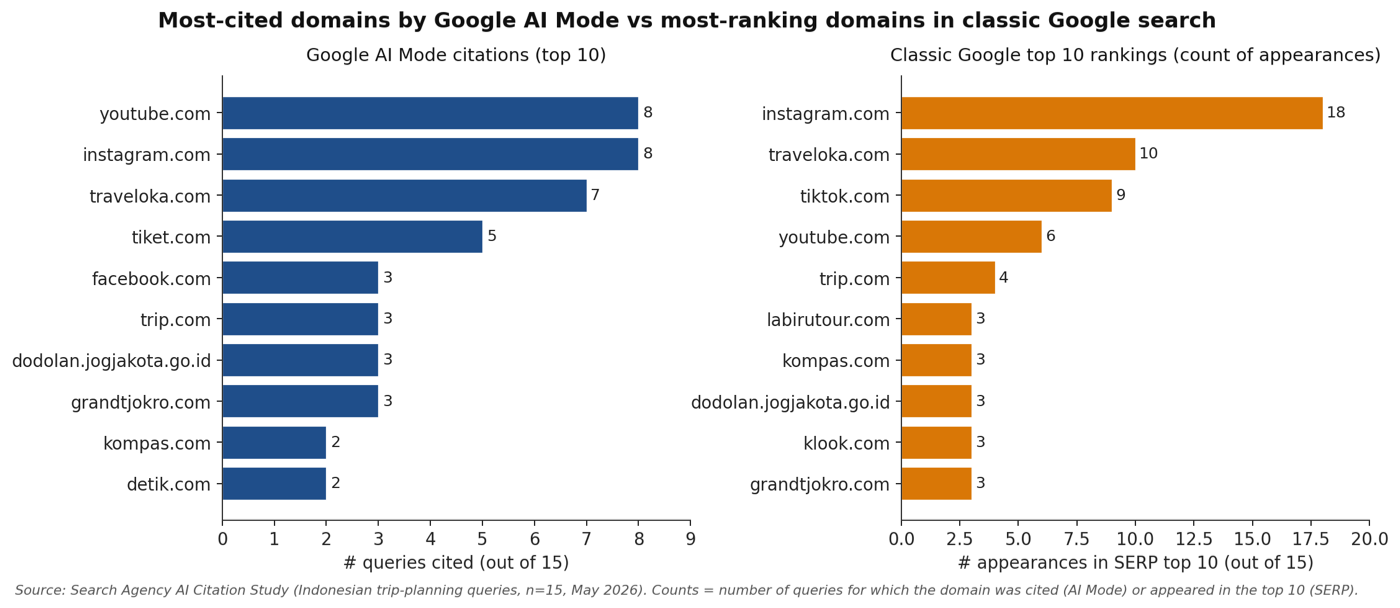
Source: Search Agency AI Citation Study, Indonesian trip-planning queries, n=15, May 2026. AI Mode counts = number of queries for which a domain appeared in the AI Mode reference panel. SERP counts = number of queries for which a domain appeared in the classic Google top 10.
YouTube and Instagram tie at the top of AI Mode, cited across 8 of 15 queries each. Traveloka follows at 7 and Tiket.com at 5. The composition is a mix of social and video platforms, OTA brand pages, and a handful of regional travel media. The classic Google top ten is more concentrated on a single source. Instagram appears in 18 separate top-tens across the 15 queries, because Google often surfaces multiple Instagram reels or posts on the same SERP, with Traveloka at 10 and TikTok at 9. Both surfaces tilt heavily toward user-generated and OTA content, but AI Mode distributes attention across a wider pool of brands and content types than the SERP does.
Two things follow from that. Brand-side investment that has been pointed at "ranking number one for the head term" is now solving for a surface that makes up only part of the visibility picture, and a smaller part than it used to be. The brand-safe assumption that strong organic visibility translates automatically into AI visibility does not hold for this category.
The gap between ranking and getting cited
The cleaner way to see the misalignment is to count how many unique domains live in each pool and how much they actually share.
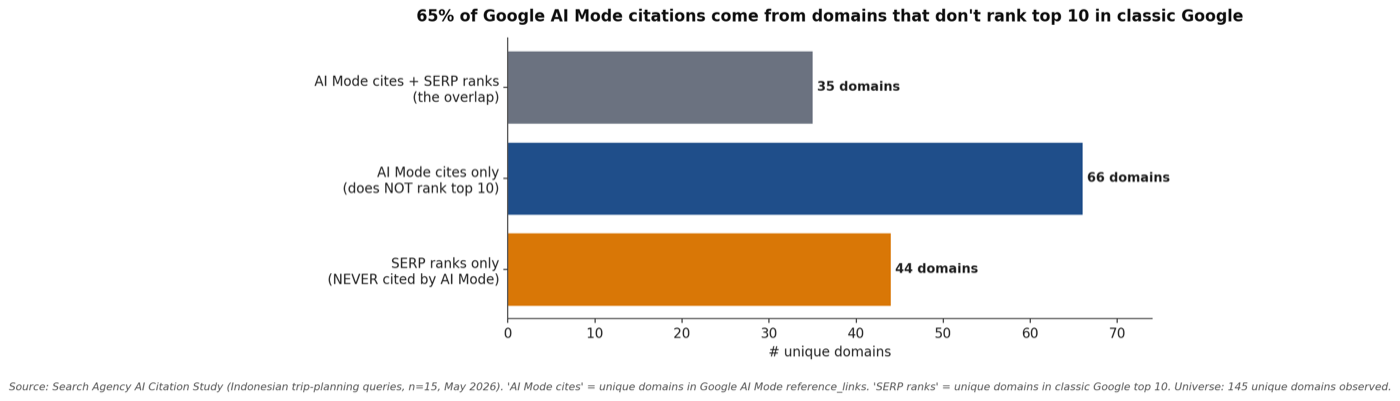
Of 145 distinct domains the study has observed, only 35 sit in both pools. That leaves 66 domains that AI Mode cites but that never appear in the top ten for the queries that cited them, and 44 domains that rank in the classic top ten but that AI Mode never cites for those queries. The headline rounding is that 65 percent of AI Mode's citation pool sits outside the top ten of the very Google SERP it sits on top of.
We expected some divergence. We did not expect the citation pool to be three times the size of the ranking pool, with the overlap making up roughly a third of the AI side. That is not a noisy edge case, it is the central observation of the study so far.
The cohorts worth naming
The shape of the gap matters more than the numbers, and naming a few of the domains involved makes the strategic implication concrete.
Several established travel brands rank well in classic Google for a relevant query but earn no AI Mode citation on it. Villabalisale.com sits at position three for "waktu terbaik ke Bali" but is absent from Google AI Mode's citations for that question. Yogyes.com, kumparan.com, scribd.com, baliagatour.co.id, balitopholiday.com, and torch.id all show similar patterns across this sample. They have done the work to rank, and that work is not currently translating into AI citation.
Meanwhile a different cohort of domains gets cited without showing up in the top ten organic results for the same query. Hilton, Hotels.com, Agoda, KKday, Qatar Airways, 30 Sundays Club, and Lux Tripper are the clearest examples in this sample, all of them international or brand-led pages cited by AI Mode for Indonesian trip-planning questions despite not ranking on the localized Google result. Government and tourism-board sites also over-index in the citation pool. Dodolan.jogjakota.go.id and sibakuljogja.jogjaprov.go.id appear in AI Mode citations more often than in the top ten itself, which suggests AI Mode is reaching for institutional and global brand pages that the localized ranking does not lift.
There is no single explanation for why a domain falls into one bucket or the other, and the study is too early to confirm one. The implication for enterprise SEO is the same regardless of cause. The question "do I rank for this query" and the question "am I cited for this query" are independent questions, and budgets that only solve for one of them will under-perform on the other.
How an enterprise SEO team should react
Three moves drop out of the data that are worth making before the study is finished, not after.
The first is to actually measure citation visibility for the queries that matter to the brand, not infer it from rank. The two pools are different enough that brand health on Google can be misleading about brand health on Google AI Mode. The cheapest version of this audit is what we are doing in the study itself: pull the AI Mode reference panel and the classic top ten for the same list of priority queries, and compare which domains appear in each. The expensive version waits until the brand discovers it is invisible in an AI answer it assumed it would dominate.
The second is to invest in the surfaces AI Mode actually pulls from, which on the evidence of this sample means treating YouTube, Instagram, and tourism-board or institutional pages as first-class earned-media targets rather than as channels somebody else owns. The "ranking pages" strategy keeps the SERP. The "owned across the platforms AI reaches for" strategy is what gets cited. Both the classic SERP and the AI answer above it are increasingly fed by the same kinds of platforms, and the gap in this study sample is exactly the gap a brand sees when it has earned its ranking presence on its own domain but not on the third-party platforms feeding the AI.
The third move is the one most enterprise teams resist. Explicitly accept that international or category-leading global brands are competing for AI citations on local queries, often successfully, even when they do not rank locally. AI Mode looked past a series of strong-ranking Indonesian travel sites to cite Hilton and KKday on Bahasa queries about Bali. The bar for being cited is set by what the model considers authoritative across its training and retrieval, not by what the localized SERP rewards. Local SEO wins do not always cross that bar, and pretending otherwise is how a brand ends up uncited in answers it expected to own.
What is next in the study
The fifteen queries in this first look were selected for coverage across intent types and destinations, but the full set the study is running spans 150 queries balanced across domestic and outbound trip-planning. The pipeline runs via SearchAPI without rate limits, so the larger sample is a matter of running batches rather than methodology risk. We will publish the full version with the same comparisons, broken down by query intent and destination type, and add an analysis of how the cohort labels shift as the sample grows.
If the pattern holds at full sample, the headline number probably moves only slightly in either direction. The strategic implication does not move at all. AI visibility on Google AI Mode is not the same problem as ranking on Google, the citation pool is bigger and differently shaped than the ranking pool, and the brands earning citations are doing so by being present in places the SERP does not always reward. Search Agency builds the AI visibility strategy that turns that into actionable work for enterprise teams. Which queries you are losing citations on, which platforms to invest in to fix it, and how to track citation share as a metric in its own right. That is the core of our AI Search service.
See where your brand stands in AI answers today, benchmarked against your competitors, no pitch required.

How to Run ChatGPT Ads in Indonesia
ChatGPT ads are now open to Indonesian advertisers. We set up two campaigns in Ads Manager and documented every screen, from the first ad preview to the pixel and context hints.
Read post →
Augmented Visibility, How AI Recommendations Can Lead to Bad Business
AI assistants now build agency shortlists for buyers, and some of the sources behind them are paid rankings or lists an agency wrote about itself. What augmented visibility is, and how to check an AI-recommended agency before you sign.
Read post →
How 16 Indonesian Nutrition Brands Score on AI Search Authority
We scored 16 of Indonesia's biggest milk and nutrition brands on the graph signals that decide whether AI search names them. The category average was 19.9 out of 100, and no brand has built the foundation yet.
Read post →