
How to Run a Persona-First Content Gap Analysis With StoryMint

Contents+
- 01Two kinds of gap, and only one of them is about your reader
- 02Start from the persona, not the keyword
- 03Choose the query your buyer would actually type
- 04Read the SERP before you add to it
- 05Where the gaps surface, ranked
- 06From gap to brief without losing the thread
- 07Where a persona-first gap still needs a second opinion
A persona-first content gap analysis finds the questions your audience is asking that the current search results fail to answer. That is a different exercise from the gap analysis most teams run, which finds the keywords competitors rank for and you do not. Both go by the same name. Only one of them tells you what to actually say.
For years the difference was academic, and the keyword version won by default because it was the one the tools could measure. That default is now expensive. AI assistants answer most questions by synthesizing the consensus already sitting on the first page, so a piece that restates what ten other pages already say gives the model nothing it cannot get elsewhere, and no reason to name you. The work that earns a ranking, and increasingly a citation, is the work that adds something the page does not already contain. Finding that something is what a persona-first analysis is for.
Two kinds of gap, and only one of them is about your reader
A keyword-coverage gap is competitive arithmetic. Tools like Ahrefs and Semrush line your domain up against rivals and surface the terms they rank for where you are absent. It is genuinely useful work, and we have written a full walkthrough of the keyword-based version in Ahrefs. But notice the instruction buried inside the output. A keyword gap tells you a topic has proven demand and you are missing from it. The implied next step is to produce your own version of whatever already ranks, a little better. You end up aiming at parity.
An information gap is a different measurement entirely. Instead of comparing you to a competitor's URL list, it compares the live search results to a real reader's needs and asks what falls in the second column but not the first. The question stops being "what term am I not ranking for" and becomes "what does my buyer still need to know that nobody on this page has told them." One produces a longer to-do list. The other produces an angle.
This matters more in AI search than it ever did in the ten-blue-links era. When you publish the consensus answer, you are handing a model a fact it already holds from a dozen sources, which is the opposite of making an AI engine cite your brand. Net-new information is the unit that gets pulled into an answer. The keyword method cannot see net-new information by design, because it only knows what is already being searched and already being ranked. You need a layer on top of it.
Start from the persona, not the keyword
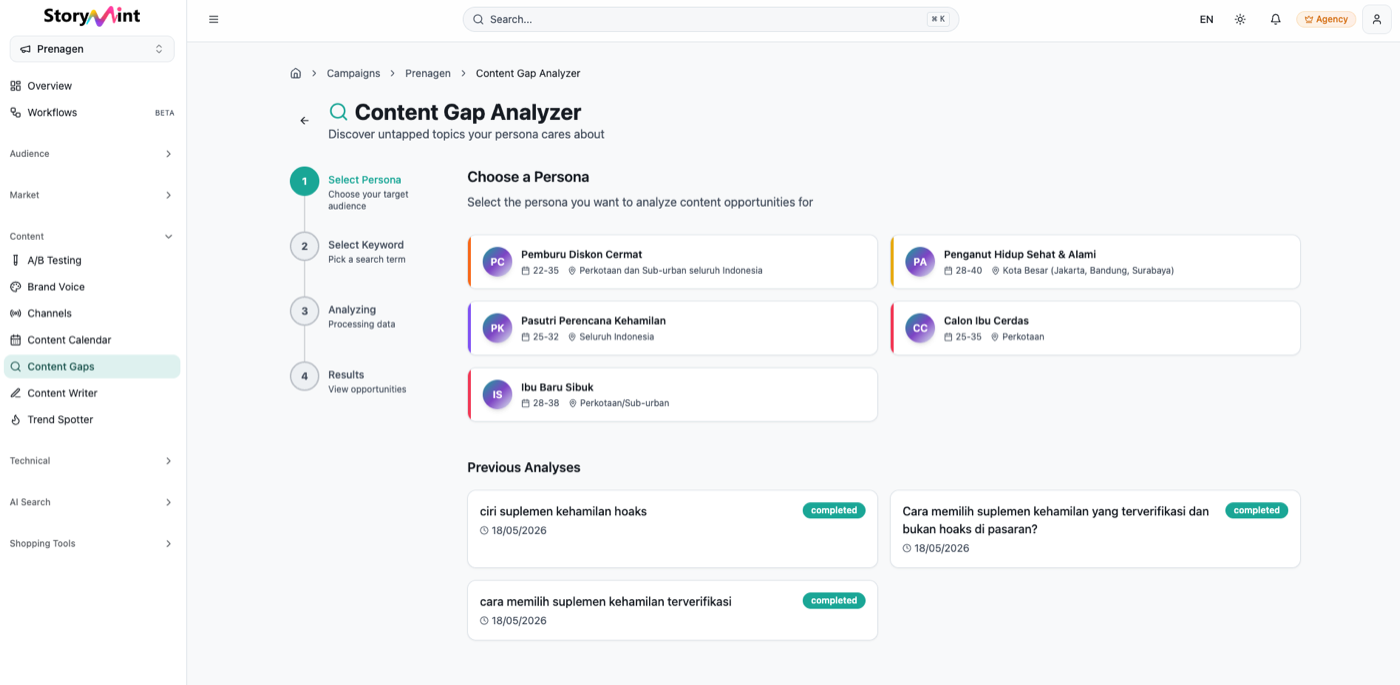
StoryMint is built audience-first, and the Content Gap Analyzer makes that literal: the first step is choosing a persona, before you have typed a single search term. That ordering is the whole argument in miniature. You are not asking "what is everyone searching," you are asking "who am I trying to reach, and what is unresolved for them."
A StoryMint persona is more than a demographic label. Each one carries explicit pain points and buying behaviors. In the Prenagen campaign, for example, the personas include Pemburu Diskon Cermat, the careful bargain hunter: a student or new employee aged 22 to 35 who worries about the monthly budget, researches deeply before committing, and actively hunts for promos. Those traits are not decoration. They become the yardstick every later gap is measured against, which is why the output reads like advice about a person rather than a list of strings.
Choose the query your buyer would actually type
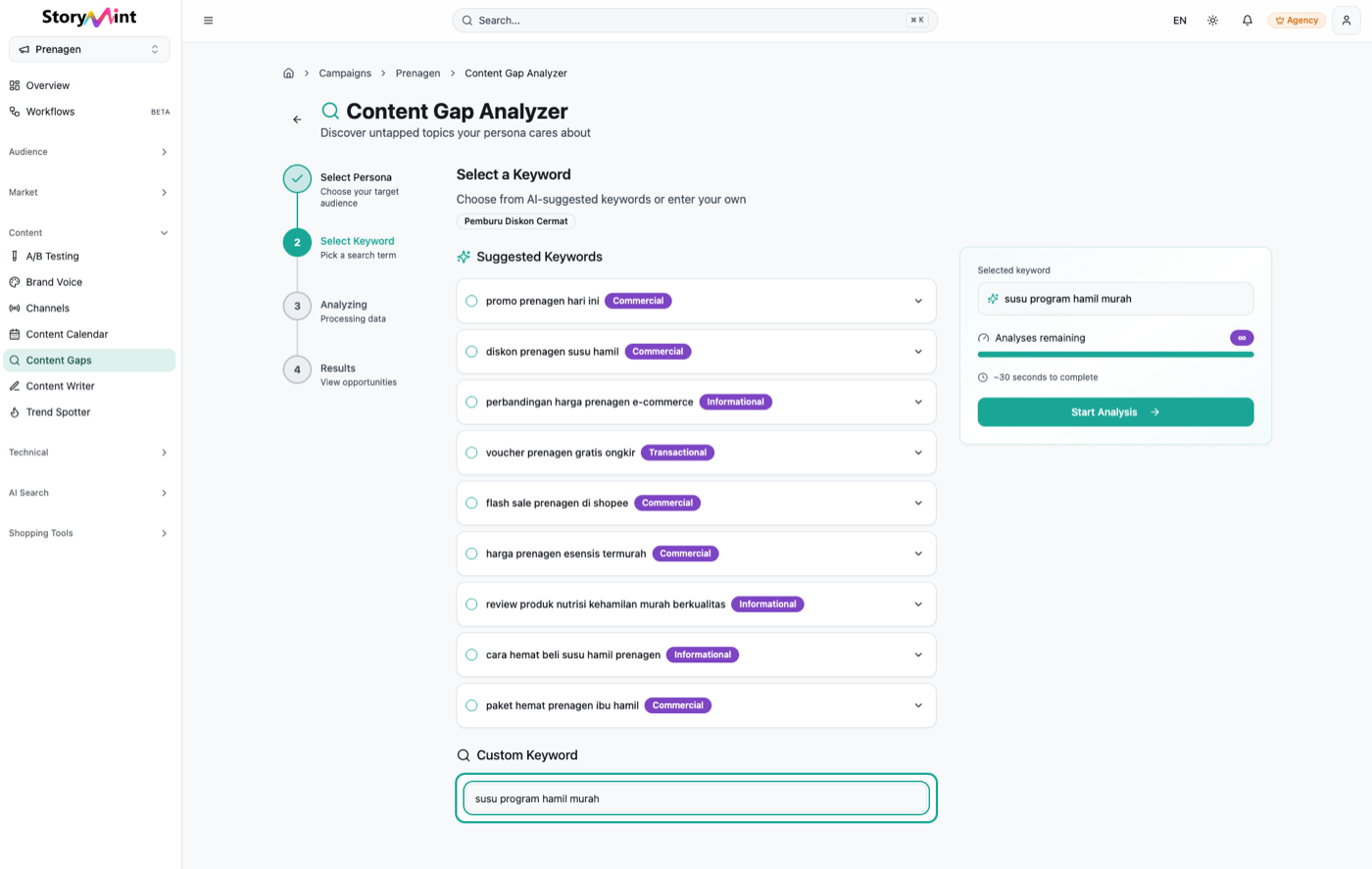
With a persona selected, you pick a keyword. StoryMint suggests options tagged by intent, Commercial, Informational, or Transactional, and you can enter your own. In the run I am describing, the custom keyword was "susu program hamil murah," roughly "affordable pregnancy-program milk."
The intent tag is doing quiet work here. The point is not to chase the fattest volume on the list; it is to choose the query that sits where your persona actually is. A bargain hunter deep in research is closer to a commercial comparison than to a top-of-funnel definition, and picking the matching intent keeps the rest of the analysis pointed at a decision the reader is genuinely close to making.
Read the SERP before you add to it
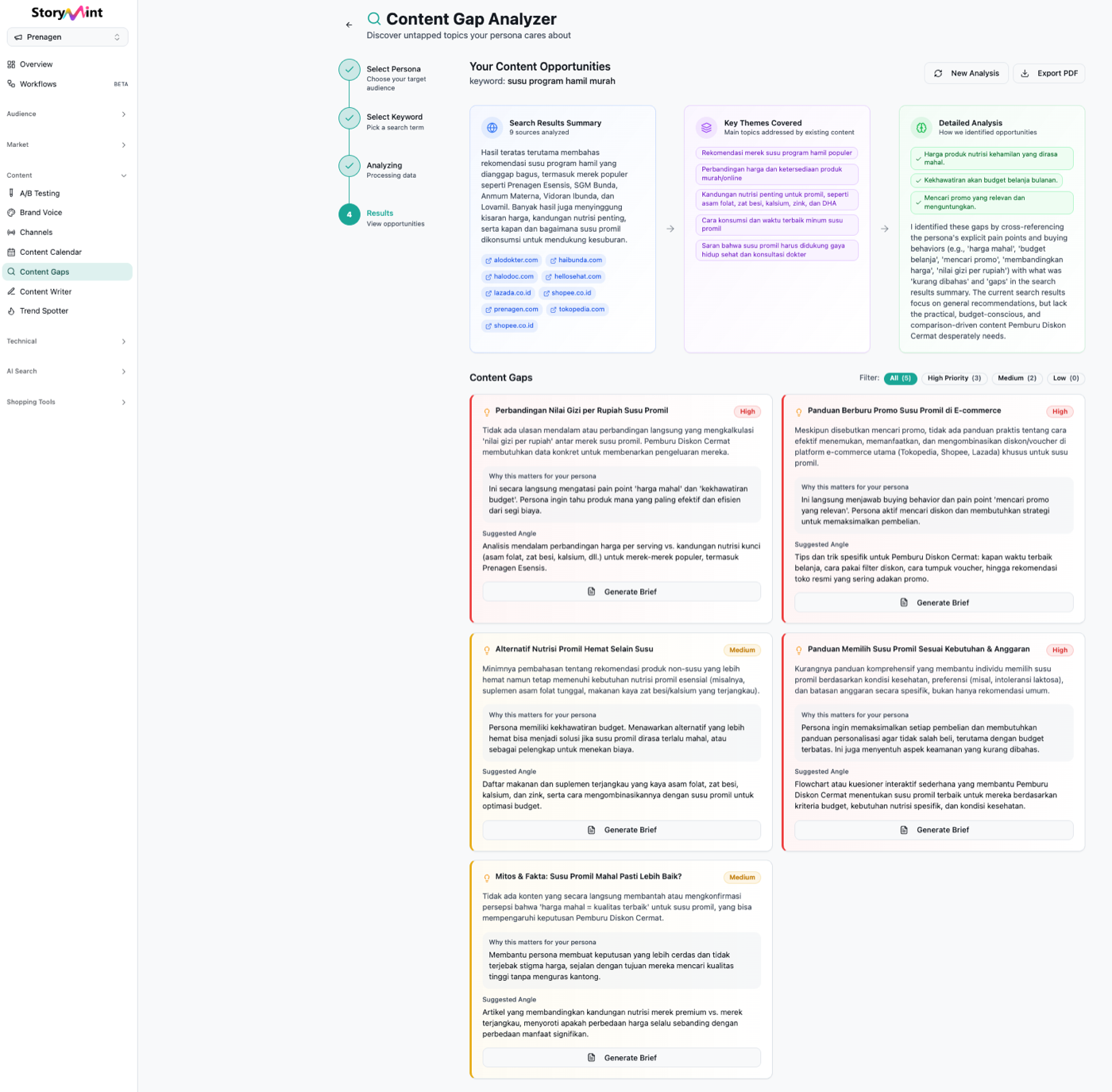
The analysis runs in about half a minute, and the first thing it returns is not a gap. It is a map of what already exists. StoryMint pulls the live results for your query (nine sources in this example) and gives you a Search Results Summary of what those top pages actually cover, plus a Key Themes Covered panel listing the topics the existing content already saturates: popular brand recommendations, price comparisons, the standard nutrition checklist, when and how to drink it.
That cataloguing step is more valuable than it looks, because almost nobody does it. Most content briefs get written without anyone reading the current first page, which is how teams keep producing the article that already exists three times over. You cannot identify what is missing until you have an honest inventory of what is present, and this is that inventory, assembled for you.
Only then does the Detailed Analysis cross-reference the persona's stated pain points and buying behaviors against that inventory. The gap is whatever the persona needs that the page does not supply. The method is legible, which matters: you can see exactly why something was flagged, rather than trusting a black box.
Where the gaps surface, ranked
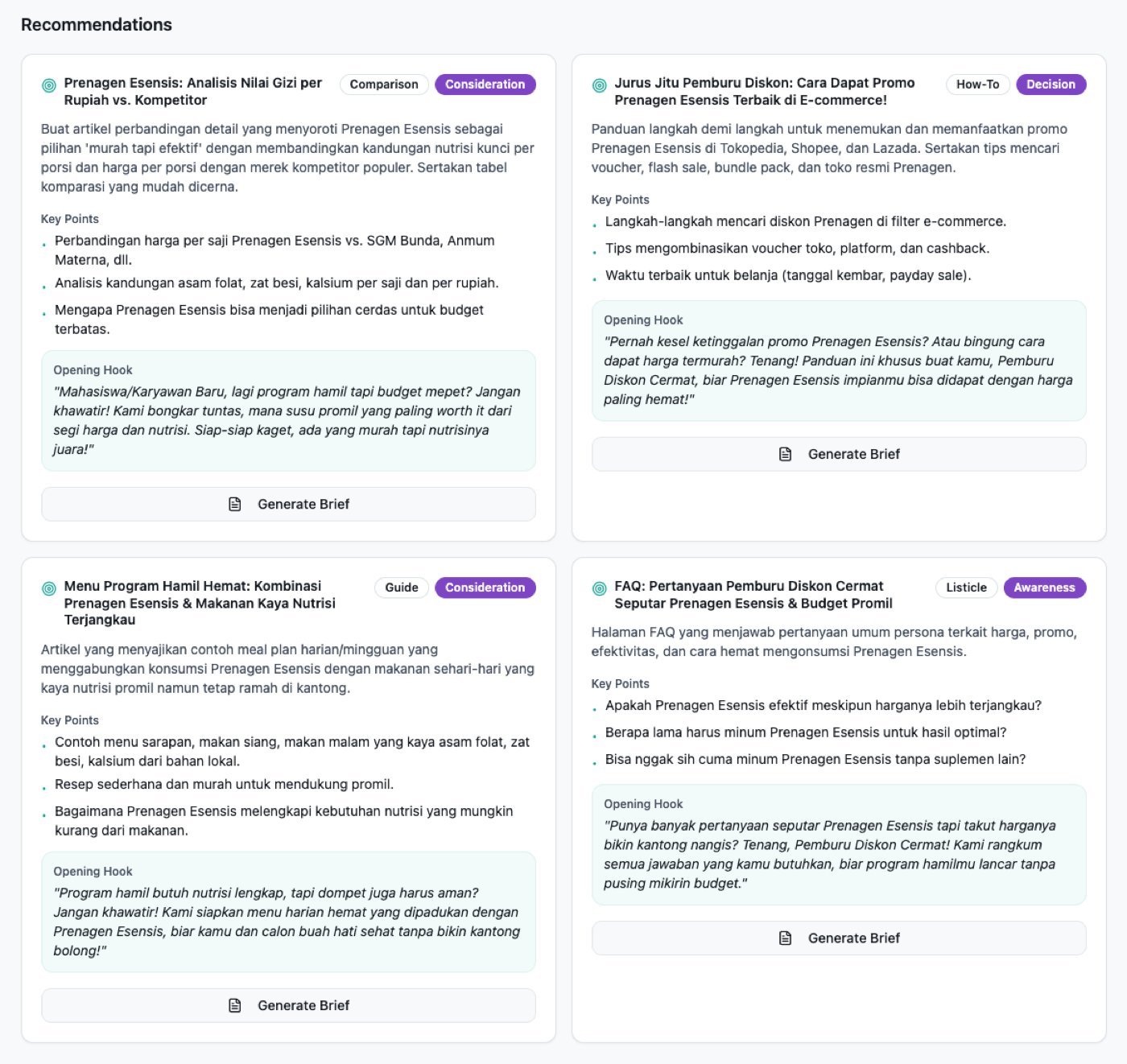
The output is a list of gaps ordered by priority, High through Low. Each one comes with a description of what is missing, a "Why this matters for your persona" line that ties it back to a specific pain point, and a Suggested Angle you could write toward.
For the bargain-hunter persona, the High-priority gaps were telling. One was a nutrition-value-per-rupiah comparison across promil brands, flagged high because it speaks straight to the budget anxiety the persona is defined by. Another was a practical guide to hunting promos across e-commerce platforms, high because it matches the persona's documented buying behavior. Neither of those is a keyword anyone hands you with a volume figure attached. They are unanswered questions a particular buyer carries, which is precisely what a keyword tool is structurally blind to.
Sitting alongside the gaps is a set of Recommendations, each tagged by content format (Comparison, How-To, Guide, Listicle) and by funnel stage (Awareness, Consideration, Decision), and each carrying its key points and an opening hook. That pairing answers the question that usually stalls a brief: not just what to write about, but what shape it should take and where in the journey it belongs. A "gizi per rupiah" comparison wants a table and a Consideration framing; a promo-hunting piece wants a How-To. The tool has already made that call.
From gap to brief without losing the thread
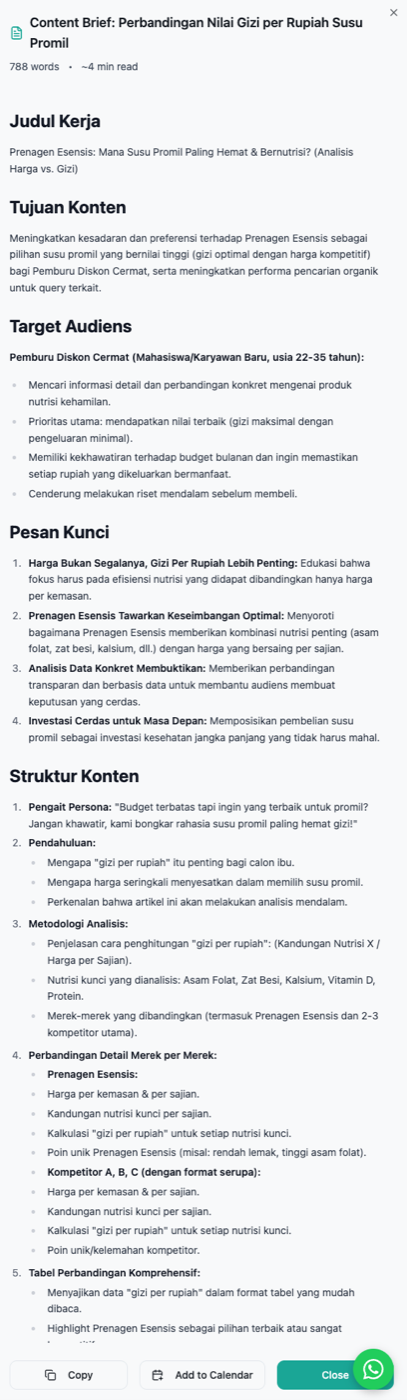
Each gap has a Generate Brief button, and pressing it turns the chosen gap into a working brief: a working title, the content goal, the target audience, the key messages, and a full content structure down to the section level.
The real value is continuity. The persona's pain point flows into the gap, the gap into the angle, the angle into the brief, and the brief into the eventual draft, with the same reader present at every step. In a normal workflow that thread snaps early. The keyword that justified the piece is forgotten by the time a writer opens the document, and what ships is generic because nothing carried the original reader forward. Here the person you started from is still in the room when the writing begins, which is most of why the output lands closer to the audience.
Where a persona-first gap still needs a second opinion
This method is powerful, and it is not complete on its own. Three checks keep it honest.
The first is demand. A gap is evidence of a need, not proof that anyone types it into a search box. A persona can genuinely need something that almost nobody searches for, and writing only to needs with no query behind them is how you produce thoughtful content that no one ever finds. Run the highest-priority gaps past real volume data before you commit a quarter to them. The persona method and the keyword method are complements, not rivals; the strongest content programs run both and write toward the topics that show up in each.
The second is the persona itself. The analysis can only be as honest as the input behind it, and a persona built from assumptions returns gaps built from assumptions. Ground your personas in something real, support tickets, sales-call notes, reviews, search queries you already win, rather than a whiteboard guess about who the buyer might be. The ceiling on the output is set here, at the start.
The third is restraint. Some needs are unmet because there is no audience for them, and serving every long-tail itch a persona has will scatter your effort across pages that cannot earn their keep. The tool surfaces opportunities; deciding which ones are worth a writer's week is still your call. That judgment, what to own versus what to skip, is the same discipline behind any topic ownership strategy worth the name.
The gap analysis built for the blue-links era asked a single question: what are my competitors ranking for that I am not. The question worth asking now is quieter and harder: what does my reader still need that no one on the page has answered. Answer that and you stop competing for parity. You become the only result saying the new thing, which is the one thing an AI engine has a reason to cite. You can run that persona-first analysis end to end in StoryMint, which builds the personas, reads the live results for you, and hands back the gaps ranked by how much they matter to the reader you chose.
See where your brand stands in AI answers today, benchmarked against your competitors, no pitch required.

How DOKU Became the Most Visible Payment Gateway in Indonesian Search
DOKU was the better-known brand and the worse-ranked one. Eight months of technical repair and four content pillars later, it holds more Top 3 rankings than any payment gateway in the market.
Read post →
How to Fix Crawled and Discovered Currently Not Indexed Pages in Search Console
Google found these pages, sometimes even read them, and still left them out of the index. How to tell the two Search Console statuses apart, and which fixes actually move them.
Read post →
How to Set Up the Bing Webmaster MCP (Step by Step)
Connect Claude to your Bing Webmaster Tools account with an open-source MCP server, so you can pull index coverage and query data or submit URLs without leaving the chat. A step-by-step setup for technical SEOs who care about AI search visibility.
Read post →