
How to Use the Ahrefs Content Gap Report to Find Content Ideas

Content gap analysis in Ahrefs shows you the keywords your competitors rank for that you do not. That single view is one of the fastest ways to find content ideas backed by demand you can actually see, rather than guessing what to write next.
The hard part of content has never been writing. It is deciding what to write. Thousands of posts go live every day, and most of them target topics nobody picked on purpose. The content gap report flips that. Instead of starting from a blank page, you start from a list of proven queries your competitors already earn traffic from and you miss entirely.
What the Ahrefs content gap report actually shows
The report compares your site against a set of competitors and surfaces the keywords where they rank and you are absent. You can run it at different levels: a whole domain, a subdomain like blog.example.com, or a subfolder like example.com/blog. Each keyword it returns is a gap, a topic your audience is searching for and finding on someone else's site instead of yours.
The value is that these are not hypothetical ideas. They are queries with real search volume that competitors have already validated by ranking for them. That makes the report a shortlist of demand, not a brainstorm.
Running a content gap analysis in Ahrefs
The feature lives in Ahrefs under Competitive Analysis, and a version of it also sits inside Site Explorer. Ahrefs moves it between the two from time to time, so if you cannot find it in one place, check the other.
The flow is straightforward. Set your own domain as the target. Add up to ten competitor domains, and choose real search rivals, not just the biggest names in your industry, because a site that competes for your exact queries returns far more useful gaps than a giant that ranks for everything. Optionally, restrict the report to keywords where at least one competitor ranks on the first page, which filters out long-tail noise where nobody has really won yet. Then run it.
As a worked example, imagine you run detik.com and want ideas from your direct rivals. You would enter kompas.com, kumparan.com, and viva.co.id as competitors, run the report, and read back the queries those three earn that detik does not.
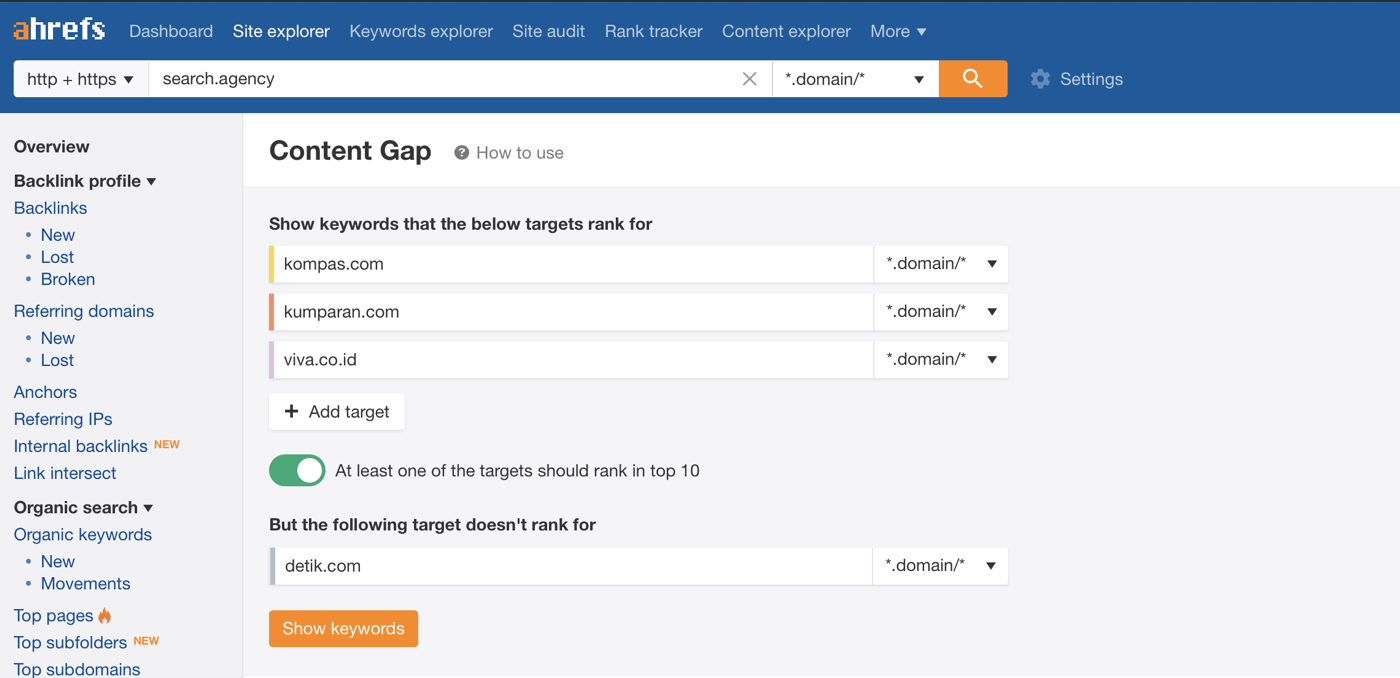
Click on "Show keywords".
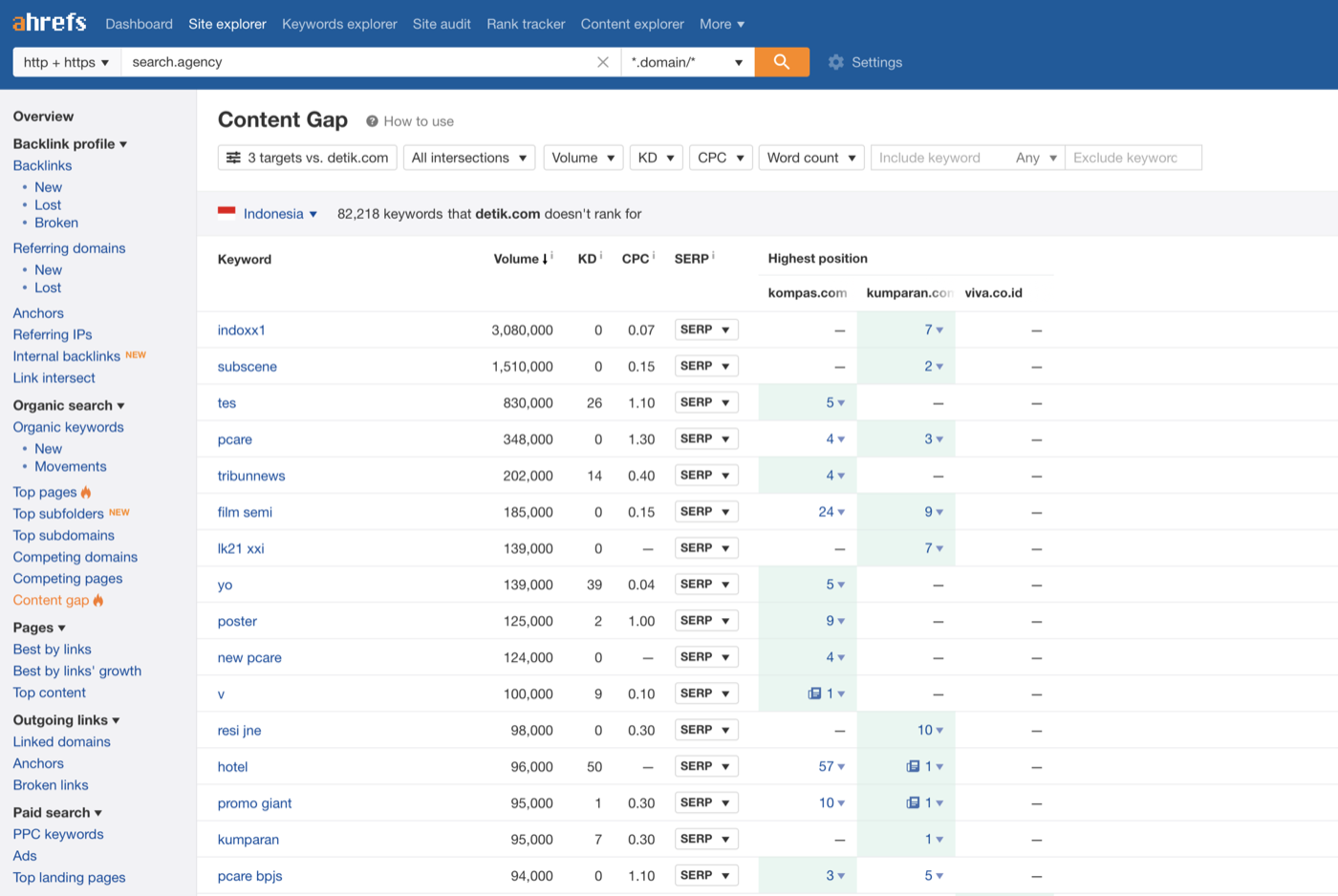
Reading the results
Once it runs, you see every keyword where at least one competitor ranks in the top ten and you do not appear in the top hundred. That gap between their position and your absence is the opportunity.
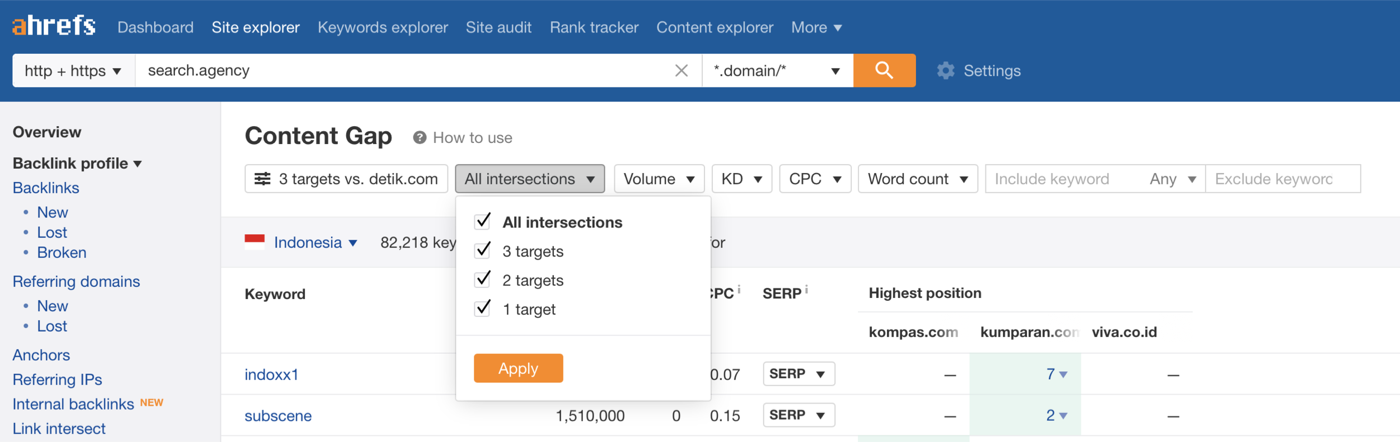
To tighten the list, use the competitor-intersection control to show only keywords where several or all of your competitors rank. A keyword that two or three rivals all cover is usually a topic that matters in your space, not a one-off. Those intersections are the highest-confidence gaps on the page.
Filter for the gaps worth chasing
A raw gap report is long, and most of it is not worth your time. The skill is narrowing it to the handful that will pay off.
Cut anything irrelevant to your business first, no matter how high the volume. A gap you can rank for but that brings visitors who never convert is a distraction, not an opportunity. Then weigh the rest on three things: search volume, so the topic has enough demand to matter; keyword difficulty, so you are not picking a fight you cannot win this quarter; and intent, so the query matches something you actually want to be found for. A mid-volume keyword with clear commercial intent and reachable difficulty beats a high-volume informational term every time.
What you should end up with is not a hundred keywords. It is a focused shortlist you can defend to whoever signs off on the content budget.
Turn the gaps into a plan, not a pile of posts
The most common mistake is treating the report as a to-do list and writing one post per keyword. That produces a scattered library that ranks for nothing in particular.
Group related gaps into topics instead. Several keywords that circle the same subject become one strong piece, or a small cluster of linked pieces, rather than five thin articles competing with each other. This is the foundation of a topic ownership strategy, where you aim to own a subject completely instead of chasing isolated terms. Map each cluster to where the reader is in their journey, and write for the person behind the query rather than the keyword string, which is the difference between content that ranks and content that converts.
The same gaps matter in AI search
Content gap analysis was built for the ten-blue-links era, but it has a second use now. The topics your competitors own on Google are often the same topics AI assistants pull from when they answer a question and cite a source. A gap is therefore not just a ranking you are missing, it is an answer ChatGPT or Perplexity is giving with a competitor's name attached instead of yours. Closing the gap with genuinely strong content is how you start showing up in AI-generated answers, not only in the results page.
Common mistakes to avoid
Three errors waste most of the value. Chasing high-volume gaps that do not fit your business, which fills your site with traffic that never buys. Ignoring intent, which lands you on page one for a query whose searchers want something you do not offer. And running the report once, when competitor gaps shift constantly, so a quarterly pass keeps the ideas fresh.
The content gap report will not write anything for you, but it will make sure that what you do write is aimed at demand you can prove. Run it against your real rivals, filter hard, and build around topics rather than stray keywords. If you would rather hand the whole content engine to a team that does this at scale, here is where to start.
See where your brand stands in AI answers today, benchmarked against your competitors, no pitch required.

How to Build Topical Authority That Google and AI Search Reward
Topical authority is the trust you earn across a whole subject, and topic ownership is how you build it on purpose. Here is the strategy, how to measure it, and why it decides who AI search cites.
Read post →
Most of your brand mentions never link to you, here is how to find and use them
Every unlinked mention of your brand is a link and an AI citation you have not claimed yet. Here is how to find them, prioritize the ones worth chasing, and turn them into both.
Read post →
Instagram and YouTube out-cite every carmaker in Indonesia's car AI Overviews
We ran 149 Indonesian car queries through Google's AI Overviews and saved every answer. Toyota still owns the brand mentions, yet its own website barely shows up in the sources feeding them.
Read post →