
Governing AI-Assisted SEO Content at Enterprise Scale

Contents+
- 01What does AI content governance mean for an enterprise?
- 02Step 1: Set guardrails before you scale usage
- 03Step 2: Assign clear roles in the loop
- 04Step 3: Protect entity and brand consistency
- 05Step 4: Build verification into the workflow, not after it
- 06Step 5: Instrument quality so leadership can see it
- 07The principle to scale
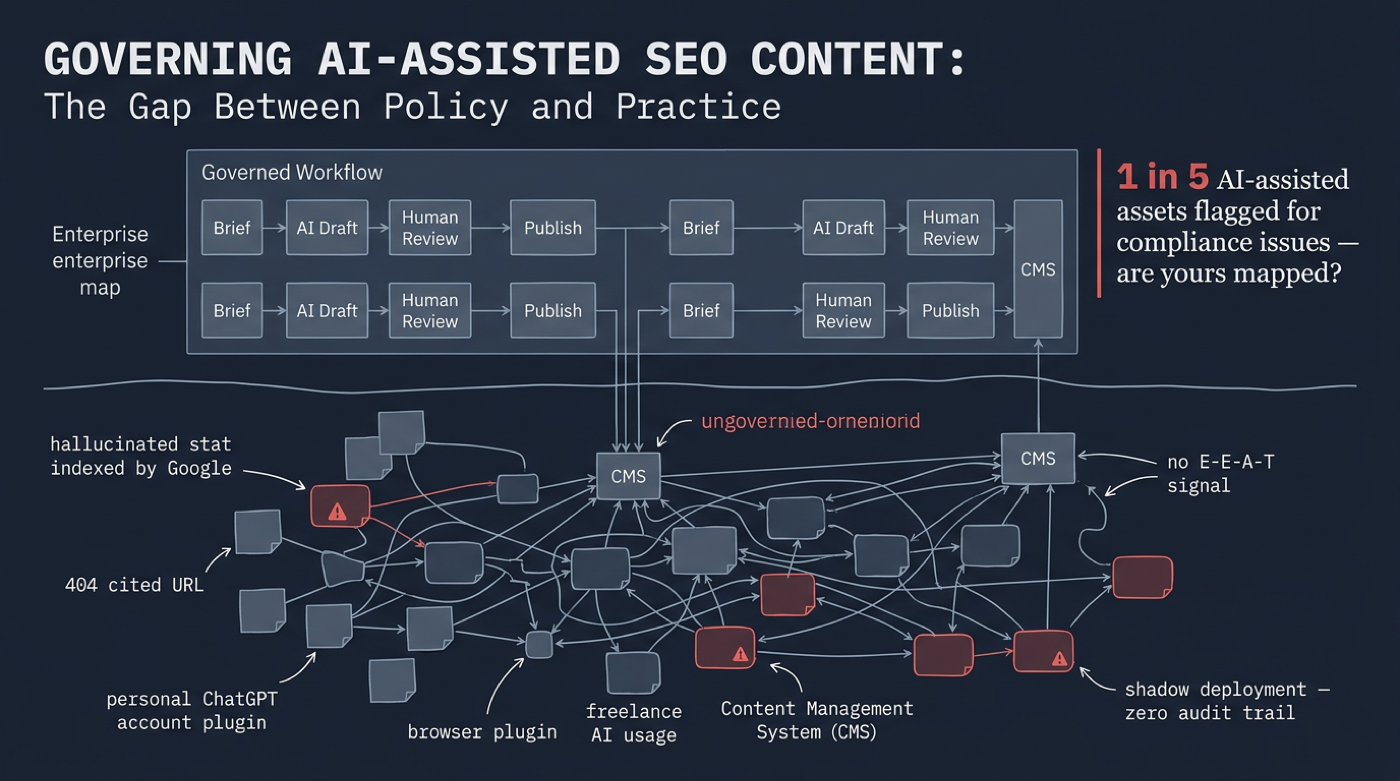
At enterprise scale the question is not whether to use AI for SEO content. Dozens of people across brand, regional and product teams are already using it. The real question is how to govern that usage so output stays accurate, on-brand and ranking-safe across hundreds or thousands of pages. Without governance, AI does not just speed up good work, it industrializes the thin, generic content that search engines and AI engines now discount, and it does so under your brand at volume.
Governance is the difference between AI as a force multiplier and AI as a quality liability. The model is simple to state and harder to operate at scale: a human directs, AI accelerates, a human verifies, and the whole loop is instrumented so leadership can see it is holding.
What does AI content governance mean for an enterprise?
It means a defined set of roles, guardrails and checks that control how AI is used to produce and update content across every team, so quality and brand consistency are enforced rather than hoped for. It turns an individual habit into an accountable, auditable process.
The reason this matters more for enterprises is exposure. One bad AI-written page on a small site is a minor problem. Ten thousand mediocre, unverified pages across a global site is a structural risk to rankings, to how AI engines describe you, and to brand trust. Scale converts a small quality gap into a large liability.
Step 1: Set guardrails before you scale usage
Define what AI may and may not do in your content process, in writing, before you expand it across teams. Permit drafting, restructuring, research acceleration and schema generation. Prohibit publishing unverified claims, fabricated statistics, and unedited drafts.
The guardrails should name the non-negotiables: every factual claim is verified against a real source, every piece has a named human owner, and nothing ships without human review. Written guardrails are what make the policy enforceable across people who will never sit in the same room.
Step 2: Assign clear roles in the loop
Make the human responsibilities explicit so accountability does not dissolve into the tool. A strategist or SEO lead directs the brief and the angle. A subject expert supplies and verifies the substance. An editor enforces brand voice and the guardrails. The AI sits inside that loop as an accelerator, never as the accountable party.
At scale this is a workflow, not a vibe. Each piece should carry an owner and a reviewer of record, so when an engine misquotes you or a page underperforms, there is a person and a process to trace it back to.
Step 3: Protect entity and brand consistency
Give AI tools the canonical descriptions of your company, sub-brands and products, and require their use. Left to general training data, AI will reintroduce the inconsistency that confuses generative engines about who you are.
This is where governance and AI search visibility meet. Consistent, verified descriptions propagated across content are exactly what make engines confident citing you, the connective point between content governance and generative engine optimization.
Step 4: Build verification into the workflow, not after it
Bake fact-checking and schema validation into the publishing pipeline so nothing reaches production unverified. AI can invent statistics and misattribute sources with total confidence, and at volume those errors compound silently.
Pair every AI-assisted draft with a verification step against a real data source, and validate generated schema with a testing tool before it ships. Catching errors in the pipeline is cheap. Catching them after an engine has repeated them across answers is not.
Step 5: Instrument quality so leadership can see it
Measure the output, not just the volume. Track the share of AI-assisted pages that pass review on first pass, ranking and citation performance of AI-assisted versus human-led content, and any corrections triggered by misinformation. These signals tell you whether governance is working.
Reporting this upward matters because leadership will ask whether the efficiency gain is costing quality. Instrumented governance lets you answer with evidence, which connects directly to how you measure AI search visibility.
The principle to scale
A human directs, AI accelerates, a human verifies. Enterprises that wire that loop into roles, guardrails and pipeline checks get the speed of AI with the quality their rankings and brand depend on. Those that skip the bookends get volume that quietly erodes both. If you want help designing and running that governance model, that is part of what our AI search team in Indonesia does.
See where your brand stands in AI answers today, benchmarked against your competitors, no pitch required.

How to Run ChatGPT Ads in Indonesia
ChatGPT ads are now open to Indonesian advertisers. We set up two campaigns in Ads Manager and documented every screen, from the first ad preview to the pixel and context hints.
Read post →
Augmented Visibility, How AI Recommendations Can Lead to Bad Business
AI assistants now build agency shortlists for buyers, and some of the sources behind them are paid rankings or lists an agency wrote about itself. What augmented visibility is, and how to check an AI-recommended agency before you sign.
Read post →
How 16 Indonesian Nutrition Brands Score on AI Search Authority
We scored 16 of Indonesia's biggest milk and nutrition brands on the graph signals that decide whether AI search names them. The category average was 19.9 out of 100, and no brand has built the foundation yet.
Read post →