
What Is Generative Engine Optimization (GEO)? The Complete 2026 Guide

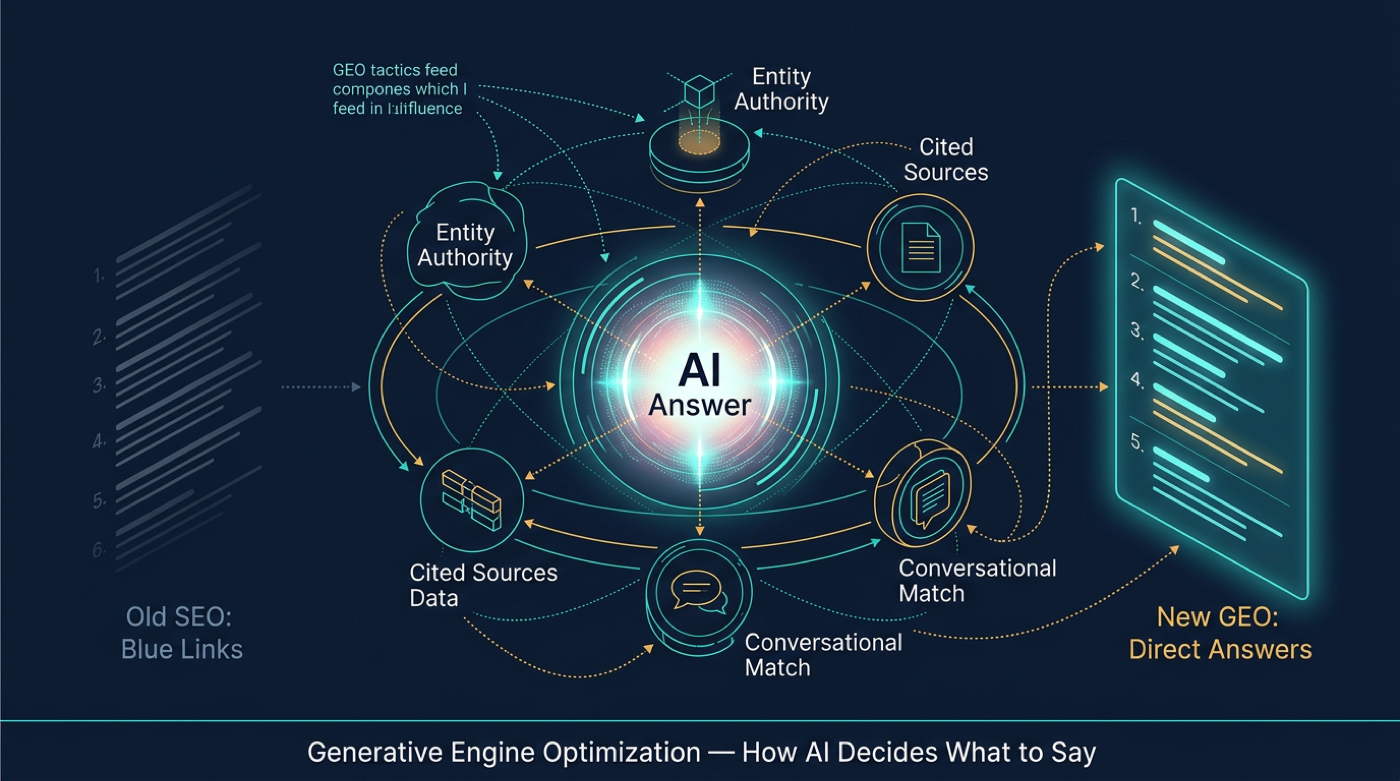
Generative Engine Optimization (GEO) is the practice of structuring your content and brand presence so that generative AI engines like ChatGPT, Google Gemini, Perplexity and Google AI Overviews cite, quote and recommend you inside their answers. Where traditional SEO competes for a ranking position on a results page, GEO competes for a sentence inside an AI-generated answer.
That difference is the whole story. A person used to scroll ten blue links and choose one. Now they ask an AI a question and read one synthesized answer. If your brand is not inside that answer, you do not exist for that query, no matter how well you rank on the classic results page.
Most Indonesian brands still measure success by where they rank on Google. That number no longer tells you whether you are visible where buyers increasingly look, which is inside the AI answer itself. Closing that gap is what GEO is for, and it anchors everything else we publish on AI search.
What does GEO stand for and what does it mean?
GEO stands for Generative Engine Optimization. It means optimizing your content, structure and authority so that generative AI systems select your material when they compose an answer for a user.
A generative engine is any system that produces a written answer rather than a list of links. ChatGPT, Gemini, Perplexity, Microsoft Copilot, Claude and Google AI Overviews are all generative engines. Each one reads across many sources, decides which are trustworthy and relevant, and writes a single response. GEO is the discipline of being one of the sources it trusts.
You will also see the term AEO, or Answer Engine Optimization. In practice GEO and AEO describe the same goal from slightly different angles. GEO emphasizes the generative model writing the answer. AEO emphasizes the answer being the unit of competition. We treat them as one discipline.
How is GEO different from SEO?
SEO optimizes for a ranking position. GEO optimizes for a citation inside an answer. The work overlaps, but the target is different.
The table below shows where the two diverge.
| Dimension | Traditional SEO | Generative Engine Optimization |
|---|---|---|
| Goal | Rank in the list of links | Get cited inside the AI answer |
| Unit of competition | A page for a keyword | A sentence or fact for a question |
| Who decides | Search ranking algorithm | The generative model selecting sources |
| What wins | Relevance, links, technical health | Clarity, structure, verifiable authority |
| Measure of success | Position and clicks | Citations, mentions, recommended status |
Crucially, GEO does not replace SEO. AI engines still lean heavily on the web they crawl and rank. Strong SEO makes your content discoverable. GEO makes it quotable once discovered. You need both, and the brands that treat them as one program will pull ahead of the ones that treat AI search as a separate experiment.
How do AI engines decide what to cite?
Generative engines favor content that is clearly structured, factually specific, and demonstrably authored by a credible source. Three signals matter most.
The first is structure. Engines lift answers that are self-contained. A heading phrased as a real question, followed immediately by a direct two-sentence answer, is far easier for a model to extract and quote than the same information buried in the middle of a long paragraph.
The second is specificity. Named entities, real numbers, dates and concrete examples are more citable than vague claims. A sentence like "Perplexity had over 2.7 million monthly branded searches in Indonesia in 2026" is quotable. A sentence like "Perplexity is getting popular" is not.
The third is authority. Engines weight who is saying something. A clear author byline, a real bio with credentials, an "updated on" date and consistent expertise across a topic all raise the chance of being cited. This is the same E-E-A-T idea that search has used for years, now applied to which voice an AI is willing to repeat.
What is GEO worth in Indonesia right now?
The opportunity in Indonesia is unusually open because the category is early. Formal terms like "generative engine optimization" and "answer engine optimization" carry almost no search volume here yet, which means very few local sites have claimed them. At the same time, Indonesians are already adopting the engines themselves at scale, with hundreds of thousands of monthly searches for tools like ChatGPT and Perplexity.
That gap, low competition for the discipline and high adoption of the tools, is the window. The brands that publish clear, structured, authoritative content now will be the default citations when this demand matures. Waiting until "GEO" has high search volume means arriving after the citations have already been awarded to someone else.
How do you start with GEO?
Start by making your most important pages answerable, then prove your authority, then measure what the engines actually say about you.
Make pages answerable by restructuring them around real questions with direct answers, adding a plain definition near the top of each page, and marking up the content with FAQ and Article schema so machines can parse it. Prove authority by attaching real authors, citing real data, and covering a topic in depth rather than in a single thin post. Measure by testing the prompts your buyers actually use across ChatGPT, Perplexity and Gemini, and tracking whether your brand shows up.
The detailed mechanics of getting cited are covered in our companion guide on how to get your brand cited in ChatGPT, Gemini and Perplexity. Prefer to hand the whole program to a team? That is where our AI search work comes in.
See where your brand stands in AI answers today, benchmarked against your competitors, no pitch required.

How to Run ChatGPT Ads in Indonesia
ChatGPT ads are now open to Indonesian advertisers. We set up two campaigns in Ads Manager and documented every screen, from the first ad preview to the pixel and context hints.
Read post →
Augmented Visibility, How AI Recommendations Can Lead to Bad Business
AI assistants now build agency shortlists for buyers, and some of the sources behind them are paid rankings or lists an agency wrote about itself. What augmented visibility is, and how to check an AI-recommended agency before you sign.
Read post →
How 16 Indonesian Nutrition Brands Score on AI Search Authority
We scored 16 of Indonesia's biggest milk and nutrition brands on the graph signals that decide whether AI search names them. The category average was 19.9 out of 100, and no brand has built the foundation yet.
Read post →