
How to Get Your Content Cited by AI Assistants

Contents+
- 01Citation is not ranking, and that is the whole point
- The four extraction questions
- 02The structural traits that get content picked up
- 03Write direct answer blocks that survive extraction
- A working example
- 04Corroboration and entity signals carry the second half of the work
- 05Schema and technical signals that actually help
- 06Measuring whether it is working
- Further reading
- 07Work with Search Agency
Most teams treat AI search like a slightly stranger version of Google. They write the same article, add a few FAQ blocks, ship it, then wonder why ChatGPT keeps citing a Reddit thread and a Wikipedia stub instead of the page they spent three weeks on.
The mismatch is real, and it is structural. Generative engines do not rank pages and serve them. They retrieve passages, evaluate them against the question, and decide whether the wording is usable inside an answer. A page can be the best resource on the web by every classical metric and still get skipped because the engine could not extract a clean, self contained sentence to quote.
This post is about that extractable layer of your content. Not the meta description, not the keyword density, not the backlinks profile. The actual paragraphs, the way they answer questions, the way they signal authority, and the way they make a generative model confident enough to pull a quote without hedging.
The good news is that the underlying mechanics are knowable. The Princeton GEO research, the citation pattern studies from major AI visibility platforms, and a year of practical experimentation have converged on a small number of moves that consistently raise citation rates across ChatGPT, Claude, Gemini, and Perplexity.
Citation is not ranking, and that is the whole point
A traditional search result is a ranked link. A generative answer is a synthesis. Those two outputs reward different content shapes.
Ranking rewards a page that covers a topic comprehensively, attracts links, and matches search intent in aggregate. Citation rewards a page that contains specific extractable passages: a short definition, a numbered procedure, a comparison, a statistic with a source. A model needs material it can quote with confidence, not material it has to summarize and risk distorting.
This is why the same brand that dominates organic results for a query can be invisible inside the AI Overview for that same query. The traditional optimization work, covered in our SEO service playbook, gets the page indexed and crawled. AI citation is a separate retrieval problem layered on top.
The four extraction questions
Before publishing any page that targets AI visibility, ask four questions of every section:
1. Is there a single self contained paragraph that answers a specific question without needing the rest of the page for context?
2. Does any concrete claim in this section have a source, a date, or a number attached to it?
3. Would a model citing this passage need to paraphrase, or could it quote a clean sentence verbatim?
4. Does the section make the author, the brand, or the publication identifiable as an authority on this exact subtopic?
If a section fails two or more of those questions, it is not extractable. Rewrite it before worrying about anything else.
The structural traits that get content picked up
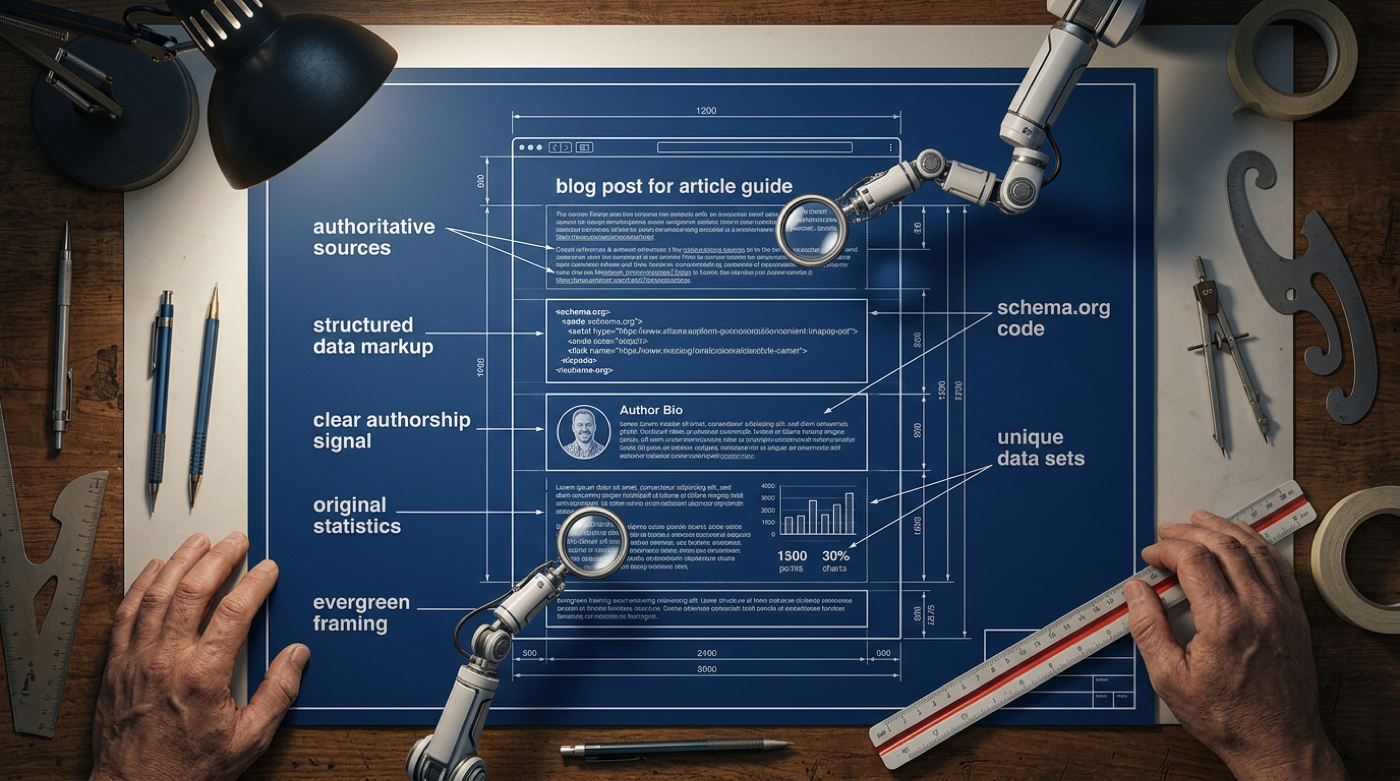
The Princeton GEO study tested six content modification strategies across 10,000 queries and 10 generative engines. The interventions that produced the biggest gains were not stylistic. They were structural: adding statistics with sources, adding quotations from named experts, citing third party sources inline, and improving the fluency of sentences so they could be quoted without editing.
In their evaluation, these moves lifted visibility in generative responses by up to 40 percent over an unoptimized baseline. The effect was uneven across domains, meaning the optimal mix depends on the topic, but the direction of effect was consistent.
Three takeaways have held up well in practice:
The first is that statistics are citation magnets, but only when they are attributed. A claim like "open rates have declined 12 percent year over year" with no source attached is unusable for a model that does not want to invent a reference. The same claim with a clear inline attribution to a recognizable research source becomes quotable.
The second is that direct quotations from named individuals act as anchors. Models prefer to attribute a strong claim to a person rather than make it themselves. An article that quotes a specific researcher, engineer, or operator gives the model permission to repeat the claim with that attribution intact.
The third is that fluency matters more than people expect. Awkward sentences full of nested clauses do not survive extraction cleanly. Short declarative sentences with a single subject and a single verb do.
Write direct answer blocks that survive extraction
The most consistently citable unit of content on any page is the direct answer block. Not the FAQ schema. Not the bullet list. The paragraph immediately under a question shaped heading.
A direct answer block has three properties. It is short, ideally 40 to 60 words. It answers the heading question completely in its first sentence. And it stands alone, with no pronouns or references that depend on previous paragraphs to make sense.
A working example
Compare these two openings to a section titled "What is answer engine optimization."
Version one: "AEO is one of the most important topics in modern search. As more users turn to AI for answers, it becomes essential to optimize content accordingly. There are many factors involved, and we will cover them in depth below."
Version two: "Answer engine optimization is the practice of shaping content so it can be retrieved and quoted by AI answer engines like ChatGPT, Perplexity, and Google AI Overviews. Unlike traditional SEO, AEO optimizes for inclusion inside an answer, not for a ranked link on a results page."
The second version is shorter, denser, self contained, and contains a useful contrast. Any model retrieving for the query "what is AEO" can pull that paragraph verbatim and the result reads cleanly. The first version is throat clearing.
This single discipline, replacing throat clearing with direct answer blocks under every question shaped heading, will move citation rates more than any schema rollout.
Corroboration and entity signals carry the second half of the work
Structural extractability gets a passage into the candidate pool. Whether the engine actually quotes it depends on something else: corroboration.
Generative engines weight sources higher when the same claim is repeated across independent destinations. If your brand position appears consistently across Wikipedia, Reddit threads, YouTube tutorials, review sites, industry publications, and your own owned content, the engine treats that convergence as evidence the claim is reliable. If you are the only source for a strong claim, you get downgraded.
This is why an AI visibility strategy cannot be a pure on page strategy. The on page work, the structural extractability we have been discussing, sets the ceiling. The off page work, the consistent presence of your brand across the third party surfaces these engines actually crawl, determines whether you hit it.
A practical sequence works like this. Identify the 20 to 30 prompts that genuinely matter for your category. Audit which sources currently get cited for those prompts inside each major engine. Note which third party surfaces dominate, because they vary: ChatGPT leans heavily on Wikipedia, Perplexity weights Reddit, Google AI Overviews pulls a different blend that includes forums, news, and structured commercial content. Then plan a content and presence program that puts your brand and your claims into those surfaces with the same wording you use on your own site.
The author entity matters here too. A page written by a credentialed, identifiable person, with a published author page, a record of expertise on the same topic, and consistent presence across LinkedIn, podcasts, and industry events, is more citable than the same page written by a faceless "team." Build the entity intentionally. Our case study shows what this looks like in production for brands operating in competitive verticals.
Schema and technical signals that actually help
Schema markup is the most over claimed lever in this space. It will not make a poorly written page citable. What it does, reliably, is reduce extraction errors on pages that are already well structured.
The structured data types with the most consistent practical effect are Article, FAQPage, HowTo, Organization, Person, and Product. They give engines a clean fact graph: who wrote this, when, about what, with what credentials, on what entity. Without that graph the engine has to infer the answers from page text, and inference introduces error.
A few technical signals matter beyond schema. Visible publish and update dates raise citation rates, because generative engines penalize stale content sharply. Crawlable and renderable HTML matters, because client side rendered content is regularly missed by AI crawlers that do not execute JavaScript. Internal anchor text matters, because it shapes how the engine understands what each page is about. And canonical entity linking on your own site, the practice of linking the same anchor to the same canonical resource consistently, gives the engine an internal consensus to lean on.
If you want to go deeper on the surrounding tracking and reporting that makes all of this measurable, our digital measurement service covers the dashboards that distinguish meaningful citation lift from random variance.
Measuring whether it is working
You cannot manage what you do not track, and AI citation tracking is genuinely harder than rank tracking. The output is non deterministic. The same prompt fired twice can return different sources. The engines themselves change retrieval behavior without notice.
Two metrics are stable enough to anchor a program. The first is citation rate by prompt: out of your tracked priority prompts, how many return a response that cites your brand or your owned content in some position. The second is share of mention: across responses that cite anyone in your category, what percentage cite you versus competitors.
Run the same prompt set on a fixed cadence, weekly or biweekly, against each of the engines you care about. Track movement, not absolute values. A 15 percent lift in citation rate over six weeks after a structural rewrite is a real signal. A two point bounce on a single day is noise.
Pair the citation tracking with a content level diagnostic. Which of your pages have ever been cited, even once. Which queries triggered the citation. Which passage was actually quoted. That triangulation tells you which structural choices are working and which are not, and it is the only honest way to feed a roadmap of further rewrites.
AI visibility is not a different game from search; it is the same game with a different reward function. The brands that win are not the ones publishing more, they are the ones writing in shapes that survive extraction and building the off page corroboration that gives engines confidence to quote them.
Further reading
- GEO: Generative Engine Optimization (Princeton, KDD 2024: The first peer reviewed study to quantify which content modifications lift visibility in generative engines, including the 40 percent benchmark cited above.
https://arxiv.org/abs/2311.09735
- How schema markup fits into AI search, without the hype (Search Engine Land): Honest practitioner read on what structured data does and does not do for AI citations.
https://searchengineland.com/schema-markup-ai-search-no-hype-472339
- How ChatGPT, Perplexity, Gemini, and Claude decide what to cite (Yext): Side by side breakdown of how each major engine sources information, with the platform specific patterns that matter for planning.
https://www.yext.com/blog/how-chatgpt-perplexity-gemini-claude-decide-what-to-cite
Work with Search Agency
Most brands have the on page raw material to be cited and are losing visibility to structural and corroboration gaps they have not diagnosed. Search Agency is a specialist AI search partner that runs measurable GEO and AEO programs for brands operating in competitive categories, focused on durable citation performance rather than one off lift. Explore our AI Search Optimization service when you are ready to make your content extractable by the engines your customers actually use.
See where your brand stands in AI answers today, benchmarked against your competitors, no pitch required.