
Search Intent Classification That Survives Google Updates

Contents+
- 01Why intent labels rot
- 02The four buckets are a starting point, not the system
- Intent is observed, not declared
- 03Read the SERP, not the keyword
- What to capture for each tracked query
- 04A framework you can apply this week
- 05When intent splits or shifts
- The same logic applies to AI answers
- 06Build a reclassification cadence
A core update rarely changes your rankings at random. More often it re-reads what people want from a query and rewards the pages that match the revised reading. Teams that treat search intent as a label they assigned once, stored in a spreadsheet, and never revisited are the ones who watch positions evaporate and call it volatility. It was not volatility. The intent moved, and their classification did not.
Search intent is the most quoted concept in SEO and one of the least operationalized. Most teams can recite the four buckets. Far fewer have a system that keeps those buckets accurate across thousands of URLs as the SERP shifts underneath them. At enterprise scale the gap is expensive: a single mis-mapped page type on a high-value commercial term can cost more traffic than a hundred well-built blog posts earn.
This piece is about building intent classification that holds. Not the definitions you already know, but the operating model behind them: where the real signal lives, how to read it, and how to keep your classification current without manually re-checking forty thousand keywords every quarter.
Why intent labels rot
The standard workflow assigns intent at keyword-research time. An analyst pulls a list, tags each term informational, commercial, transactional, or navigational, and hands the sheet to content and product teams who build pages against those labels. The labels then sit untouched for a year or more.
The problem is that intent is not a property of the keyword. It is a property of what searchers currently want, which Google infers from behavior and expresses through the SERP. The phrase "best running shoes" carried mostly comparison-style intent for years; in many markets it now returns a blend of editorial roundups, shopping carousels, and brand landing pages, because buying behavior shifted. The keyword string never changed. The intent did.
When you hard-code a label, you freeze a snapshot of a moving target. Every core update that re-weights intent leaves your classification a little more wrong. The decay is invisible until a page that was perfectly built for last year's intent stops ranking, and nobody can explain why, because the spreadsheet still says "commercial."
The four buckets are a starting point, not the system
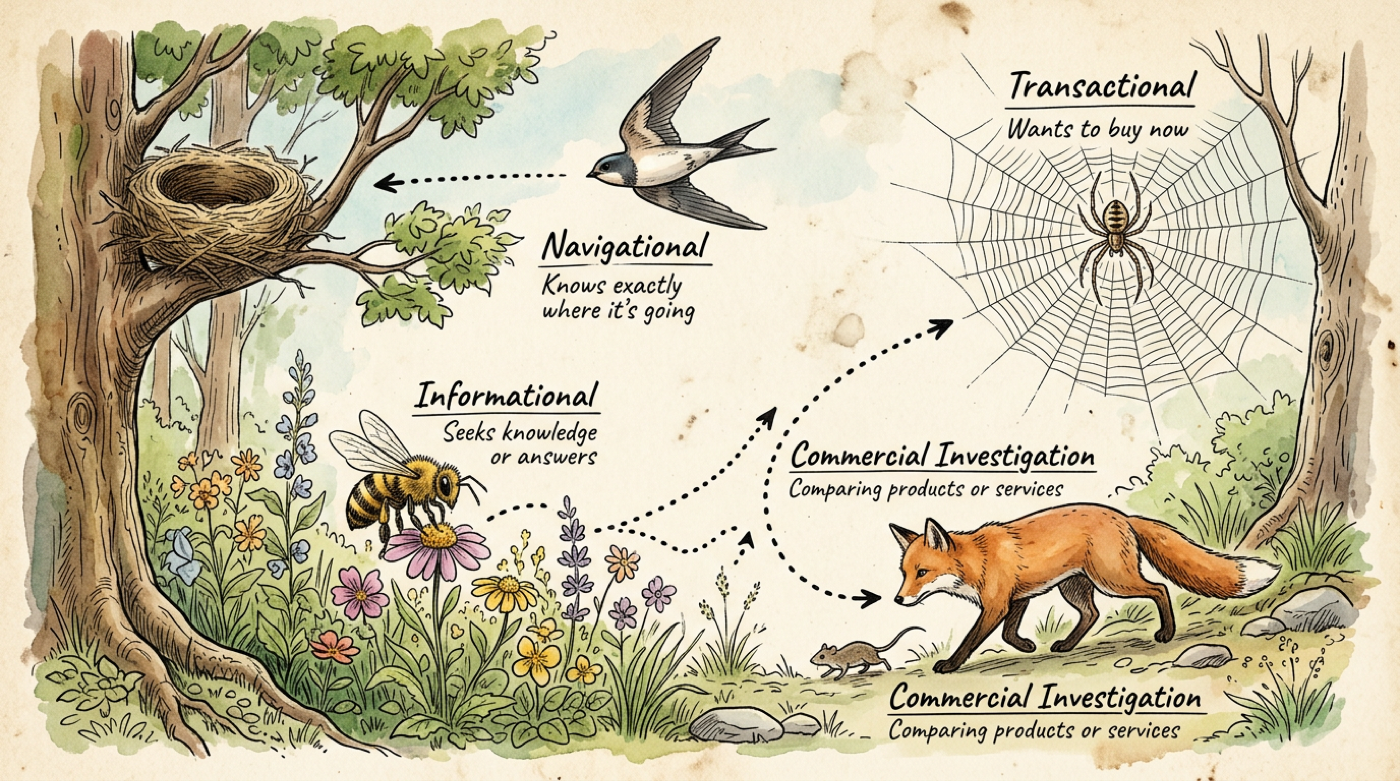
Andrei Broder's 2002 taxonomy gave us the original three-way split: navigational, informational, transactional. The industry later added commercial investigation to capture the compare-before-you-buy middle. Google's own evaluators work from a richer set: Know and Know Simple, Do, Website, and Visit-in-person, each scored against a Needs Met scale that asks whether the result actually satisfies the likely intent.
Those frameworks are useful for vocabulary. They are not a classification system, because they describe categories without telling you how to assign a live query to one or how to notice when the assignment changes. The four buckets are the alphabet, covered well in any introductory guide to search intent. The system is what you do with the letters.
Intent is observed, not declared
The durable shift is to stop declaring intent from the keyword and start observing it from the SERP. The first page of results is Google's own answer to the question "what do people want here." If eight of the top ten results are comparison articles, the intent is commercial investigation regardless of what your spreadsheet says. If the page fills with product listings and a map pack, the intent has a transactional and local component you need to serve, and no amount of well-written prose will substitute for the page type the SERP is asking for.
Read the SERP, not the keyword
The most reliable classification method is to analyze what already ranks. There is a useful lens for this work, often called the three C's: content type, content format, and content angle.
Content type is the dominant page format Google rewards for the query, whether that is a blog post, product page, category page, tool, or video. Content format is the specific shape within that type: a how-to, a listicle, a comparison, a definition. Content angle is the framing searchers respond to: beginner versus advanced, current-year freshness, price-led versus quality-led. Reading all three tells you not only what kind of page to build, but how to build it so it matches the prevailing expectation.
What to capture for each tracked query
For any query that matters, record four things: the dominant content type across the top ten, the prevailing format, the SERP features present (featured snippet, people also ask, shopping, local pack, video carousel), and the proportion of results that are editorial versus commercial. That snapshot is your intent classification. It is concrete, it is observable, and it can be re-run on demand rather than re-argued in a meeting.
A framework you can apply this week
Here is a five-step model for classifying intent in a way that survives updates.
1. Sample the SERP, not the string. For each priority keyword, capture the top ten results and tag the dominant content type and format. The majority pattern is your primary intent.
2. Flag mixed SERPs. If no single content type holds a clear majority, the query has fractured intent. Mark it explicitly rather than forcing a single label onto it.
3. Map intent to a page type, not a single page. Decide which kind of page serves the observed intent: a guide for informational, a comparison for commercial investigation, a product or category page for transactional, a location page for visit-in-person.
4. Set a Needs Met bar. Borrow Google's question directly: would a searcher with this intent be fully satisfied by your page, or only partly? Partly-met pages are your highest-leverage rewrites.
5. Schedule re-observation. Attach a re-check date to every classification. High-volatility commercial terms get checked quarterly; stable informational terms can wait two or three times longer.
The output is not a static label. It is a living record with a timestamp and a review cadence, which is the difference between a classification that ages well and one that quietly rots.
When intent splits or shifts
Two patterns break naive classification more than any others.
The first is fractured intent, where a single query serves multiple goals at once. Consider a B2B software company tracking the term "invoicing." The SERP returns a definition box, several how-to guides, two product pages, and a comparison roundup. There is no single correct page type. The durable response is to serve the intent with a small cluster: a strong informational hub that answers the definitional and how-to demand, linked tightly to a commercial comparison page and the product page itself. One URL cannot win a fractured SERP; an architecture can. This is also where measuring whether each page actually matches its slice of intent becomes essential, and where a measurement layer that tracks engagement by page type earns its keep.
The second pattern is seasonal or event-driven intent drift. A query like "tax filing" leans informational for most of the year and tilts sharply transactional in filing season. If your classification is a single annual label, you serve the wrong page type for the months that matter most. Calendar the known shifts and re-observe the SERP ahead of each one rather than reacting after the traffic has already moved.
The same logic applies to AI answers
Intent does not stop at the blue links. The systems behind AI assisted answers resolve the same underlying goal before they generate a response, and they pull from sources that match it. A page built for the wrong intent will not be cited, the same way it will not rank. Teams investing in optimizing for AI assisted answers should run the same observation discipline on the SERP and on the sources those engines cite, because the intent signal is shared even when the surface is different.
Build a reclassification cadence
At enterprise scale you cannot reclassify by hand. The system needs three components: triggers, ownership, and thresholds.
Triggers are the events that force a re-check: a confirmed core update, a ranking drop beyond a set threshold on a priority term, or a calendar date for seasonal queries. Ownership answers who acts when intent shifts, because a move from informational to transactional often changes which team owns the page. Thresholds keep the work bounded: you do not re-observe everything, you re-observe the queries where being wrong is expensive.
A practical pattern that scales is tiered cadence. Tier one is your revenue-driving head terms, re-observed quarterly and after every confirmed update. Tier two is the supporting mid-tail, on a semi-annual cycle. Tier three is the long tail, sampled rather than fully re-checked, with spot audits when a cluster underperforms. The payoff from this discipline is visible in documented case studies where reclassification, not new content, recovered the traffic that an update had quietly redirected to better-matched competitors.
Intent is not a label you assign; it is a reading you keep current. The teams that treat it as a live signal, observed from the SERP and re-checked on a cadence, are the ones whose rankings stop feeling like weather and start behaving like a system.
When intent shifts and your pages do not, rankings slip for reasons no one on the team can name. We build search intent classification as a living system, observed from the SERP and re-audited on a cadence, so your highest-value pages stay matched to what searchers actually want. The outcome is measurable, durable performance from a specialist team rather than a one-time tagging exercise.
See where your brand stands in AI answers today, benchmarked against your competitors, no pitch required.

How to Run ChatGPT Ads in Indonesia
ChatGPT ads are now open to Indonesian advertisers. We set up two campaigns in Ads Manager and documented every screen, from the first ad preview to the pixel and context hints.
Read post →
Augmented Visibility, How AI Recommendations Can Lead to Bad Business
AI assistants now build agency shortlists for buyers, and some of the sources behind them are paid rankings or lists an agency wrote about itself. What augmented visibility is, and how to check an AI-recommended agency before you sign.
Read post →
How 16 Indonesian Nutrition Brands Score on AI Search Authority
We scored 16 of Indonesia's biggest milk and nutrition brands on the graph signals that decide whether AI search names them. The category average was 19.9 out of 100, and no brand has built the foundation yet.
Read post →