
How Kompas.ID Added More Than 2 Million Users in 6 Months


Contents+
- 01The Challenge
- 02The Approach
- Play 1: Topic Ownership Strategy
- 03Topic Ownership Strategy.
- Play 2: Helpful content, not long content
- Play 3: Information flow over link equity
- Play 4: Content enrichment on top performers (Heading 3 + Text)
- Results section header
- Why this worked
- 04Reverse the bleed before it compounds.
When we inherited the engagement, Kompas.ID's site was bleeding users. Monthly losses ran 15 to 20 percent. The strategy on the table was the one most teams default to: chase individual high volume search queries, write pages around them, hope a few rank.
The problem with that strategy is fragility. Every page depended on a handful of fragile keywords. When those keywords shifted position even slightly, the entire site dropped with them. The information architecture was built for rankings, not for readers, and internal links existed only to push link equity around.
We had six months to reverse the trend.
The Challenge
The website was losing 15 to 20 percent of users month over month.
The diagnosis was clear:
Content was organised around individual search queries, not topics.
Internal links served crawlers, not readers; navigation felt mechanical.
Long form articles padded the intro and buried the answer, so dwell time was poor.
Top performing pages had not been enriched in months; they were leaving impressions on the table.
The fix had to address all four at once. Touching only one would not stop the bleed.
The Approach
We worked four plays in parallel, each one reinforcing the others.
Play 1: Topic Ownership Strategy
We mapped the topic clusters that mattered for the business, then built a Topic Ownership Strategy across the whole site. Each cluster had a clear role: anchor a subject (pillar), answer a specific question (cluster article), or drive a conversion at the end of the journey. The strategy stopped treating each page as a lone soldier and started treating the site as a system.
Topic Ownership Strategy.
Our trademark methodology for winning entire query spaces rather than fighting for individual keywords. Topic Ownership is a registered trademark in Indonesia.
Read about Topic Ownership →Play 2: Helpful content, not long content
Every new piece of content was designed around three guides: the specific topic it covered, the search query intent behind it, and the question the audience was actually asking. Each article had to answer the question and serve the intent. No more.
We also cut the padding. Most SEO content opens with two paragraphs of context the reader did not ask for. We stripped those out and led with the answer. The result was immediate: users started reading almost the entire piece and stayed on site longer.
Play 3: Information flow over link equity
The old internal linking strategy treated links as crawl signals. The new strategy treated them as a path through the topic. Every internal link served the reader's next step, whether that was a deeper question, a comparison, or a conversion CTA. We tracked which links got clicked and which were ignored, then refined the architecture based on real behaviour.
No more links that existed only for the algorithm.
Play 4: Content enrichment on top performers (Heading 3 + Text)
The pages already winning impressions were the cheapest wins on the board. For each top performer, we identified the related search queries the page was already ranking for and added sections that addressed them. The page expanded its surface area without needing a new URL or a separate ranking effort.
Results section header
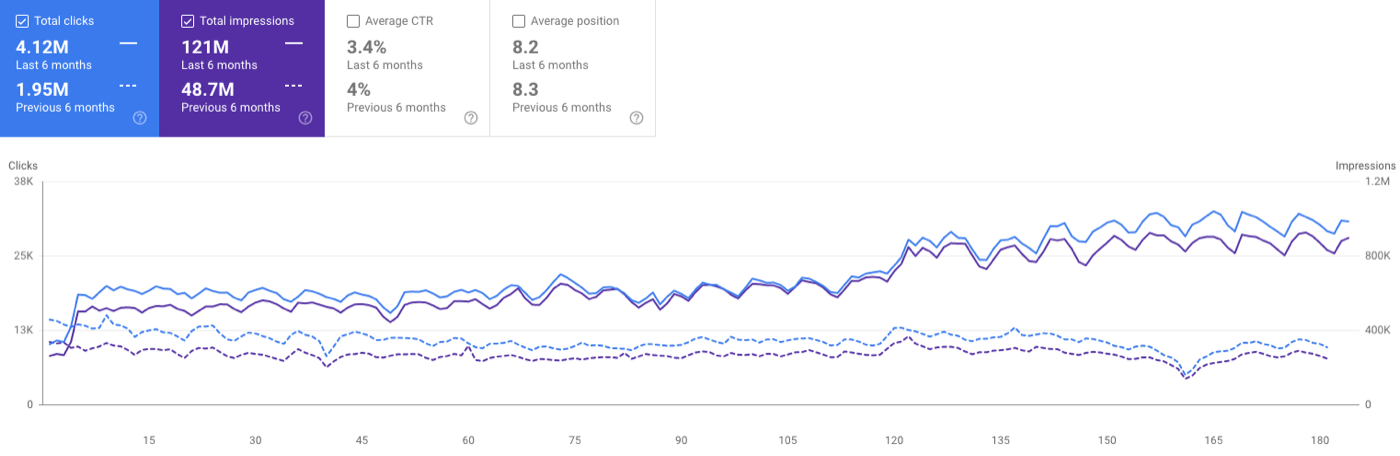
Six months in, the trend had not just stopped, it had reversed.
Why this worked
Three reasons the program reversed the decline and then compounded.
Topic Ownership Strategy compounds. Every cluster article supports the pillar; every pillar supports the brand. Each new piece strengthens the system rather than starting from zero. After the first quarter, new content ranked faster because the surrounding topic graph was already dense.
Helpful content earns dwell time. Search engines have always rewarded pages users actually consume. By cutting the padding and answering the question, we turned every entry page into a stronger ranking signal.
Internal links should serve readers first. When links match what readers want next, they get clicked. Clicks become session depth. Session depth becomes ranking authority. The whole loop compounds.
Reverse the bleed before it compounds.
Request a free SEO audit. We will identify the structural and content gaps causing the decline, and recommend a Topic Ownership program that turns the trend around inside six months.
Request a free SEO audit →See where your brand stands in AI answers today, benchmarked against your competitors, no pitch required.

How DOKU Became the Most Visible Payment Gateway in Indonesian Search
DOKU was the better-known brand and the worse-ranked one. Eight months of technical repair and four content pillars later, it holds more Top 3 rankings than any payment gateway in the market.
Read post →
How Taman Safari Indonesia Became the Most-Cited Wildlife Brand in AI Search
Taman Safari already led AI answers about Indonesian wildlife parks. The harder win was turning it into the page assistants cite, not the name they borrow.
Read post →
How Prenagen Came to Own AI Search in Indonesia
Generative engines now answer many of the high-intent questions that brands once captured through traditional rankings. When an AI Overview resolves a query inside the results page, the underlying website often loses the click, even when it ranks well. Across the Indonesian maternal-health category, keyword visibility contracted by roughly 9% as this repricing took hold.
Read post →